
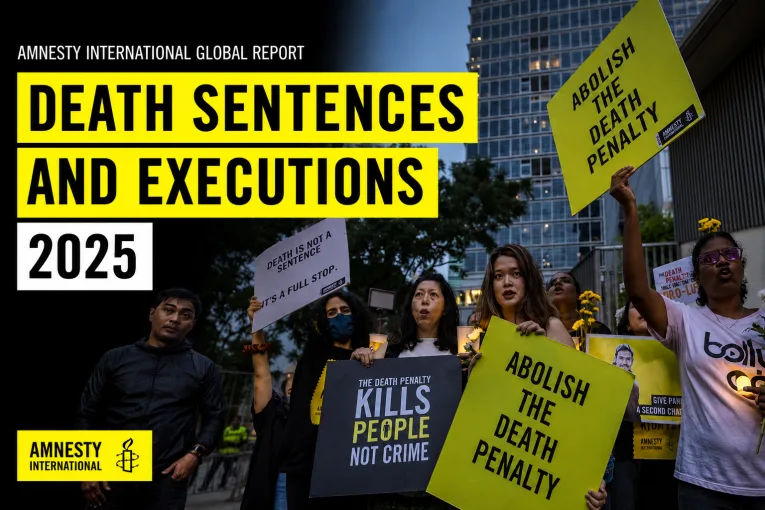
- “The resurgence of highly punitive approaches in the ‘war on drugs’ drove efforts to expand the use of the death penalty.” – Amnesty International
Global executions surged to their highest level since 1981 in 2025, according to Amnesty International’s annual report on the death penalty, with the human rights organization warning that a small group of governments are increasingly using executions to “instill fear, crush dissent and show the strength state institutions have over disadvantaged people and marginalized communities.”
In its report, Death Sentences and Executions 2025, Amnesty International documented at least 2,707 executions worldwide across 17 countries, marking a 78 percent increase from 2024. The organization said the true number is likely much higher because China, believed to remain the world’s leading executioner, continues to classify death penalty statistics as state secrets.
“Executions in 2025 soared to the highest figure recorded by Amnesty International since 1981, with 2,707 people executed across 17 countries,” Amnesty International stated in a summary accompanying the report.
The report found that Iran accounted for the overwhelming majority of executions, with at least 2,159 carried out in 2025, more than doubling the country’s total from the previous year and accounting for roughly 80 percent of all recorded executions worldwide.
“The sharp rise was driven primarily by Iran, which recorded its highest number of executions in decades,” Amnesty International wrote. “The Iranian authorities continued to weaponize the death penalty, often after grossly unfair trials, to instil fear among the population and punish those who challenged, or are perceived to have challenged, the Islamic Republic of Iran establishment.”
Saudi Arabia also dramatically increased its use of executions, carrying out at least 356 executions in 2025, including 240 for drug-related offenses. Kuwait nearly tripled its executions from six to 17, while Egypt, Singapore and the United States all nearly doubled their execution totals.
“This alarming spike in the use of the death penalty is due to a small, isolated group of countries willing to carry out executions at all costs, despite the continued global trend towards abolition,” said Agnès Callamard, Amnesty International’s secretary-general. “From China, Iran, North Korea and Saudi Arabia to Yemen, Kuwait, Singapore and the USA, this shameless minority are weaponizing the death penalty to instill fear, crush dissent and show the strength state institutions have over disadvantaged people and marginalized communities.”
Amnesty International reported that nearly half of all known executions globally — 1,257 executions, or 46 percent — were tied to drug-related offenses.
The organization said executions for drug crimes violate international human rights standards because they do not meet the threshold of the “most serious crimes” involving intentional killing.
“The resurgence of highly punitive approaches in the ‘war on drugs’ drove efforts to expand the use of the death penalty,” the report stated.
Amnesty identified China, Iran, Kuwait, Saudi Arabia and Singapore as the countries primarily responsible for executions related to drug offenses.
The organization also documented executions and death sentences imposed in violation of international law, including public executions, executions of people accused of crimes committed while under 18 years old, and death sentences resulting from unfair trials or confessions allegedly obtained through torture.
According to the report, at least 17 public executions occurred in Afghanistan and Iran in 2025. Amnesty further stated that people with mental or intellectual disabilities remained on death row in countries including Japan and the United States.
The United States remained the only country in the Americas to carry out executions for the 17th consecutive year.
Amnesty recorded 47 executions in 11 states in 2025, the highest U.S. total since 2009. Nearly half of those executions occurred in Florida, which carried out 19 executions during the year.
“In the USA, the unprecedented rise in executions in one state — Florida — drove the national total to the highest figure since 2009,” Amnesty International wrote. “Officials at the federal level and in some states promoted inflammatory and flawed narratives on the death penalty and its effect on crime, advocating for an increase in its use.”
Florida recorded its highest number of executions since 1972, according to the report. Alabama, South Carolina and Texas each carried out five executions. The report also noted that Louisiana resumed executions for the first time since 2010, while Arizona and Mississippi resumed executions after pauses dating back to 2022.
The report sharply criticized the increasing use of nitrogen gas executions in the United States, noting that Alabama and Louisiana both used nitrogen hypoxia in 2025. South Carolina also carried out three executions by firing squad.
“Amnesty International opposes all executions, by all methods, unconditionally,” the report stated. “Yet, the implementation of these methods of execution put on display the determination of some state authorities to pursue executions at all costs.”
Amnesty also highlighted what it described as political rhetoric encouraging broader use of capital punishment in the United States. The report pointed specifically to President Donald Trump’s executive orders and comments supporting expanded use of the death penalty.
“On the day of the inauguration of his second term in office, President Donald Trump of the USA signed the first of two executive orders advocating for an increased use of the death penalty to protect people ‘from violent rapists, murderers, and monsters’ and promising help to ‘preserve capital punishment in the States,’” Amnesty wrote.
The organization also criticized officials in states such as Florida for publicly promoting executions as crime deterrence despite longstanding evidence disputing such claims.
California continued to hold the nation’s largest death row population by a wide margin, with 580 people under sentence of death at the end of 2025. Florida followed with 251, Texas with 169 and Alabama with 155.
“It’s alarming that California, a state that has not executed anyone in nearly 20 years, has more than 550 people on death row,” said Justin Mazzola, deputy director for research with Amnesty International USA. “Before leaving office in 2027, Governor Newsom has the power to take a historic step: commute every death sentence in the state. Doing so would be a definitive action backing up his stated anti-death penalty position and impact more than a quarter of all people currently on death row in the U.S.”
Despite the rise in executions, Amnesty emphasized that the global trend still favors abolition. The organization noted that 113 countries have now abolished the death penalty for all crimes, compared to just 16 countries when Amnesty began its anti-death penalty campaign in 1977.
The report pointed to several countries making abolitionist progress in 2025. Viet Nam abolished the death penalty for eight offenses, including bribery and drug transportation. Gambia abolished capital punishment for murder and treason. Bills to abolish the death penalty were introduced in Lebanon and Nigeria, while Kyrgyzstan’s Constitutional Court ruled attempts to reinstate the death penalty unconstitutional.
Amnesty also highlighted Alabama Gov. Kay Ivey’s commutation of Rocky Myers’ death sentence as a rare positive development in the United States. Myers became the first Black person on Alabama’s death row to receive clemency since the death penalty was reinstated in 1976.
“With human rights under threat around the world, millions of people continue to fight against the death penalty each year in a powerful demonstration of our shared humanity,” Callamard said. “Total abolition is possible if we all stand strong against the isolated few. We must keep the flame of abolition burning bright until the world is entirely free from the shadows of the gallows.”
Follow the Vanguard on Social Media – X, Instagram and Facebook. Subscribe the Vanguard News letters. To make a tax-deductible donation, please visit davisvanguard.org/donate or give directly through ActBlue. Your support will ensure that the vital work of the Vanguard continues.
