
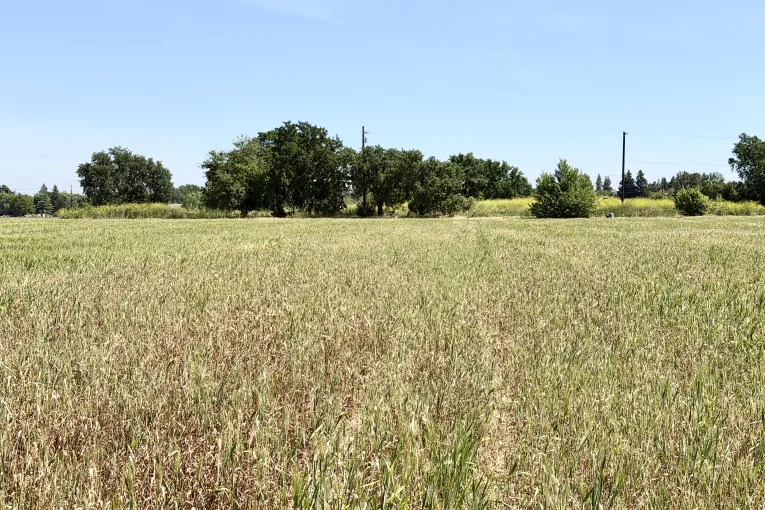
DAVIS, Calif. — As the proposed Village Farms development moves through the approval process and toward a likely Measure J/R/D vote in 2026, concerns over farmland preservation and urban expansion remain a central issue in Davis politics, reflecting longstanding tensions between the city’s growth-control policies and mounting state housing obligations.
Critics of the project argue that Village Farms would permanently convert agricultural land at the city’s edge into urban development, accelerating sprawl and undermining Davis’ identity as a compact university community surrounded by farmland.
Supporters counter that Davis has severely limited outward growth for decades, has exhausted most realistic infill opportunities, and now faces legal and practical pressure to build housing—including affordable housing—or risk state intervention.
The debate reflects broader statewide tensions playing out across California as cities attempt to balance farmland preservation, climate concerns and housing mandates.
Village Farms, proposed on the city’s northern edge, would include thousands of housing units along with affordable housing commitments, habitat protections and land dedicated for future affordable projects.
Opponents have argued the project represents a significant departure from Davis’ historic resistance to peripheral growth and fear it could set precedent for additional annexations in the future.
Those concerns have become a central theme among slow-growth advocates and farmland preservation groups, many of whom argue that development should remain within existing city boundaries.
But supporters of the project point to Davis’ unusually restrictive growth history.
Supporters of Village Farms argue Davis has approved very little peripheral housing growth over the last quarter century, with Bretton Woods representing one of the city’s few major voter-approved edge developments during that period.
Other than that, Davis has largely relied on infill and redevelopment projects, particularly student-oriented apartment construction near UC Davis and within the city’s existing footprint.
Housing advocates argue that strategy has produced important gains in rental supply but has failed to generate sufficient ownership housing or family-oriented development.
The city has also faced growing scrutiny over its ability to meet state housing requirements.
Over the last 17 years, Davis has built only 805 single-family homes, according to data repeatedly cited in Vanguard housing coverage and city discussions regarding Measure J/R/D and the city’s Regional Housing Needs Allocation obligations.
Supporters of Village Farms argue those numbers demonstrate that Davis’ existing development model has not produced sufficient housing for working families, middle-income residents or lower-income households.
The debate has increasingly centered on whether Davis still has viable infill opportunities capable of accommodating the scale of housing required under state mandates.
In previous council discussions for instance, former Davis Mayor Will Arnold argued the city’s realistic infill capacity is far more limited than many project opponents claim.
In December 2023, then-Mayor Will Arnold warned, “I would just say to those who have said that we will be able to meet our next RHNA cycle numbers without going outside of the city limits… I suggest they tune in or watch the recording of this meeting as we really try to meet our current requirements simply with infill and the difficulty we’re having in doing so.”
Arnold stated that Davis has already pursued many of its available redevelopment opportunities and warned against assuming that substantial housing production can continue indefinitely without peripheral expansion.
“Councilmember Bapu Vaitla has argued that Davis should prioritize infill development before expanding outward, while also acknowledging limits to how much future housing demand can realistically be absorbed within the city’s existing footprint.
“Infill is really job number one” Vaitla said during a 2026 City Council discussion on growth planning, adding that assumptions about density and redevelopment would shape ‘how much pressure is placed on outlying areas.
He also stated that the city must evaluate “how much future housing demand could realistically be absorbed within existing city limits before determining how much growth must occur on the periphery.”
According to previous Vanguard reporting based on city staff analyses and Housing Element discussions, Davis’ lower-income housing targets are likely unattainable without approval of both Village Farms and the proposed Willowgrove project.
Together, the two projects account for the overwhelming majority of lower-income housing currently identified within Davis’ major development pipeline.
Village Farms alone includes 360 permanently deed-restricted affordable units and 16 acres dedicated for future 100 percent affordable housing projects, according to project materials and prior city discussions.
The project also includes a $6 million contribution to the city’s affordable housing trust fund.
Willowgrove similarly contains substantial affordable housing commitments and has already received unanimous City Council support to proceed toward a Measure J/R/D vote.
Housing advocates argue that without those projects, Davis risks failing to meet its state-mandated lower-income housing obligations during the current RHNA cycle, which runs from 2021 through 2029.
If the city cannot produce enough affordable housing in the remaining years of the current RHNA cycle, it could face increased state intervention and renewed scrutiny of policies like Measure J.
After a closer review of the data, the conclusion is difficult to avoid: the city’s ability to meet its lower-income housing obligations appears to rest squarely on whether two large peripheral projects — Willowgrove and Village Farms — are approved and built.
That possibility has raised additional concerns about the future of Measure J itself.
Measure J, first adopted by Davis voters in 2000 and later renewed through Measures R and D, requires voter approval for most peripheral development projects on agricultural land.
Supporters of the measure view it as a crucial safeguard against unchecked sprawl and suburban-style expansion.
Even many supporters of Village Farms argue that Measure J provides important protections because it requires public scrutiny, environmental review and direct voter approval before farmland conversion can occur.
Advocates of the current system contend Davis has maintained unusually strong growth controls precisely because Measure J forces projects through extensive public debate and electoral review.
But housing advocates increasingly warn that continued housing shortages and failure to meet state obligations could place those protections at risk.
State housing officials have repeatedly signaled concern about local growth-control mechanisms that constrain housing production.
Previous Vanguard reporting documented state scrutiny of Davis’ housing policies during the Housing Element certification process, including concerns that Measure J could impede the city’s ability to meet state housing obligations.
Housing advocates warn that if Davis consistently fails to produce required housing—particularly lower-income housing—the state could eventually intervene more aggressively or pursue legal remedies that weaken local growth authority.
In that sense, some housing supporters argue that approving carefully negotiated projects like Village Farms may ultimately help preserve Measure J by demonstrating that Davis can still accommodate growth under its existing voter-approval framework.
Others frame the issue in broader regional and environmental terms.
Supporters of peripheral housing projects argue that preventing growth in Davis does not eliminate housing demand but instead shifts that demand outward to surrounding communities.
Under that argument, residents who work in Davis or at UC Davis increasingly relocate to Woodland, Dixon, West Sacramento, Sacramento or other nearby jurisdictions where housing production continues.
Advocates contend that such displacement increases regional commuting, traffic congestion and greenhouse gas emissions while exporting development pressure to communities that may have fewer environmental safeguards or weaker affordability requirements.
Some supporters of Village Farms argue that Davis’ development process is actually more restrictive and publicly scrutinized than many neighboring jurisdictions.
They note that projects in Davis undergo extensive environmental review, multiple public hearings and ultimately citywide voter approval under Measure J/R/D.
By contrast, they argue, housing built farther from Davis employment centers may face less organized opposition and fewer affordability obligations while still accommodating the same regional growth pressures.
Critics of Village Farms reject those arguments and maintain that farmland preservation remains one of Davis’ defining values.
They argue that approving peripheral projects risks incremental erosion of the agricultural buffer surrounding the city and could encourage future annexation proposals.
Some opponents also dispute the assumption that Davis has exhausted infill opportunities, pointing instead to redevelopment potential along commercial corridors and underutilized parcels within the city.
What remains largely unresolved in the debate is how opponents of Village Farms reconcile longstanding concerns about farmland preservation with the increasingly aggressive posture of the state toward cities that fail to produce housing.
California housing law has shifted dramatically over the last decade, with state officials placing mounting pressure on local governments to zone for and facilitate housing production, particularly for lower-income households.
While many Davis residents continue to oppose peripheral growth and seek to preserve agricultural land, the city now faces a political and legal environment far different from the one that existed when Measure J was first adopted in 2000.
The central question is no longer simply whether Davis should grow, but whether the city can maintain strict local growth controls while simultaneously satisfying state housing mandates that increasingly leave little room for inaction.
Follow the Vanguard on Social Media – X, Instagram and Facebook. Subscribe the Vanguard News letters. To make a tax-deductible donation, please visit davisvanguard.org/donate or give directly through ActBlue. Your support will ensure that the vital work of the Vanguard continues.

David you fail to point out that Davis, through its open space tax, has preserved nine square miles of land near Davis. That is an amount of land equal in size to the footprint of the City of Davis itself.
With 2 to 1 mitigation requirements for farmland conversion, Davis, under current rules will never have a footprint that exceeds 50% of the land available. The idea that housing and sprawl will consume all the land around here is false.
Fair point
“Previous Vanguard reporting documented state scrutiny of Davis’ housing policies during the Housing Element certification process, including concerns that Measure J could impede the city’s ability to meet state housing obligations.”
That’s not what HCD said – per your own articles.
What they said is that Davis cannot include peripheral proposals in its housing elements, unless they’re already approved.
You do realize that the vast majority of major population areas aren’t expanding outward (and yet, are still subject to the same type of RHNA targets). How do you suppose they’re going to address those targets, given that they’ve also “run out of space” (as you put it) to do so?
From HCD: “Measure J poses a constraint to the development of housing by requiring voter approval of any land use designation change from agricultural, open space, or urban reserve land use to an urban use designation.”
The City: “While Measure J adds costs, extends processing times, and has been used to halt development projects that would convert agricultural land to urban development, it is only a constraint to meeting housing needs if the city lacks sufficient infill housing sites.”
Mayor Will Arnold, circa 2023: “I would just say to those who have said that we will be able to meet our next RHNA cycle numbers without going outside of the city limits… I suggest they tune in or watch the recording of this meeting as we really try to meet our current requirements simply with infill and the difficulty we’re having in doing so.”
From HCD: “Measure J poses a constraint to the development of housing by requiring voter approval of any land use designation change from agricultural, open space, or urban reserve land use to an urban use designation.”
This is the reason that land outside of city limits that is subject to a Measure J vote cannot be included in housing elements.
HCD would likely reject any plan that includes peripheral sites subject to a Measure J vote. And if they did actually accept such a plan, that’s when Measure J would be irrelevant (since there’d be no choice but to vote “yes”).
HCD does not consider land outside of city limits in regard to any city, unless it’s on track for approval/incorporation into a city by the governing body. (In this case, via a Measure J approval.)
Since the results of Measure J are beyond the city’s control, the city will never be able to include such sites in housing elements (unless they’re already approved via a Measure J vote).
David, can you please provide us with a link to that HCD statement? Thank you
The most useful definition of “sprawl” is: “Failure to build densely.”
Building low density housing isnt “not sprawl” just because we havent built any in a while, (pardon the double negative)
and annexing farmland for housing isn’t necessarily sprawl IF you are making GOOD efficient use of that resource.
Even building low-density housing in an infill site should rightfully be considered sprawl because it forces the next development that much further out.
Humans do need to live SOMEWHERE and as our population grows that growth does have to go somewhere.
But that doesnt give us license to make bad land use decisions.
Its similar to an argument I heard the other day about electric cars… that since significant carbon emissions come from their manufacture that there is “no point” to adopting them.
Catering to these overly simplistic mental frames doesn’t serve anybody. EV’s have LESS of an impact, and that is all that matters. We will never have ZERO impacts as a society, but that does not get us off the hook for MINIMZING our impact.
So we are left in a position where the best course of action doesnt fit into a tidy soundbyte like “build housing”. Its “build at multifamily housing at moderate densities along high-service transit corridors”.
We can build some of that with densificaiton, but if you paid attention to the math DCPG did on that topic… densification of existing parts of the city isn’t nearly enough. So we have to build a little bit, at least, on the periphery. But THAT doesnt give us license to build baby build all the way to the property lines at low density.
Building just 1/2 mile around the mace curve at densities we already along parts of russell and F street is more than enough housing for us for 50 years
Sorry that this is a topic that requires nuance, but davis voters are smart. I think they can figure it out.