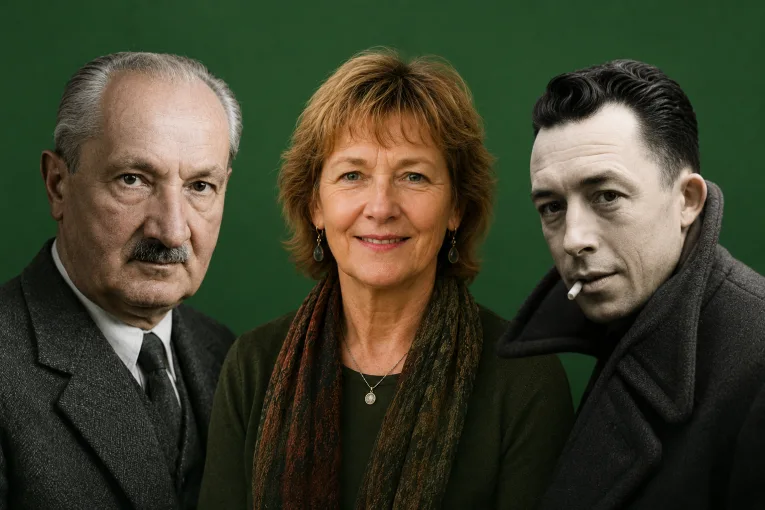
With cultures breaking down all over the world, and especially in the west, more therapists are turning into philosophers, and more philosophers are turning into therapists. It’s called “existential therapy.”
As defined by one of its leading proponents and practitioners, Emmy van Deurzen, existential therapy is “a philosophical approach to therapy and how to live your life in a better way.” Van Deurzen explains, “It is about working with life, rather than just with the psyche.”
Though van Deurzen has come to believe that depression “is really a form of oppression,” existential therapy remains essentially individualistic in its focus. Of course, it wouldn’t be therapy if it didn’t focus on the individual — it would be philosophy. The question is, do they go together?
The existential therapy movement traces its origins to two Swiss psychiatrists in the 1930s, who “tried to apply Martin Heidegger’s philosophical ideas to understanding mental illness with an existentialist therapy that focused on the patient’s immediate, lived experience rather than just subconscious drives.”
So a few words about Heidegger’s philosophy are apropos. In the 20th century, Heidegger insisted, unlike Descartes, that humans aren’t merely thinking machines trapped in bodies, but beings intertwined with our environment.
Heidegger rightly questioned the subject-object duality, but notably he didn’t offer an explanation of why humans feel and act separate from nature. For him, and for existentialists since him, the “existential mistake” arises from how we think about using tools, not in the evolution and emergence of symbolic thought, as I maintain.
Thus we end up with the rather absurd circularity of a statement like, “We only separate ourselves from our environment and tools, and view them as detached objects, when something goes wrong.” The classic example Heidegger gives is that a hammer is an extension of our arm (and being), except when it breaks, and only then do we “shift from practical use to theoretical observation.”
Van Deurzen tries to escape this philosophical cul de sac by taking a broader view of existentialism’s intellectual heritage, which she says stretches back to the Athenian philosophers and early Hindu, Buddhist and Taoist thinkers. That’s interesting, but it only begs some questions.
Why doesn’t existentialism address the greatest contradiction of all: How did nature, in which life unfolds through seamless wholeness, evolve a creature that is fragmenting the Earth all to hell?
And why do we project Homo sapiens, which is the only creature to break the bonds of ecological niche and become alienated from nature, onto nature, rather examine and bring insight into what makes us so different as a species?
Compellingly, Van Deurzen started structuring each conversation like a Socratic dialogue, asking open-ended questions and challenging a person’s assumptions. “Instead of standing in judgment or making decisions about what was wrong with the person, I was allowing this philosophical exploration to take place,” she says.
As much as I love doing philosophy, it wasn’t philosophy that saved me from what Winston Churchill aptly called “the black dog.” Having essentially lost my 20’s to undiagnosed depression, and staring into the abyss more often than I can recall, I began taking time every day in nature and learning, without a teacher, the art of methodless meditation.
It took six months of meditation, journaling and exercise, but at 30, instead of going on anti-depressants as a psychiatrist glibly recommended over the phone (which scared the bejesus out of me), the non-bipolar cycles ended and (knock on wood), I haven’t had couch-for-days episode since. Given how dark this culture and the human prospect have become, I still feel despair and low at times, but nothing like before.
Notably, I was still studying anthropology and doing philosophy. There were many insights, but they didn’t unearth and dissolve the causes of my depression. Wordlessly observing the movement of thoughts and emotions in the mirror of nature without the judgments of the observer did, though I never think I’m permanently out of the dark wilderness within.
So as a philosopher that’s grappled with clinical depression, existential therapy interests me. I don’t have the feeling it would have worked for me however.
Psychiatrists I’ve engaged in dialogue outside a therapeutic context have said that it’s extremely rare for someone as depressed as I recurrently was to get well without help and medication. So I’m not against anti-depressants per se, I just feel they’ve been way over-prescribed in the last 25 years.
Depression, I’ve come to feel, arises from personalizing and internalizing family and societal disorders that aren’t personal.
As van Deurzen says, “The pain is usually the result of feeling that the world has knocked you down or has stopped you in your tracks or has not recognized you, or has excluded you from the family or from another group.”
That’s all the more true when one’s family views one’s truth-seeking and truth-telling as threats to their edifice of falsehoods. It’s not just one’s family however, since liberals continue to deny the self-seeking darkness at the core of the body politic in America, which has given rise to an utterly mendacious and corrupt administration.
One of the core assumptions of existentialism that contributes to depression in a meaningless and chaotic world is what Camus called “the absurd conflict between the human tendency to seek inherent meaning, and a silent, indifferent universe.”
Silent states of meditative insight attest otherwise — that there is intrinsic meaning and immanent sacredness to life. Perhaps existentialism, especially existential therapy, needs to do some reexamining of it own.
Follow the Vanguard on Social Media – X, Instagram and Facebook. Subscribe the Vanguard News letters. To make a tax-deductible donation, please visit davisvanguard.org/donate or give directly through ActBlue. Your support will ensure that the vital work of the Vanguard continues.