
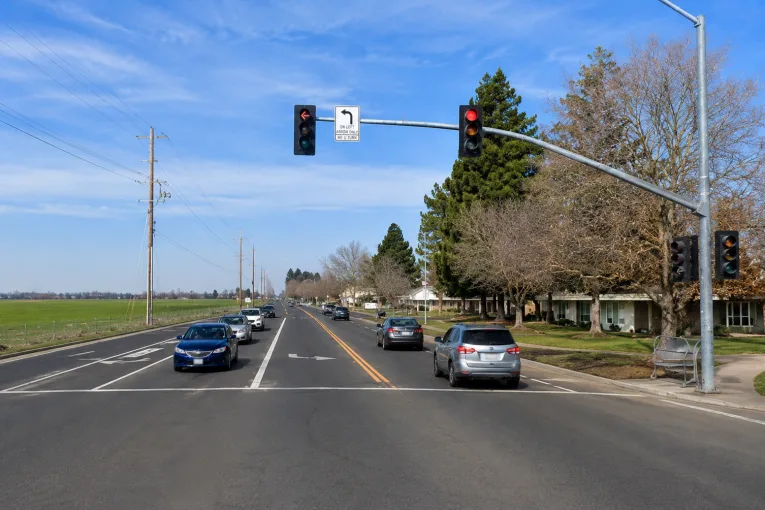
DAVIS, Calif. — Traffic has been a central factor in nearly every major Measure J housing debate over the last 25 years in Davis. But as the battle over Village Farms intensifies ahead of the Measure V vote, supporters of the project argue that many of the city’s current congestion problems are not simply the product of growth itself, but of decades of housing constraints that have pushed workers and families into longer regional commutes.
Opponents warn the development will overwhelm already congested intersections near Covell Boulevard and Pole Line Road, while supporters argue the traffic impacts are being overstated and fail to account for both major mitigation improvements and the growing regional commuter traffic already flowing into Davis each day.
The dispute reflects a broader question facing Davis and much of California: whether refusing to build housing inside job-rich communities ultimately worsens traffic by forcing workers and families into longer regional commutes.
Project opponents have repeatedly argued that Village Farms would generate unacceptable congestion impacts, particularly around East Covell Boulevard, Pole Line Road and surrounding neighborhoods.
In the rebuttal argument against Measure V, opponents warned the project “would bring over 15,000 more car trips DAILY near Covell Blvd. and Pole Line Road causing gridlock and Level of Service ‘F.’”
But supporters of the project argue those claims present an incomplete picture because they omit the extensive transportation improvements required as conditions of approval for the development.
Alan Pryor, writing in support of the project, sharply criticized what he described as exaggerated claims about the transportation impacts.
“Claims of Extreme Adverse Traffic Impacts of the Project on Surrounding Streets – Project opponents also speak of a traffic Armageddon resulting from the Project,” Pryor wrote.
“In their REBUTTAL TO ARGUMENT IN FAVOR OF MEASURE V that will be on the June ballot, they claim, ‘It would bring over 15,000 more car trips DAILY near Covell Blvd. and Pole Line Road causing gridlock and Level of Service “F.”’”
Pryor continued, “But this statement is knowingly misleading because their claim does not account for the improvements in traffic conditions brought about by mandatory traffic and street improvements that are required for the Project.”
“These will cost tens of millions of dollars and are more fully described below,” he added.
Pryor also pointed to findings from the Local Transportation Analysis associated with the project’s Environmental Impact Report.
“According to the Local Transportation Analysis provided with the Environmental Impact Report, ‘Overall, the improvements would substantially reduce delays and queuing throughout the study area. The implementation of the recommended improvements would improve peak hour operations to acceptable levels at all study intersections under Existing Plus Project conditions,’” Pryor wrote.
The EIR includes a lengthy list of required transportation mitigation measures tied directly to Village Farms. Those improvements include interchange modifications, additional turn lanes, signal coordination, bicycle and pedestrian infrastructure improvements and transit-related upgrades.
Among the planned improvements are modifications to the West Covell Boulevard and State Route 113 ramps, coordination of traffic signals along Covell Boulevard and Mace Boulevard, modifications at the Mace Boulevard and Chiles Road interchange area and additional bicycle and pedestrian facility improvements.
The project also includes transit-related mitigation measures intended to support expanded bus service and transportation alternatives. The mitigation program calls for the establishment of funding mechanisms to support ongoing transit service and infrastructure improvements associated with future project demand.
During public discussions before the Davis Transportation Commission and Planning Commission, concerns about traffic nevertheless dominated much of the testimony.
Public commenters raised concerns about congestion, emergency access, greenhouse gas emissions, project funding responsibilities and neighborhood cut-through traffic.
Mary Ann Hernandez cited “increased traffic and greenhouse gas emissions,” while Susan Rainier raised “fire safety concerns related to ingress/egress” and opposed “the added car trips.”
Marjorie Longo warned about “cut-through traffic in Wildhorse and concerns about emergency response times north of the channel.”
Other speakers argued the project underestimated future car trips and questioned whether enough transit infrastructure and mitigation planning had been included in the project analysis.
At the same time, supporters argue that the current congestion patterns near Covell Boulevard and Pole Line Road cannot be understood solely through the lens of future Village Farms residents because the corridor is already heavily impacted by regional commuting patterns tied to Davis’ longstanding housing shortage.
Morning traffic entering Davis from County Road 102 and evening traffic exiting toward Interstate 80 have become familiar realities for residents traveling through the area during peak commute periods.
In fact, morning commutes along this corridor show that most traffic is not entering and existing from local neighborhoods, but rather is cutting through the corridor itself as part of their commute.
Supporters contend that much of the traffic pressure surrounding Davis stems not from new housing construction itself, but from decades of insufficient housing production that has forced workers to live outside the city and commute into Davis each day.
Davis City Councilmember Bapu Vaitla directly connected housing shortages, commuter traffic and climate impacts in a public statement supporting the project.
“For those of us who feel that climate change is the world’s most pressing challenge, supporting compact, transit-linked, net-zero housing is the most powerful step we can take to leave a better future for the generations to come,” Vaitla wrote.
“Measure J/R/D was born from a legitimate impulse to stop sprawl, which is a real harm to both people and the environment. But pushing families out of Davis means more commuters, more emissions and more traffic. There is a reasonable middle way: supporting well-designed developments like Village Farms.”
Vaitla also pointed to the scale of Davis’ commuter imbalance.
“Eleven thousand UC Davis employees commute into town, in part because Davis lacks housing,” he wrote.
Supporters argue that the city’s current traffic conditions already reflect the consequences of limited housing supply inside Davis.
Over the last two decades, Davis has added large amounts of student-oriented apartment housing but relatively little workforce or ownership housing for families, teachers, healthcare workers, city employees and UC Davis staff. As housing costs increased, many workers increasingly relocated to Woodland, Dixon, West Sacramento and Sacramento while continuing to commute into Davis daily.
As a result, supporters argue that roads like Pole Line Road, Covell Boulevard, County Road 102 and Interstate 80 are already carrying large regional commuter volumes that would exist regardless of whether Village Farms is ultimately approved.
Some project advocates contend that building additional local housing could partially reduce those commuting pressures over time by allowing more workers to live closer to their jobs rather than traveling into Davis from surrounding communities every day.
The Village Farms proposal has therefore become about more than a single housing development. It has evolved into a broader argument over how Davis should respond to rising housing demand, increasing regional commuting patterns and worsening affordability pressures.
For opponents, the project represents a significant intensification of traffic impacts in already congested corridors.
For supporters, however, the existing congestion itself reflects the consequences of failing to build enough housing near employment centers for decades — a pattern they argue has shifted traffic burdens outward onto regional roadways and intensified commuting into Davis from surrounding communities.
The disagreement has become one of the defining political and planning debates facing Davis as voters prepare to decide the future of Measure V.
Follow the Vanguard on Social Media – X, Instagram and Facebook. Subscribe the Vanguard News letters. To make a tax-deductible donation, please visit davisvanguard.org/donate or give directly through ActBlue. Your support will ensure that the vital work of the Vanguard continues.

Because Android Auto and Waze redirect traffic around congestion on I-80, Covell Blvd becomes a traffic mess. Adding homes along this corridor will only increase this problem. The argument that adding this development will resolve the traffic issue is a fools errand.
“The argument that adding this development will resolve the traffic issue is a fools errand.”
I know, somehow Davisites are supposed to believe that adding thousands of housing units is going to decrease traffic.
So we shouldn’t build homes because of Waze?
Ron, you have become a caricature of yourself … channeling David Bowie dining Soundbite City.
I wish the citizens of Davis would stop arguing about the obvious traffic implications of Measure V and accept that the Village Farms Developers have a mystical wand they will wave to make all those pesky cars just disappear. And if you believe that, I also have some Magic Beans 🫘 to sell you.
Because choices made in the past increased traffic, we must develop where traffic woes will be multiplied since two wrongs make one right.
I know back when Orange County had orange groves, traffic was terrible! All those tractors, and people had to drive so far to reach their jobs. Then they added millions of people and roads and freeways and now it’s a piece of cake to get around! And life is so wonderful!!!
Paradoxically perhaps, adding more local vehicular traffic may be an improvement. I’d rather fill the roads with frustrated local drivers than impatient non-local I-80 refugee drivers who have even less regard for local residents health and safety or local speed laws.
David Greenwald said … The dispute reflects a broader question facing Davis and much of California: whether refusing to build housing inside job-rich communities ultimately worsens traffic by forcing workers and families into longer regional commutes.
Given the fact that Davis is a jobs-poor community, why is the above statement relevant?
There you go again trying to separate the city job market from UC and as a result you are denying reality. Simple question Matt what institution is the biggest employer in Yolo County?Hint, its a major university with a multi-billion dollar annual budget.
David Greenwald said Project opponents have repeatedly argued that Village Farms would generate unacceptable congestion impacts, particularly around East Covell Boulevard, Pole Line Road and surrounding neighborhoods.
One of the arguments the developers use is the millions of dollars that they will be putting into roadway improvements, and their statements are true; however, those improvements are going to be like saltwater taffy candy, which comes in a wax paper wrapper that is twisted at both ends so that the candy can not escape the wrapper without the ends being untwisted. (Note: small Tootsie Rolls used to come in the same kind of twisted end wrappers.) For Village Farms the twisted ends are the I-80 interchange at Mace where even with the current traffic load in afternoon rush hours southbound Mace is a long line of stalled traffic that snakes from the on-ramp entrance up Mace past 2nd Street, past Alhambra, up along the Mace Curve and down Covell often as far as the Junior High School.
Any Village Farms generated traffic that wants to escape the immediate project vicinity will quickly run into the “twisted ends” east and west on Covell, as well as south on Pole Line. And that incremental VF generated traffic will make the already bad congestion in those twisted ends even worse … unless the Village Farms developer is committed financially to working with CalTrans to improve the Mace Interchange on-ramp to I-80.
“One of the arguments the developers use is the millions of dollars that they will be putting into roadway improvements . . .”
“Improvements” are generally “impediments” to traffic flow – the exact opposite of an “improvement”.
As it is, I’ve already seen at least one “improvement” on Road 102 which causes me to que-up in a line in order to obey the “improvement”.
If I had a dollar for every “improvement” that sprawl created, I’d be wealthy-enough to not even bother commenting on the Vanguard. I’d probably be enjoying the lack of “improvements” in some place like Atherton, instead.
Ron – So you think the folks in Atherton magically fly over the daily congestion on US 101 and I -280 during rush hour every day…?
I don’t believe there’s a lot of traffic “improvements” within Atherton itself. As for the commuting patterns of residents who can afford an $8 million dollar average house price, something tells me that they’re not rushing to work to punch a time clock.
But as far as Road 102 is concerned, any traffic “improvements” caused by Village Farms (and/or Willowgrove) are an impediment to anyone already using those roads (e.g., Road 102, Pole Line, Covell, Mace, etc.).
And when current users get stuck in traffic/congestion, it increases greenhouse gas emissions as well.
Matt – Firstly, residents of Village Farms will likely be coming home in the afternoon rush hour and not commuting east on Covell like the commuter cut-through and UCD traffic heading home to Sacramento and points east. Thus, they are not likely to contribute to the eastbound congestion on Cevell and south on Mace to the I-80 interchange
In addition to the extra lane to increase throughput on I-80, the ongoing Yolo I-80 project includes substantial upgrades to both of the eastbound onramps at Mace Blvd including onramp lengthening and dynamic metering designed to reduce backup.
Alan Pryor said In addition to the extra lane to increase throughput on I-80, the ongoing Yolo I-80 project includes substantial upgrades to both of the eastbound onramps at Mace Blvd including onramp lengthening and dynamic metering designed to reduce backup.
Alan you need to do your homework before you speak. Regarding the extra lane on I-80, that has little or no effect on the backup on Mace, and Rochelle Swanson has been crystal clear that those on-ramp improvements mentioned in the EIR are speculative at best, and wholly dependent on the whims of CalTrans. Have you talked directly with CalTrans about those possible on-ramp improvements? Or are you talking through your hat?
Matt – The onramp improvements were part of the mandatory mitigation in the Yolo I-80 project’s EIR that Caltrans committed to when the project was approved. It has nothing to do with the VF project – so not talking through my hat.
But I think you may have been eating too many of those taffy candies and tootsie rolls you seem so knowledgeable about. Please be careful, the high blood sugar can affect cognitive functions at your age!
I will look up that information. In my one-to-one conversations with CalTrans about the Mace Interchange, they have been conspicuously silent about that mitigation. I suspect it has been swept under the rug. But time will tell.
Speaking of talking through a hat, I pulled up this past press release in which you are conspicuously quoted as follows: “irreversible climate change.
According to the Sierra Club Yolano Group Chair, Alan Pryor, “The EIR for the I-80 widening shows Caltrans is stuck in reverse when we need to move our region forward by investing in real alternatives to congestion that don’t just put more cars on our roads and smog in our air. Instead of spending hundreds of millions of taxpayer dollars laying down concrete and asphalt that locks us into a future of car dependency at the expense of community health and our environment, Caltrans needs to get serious about real alternatives such as improved frequency and access to public transit.” Is that the same Alan Pryor?
https://www.ecosacramento.net/wordpress/wp-content/uploads/bsk-pdf-manager/2024/05/2024-Sierra-Club-ECOS-PR-on-Caltrans-lawsuit_Pre-Final_5-29-24.pdf
Alan: “Increase throughput”, really? Matt beat me to this query, so no reason to repeat it.
Still, four lanes of miserable people instead of just three… after a short number of years. Would seem to be a negative marketing approach for Village Farms
Alan
Given your statements during the Natural Resource Commission’s reviews of the two DiSC EIRs that both of us worked on, I’m amazed that you have now turned around 180 degrees to assert that the added lanes on I-80 will improve traffic conditions. You were an adamant opponent to the notion that anything less than transit only lanes across the Causeway would be satisfactory for offsetting the increased traffic to DiSC. And now we have even more evidence from both UCD ITS and within Caltrans itself that the I-80 expansion is likely to just make traffic worse. You’re quickly losing credibility here.
David Greenwald said Supporters contend that much of the traffic pressure surrounding Davis stems not from new housing construction itself, but from decades of insufficient housing production that has forced workers to live outside the city and commute into Davis each day.
If that is true, then why didn’t the Village Farms developers and City Council put their commitment to housing sizes in the Baseline Features that are small enough to be low-priced enough to be affordable for those daily commuters to Davis jobs.
Virtually all of those daily commuters are filling modest paying service or teaching jobs. The people with high-paying jobs in Davis or on the UCD campus for the most part already live in Davis … because they have sufficient income to be able to afford to purchase a home here.
Why wasn’t Village Farms willing to take the step that Willowgrove has taken and “invest in detailed engineering and design necessary to obtain a Tentative Subdivision Map before City Council and voter approval”?
“Virtually all of those daily commuters are filling modest paying service or teaching jobs. The people with high-paying jobs in Davis or on the UCD campus for the most part already live in Davis …”
How do you know that?
Ron G
The American Community Survey data that the City’s consultant prepared for the General Plan Update presentations show this set of facts. We can see the commuting patterns for people residing in Davis and how many are commuting into Davis elsewhere. The ACS data shows the incomes of those who live and work here vs commuting.
Thank you Richard. Ron is a perpetual doubter on any argument that doesn’t support his grow baby grow agenda.
“Improvements”? Weasel words in a normal context — much worse in this one.
Tim Keller has written a thoughtful article on how supposed traffic “improvements” promised by developers turn into traffic “nightmares.” We need to build denser housing than what is being offered by Village Farms at the moment if we want to control traffic while adding more housing. https://davisite.org/2026/05/24/why-traffic-improvements-destroy-cities/