
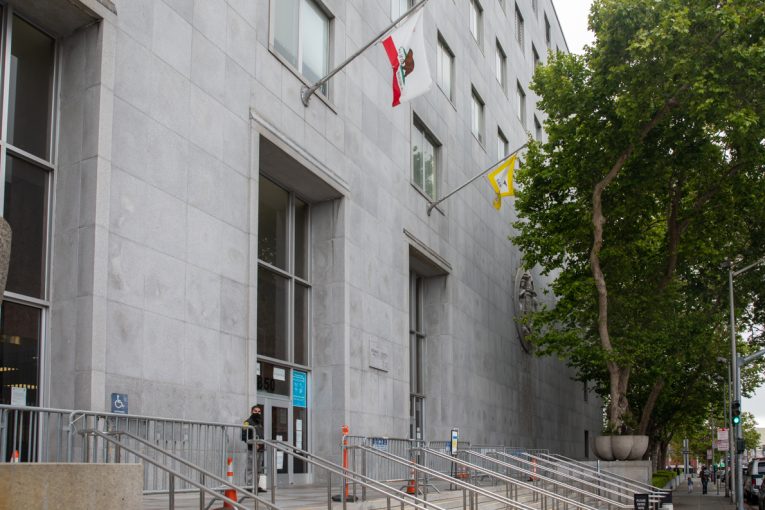
SAN FRANCISCO — During a preliminary hearing July 1 in Department 20 of San Francisco Superior Court, Deputy Public Defender Everett Hewlett highlighted inconsistencies between the testimony of Deputy District Attorney Madison Boucher’s expert witness, Officer Caden Girvin, and Girvin’s own police report. Following the preliminary hearing, DPD Hewlett argued a motion to suppress, contending Officer Girvin lacked sufficient probable cause to search the accused, but Judge John Echeverria denied the motion.
The accused was charged with possession for sale of a controlled substance. During the hearing, DDA Madison Boucher questioned Officer Girvin about the details of the arrest.
On direct examination, Officer Girvin outlined his qualifications as an expert in the sale of methamphetamine, citing participation in a 40-hour regional police academy narcotics course, the “more than 100 arrests” he had made involving narcotics-related incidents and the “more than 200 times” he had seen and handled methamphetamine. Judge John Echeverria ruled that Officer Girvin was qualified as an expert in the sale of methamphetamine.
Officer Girvin said the incident occurred April 16, 2026, at about 6 p.m. He and other officers were in the area of 16th and Mission streets, which Officer Girvin testified was known for narcotics transactions. Officer Girvin described two alleged transactions between the accused and two different individuals.
During the first alleged exchange, Officer Girvin said he saw the accused hide behind a construction barrier and pull out a “black, clear plastic case.” He then saw the other individual hand the accused an “unknown amount of U.S. currency.”
Officer Girvin said the second exchange was similar, with the accused appearing alert and looking both “north and south with his back to the building, indicating that he was looking for law enforcement presence.”
Officer Girvin testified that the black plastic case contained a “crystallized opaque substance,” which he suspected was methamphetamine. Combined with the “secretive nature” of the interaction, Officer Girvin concluded the accused was selling methamphetamine and arrested him.
“How did you know that it was methamphetamine? Could you see it?” Judge Echeverria asked for clarification.
Officer Girvin responded that he had a “clear view” of the interaction and could see that a crystalline substance was being exchanged, which he believed was methamphetamine based on his previous experience seeing and handling the drug.
After arresting the accused, Officer Girvin brought the plastic case back to the police station and opened it. DDA Boucher asked Girvin if he could identify the substance in the case, to which Girvin responded that it “looked like” crystalline methamphetamine.
On cross-examination, DPD Hewlett asked Officer Girvin, “On your police report, you never noted that the case was clear, is that correct?” After reviewing the police report, Girvin responded, “Correct, I refer to it as a black plastic case.”
DPD Hewlett then handed Officer Girvin a photograph of the case, pointing out that, besides the black lid on the outside of the case, there was an additional clear lid inside.
Because of the black outer lid, “You couldn’t see what was inside when it was closed, right?” DPD Hewlett asked. “Yes,” Officer Girvin responded.
DPD Hewlett then asked, “In your police report, you did not know if it was methamphetamine [that was in the case], correct?” After reviewing the report, Officer Girvin said he did not mention what narcotic he believed was in the case.
“And that’s because you couldn’t tell that it was methamphetamine, correct?” DPD Hewlett asked. “Yes, from a distance it was almost impossible to tell what it was,” Officer Girvin said.
Officer Girvin quickly corrected himself, saying he could not tell what was in the case during the first alleged transaction but could see it during the second alleged transaction.
On redirect examination, DDA Boucher asked Officer Girvin whether he could still determine that the exchange was a narcotics transaction regardless of the specific narcotic involved. Officer Girvin responded in the affirmative.
After Officer Girvin was dismissed, DPD Hewlett argued a motion to suppress the evidence obtained from the search, contending Officer Girvin lacked sufficient probable cause to conduct the search under the Fourth Amendment.
Because of Officer Girvin’s conflicting police report and hearing testimony regarding the transparency of the case and the specific substance allegedly exchanged, DPD Hewlett argued there was insufficient evidence to justify searching the accused. Furthermore, DPD Hewlett argued that Officer Girvin’s belief that the substance was methamphetamine was the “level of particularity required” for the search to be constitutional.
DDA Boucher responded that, under prior case law, courts must consider the totality of the circumstances known to the officer at the time of the search. DDA Boucher cited Officer Girvin’s experience with narcotics arrests, his knowledge of the area and the accused’s secretive conduct as sufficient to establish probable cause.
Finally, DPD Hewlett noted that although the burden of proof is lower at a preliminary hearing, the burden remains on the prosecution to establish sufficient evidence to hold the accused to answer. DPD Hewlett again argued that the inconsistencies between Officer Girvin’s police report and his testimony undermined his credibility as an expert witness. Judge Echeverria responded that he “agreed” with both claims.
Ultimately, Judge Echeverria denied the defense’s motion to suppress and ruled that the prosecution had “presented enough evidence” for the accused to be held to answer on a felony charge of possession of methamphetamine for sale.
The accused was released from custody on his own recognizance. His arraignment is scheduled for July 15, 2026.
Follow the Vanguard on Social Media – X, Instagram and Facebook. Subscribe the Vanguard News letters. To make a tax-deductible donation, please visit davisvanguard.org/donate or give directly through ActBlue. Your support will ensure that the vital work of the Vanguard continues.
