
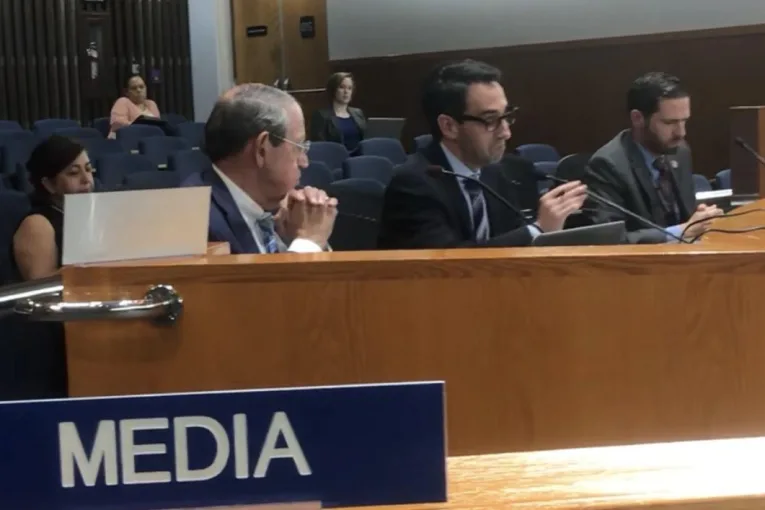
A law firm trying to give crime victims a seat in the courtroom and a voice in the legal system just got California’s Supreme Court to listen. Now, the state’s highest court wants to hear from a prosecutor who calls himself a champion for crime victims, after one attorney’s fight helped bring a public record to light that says otherwise.
By Susan Bassi and Fred Johnson
For sixteen years, one line has been repeated at nearly every major press conference in the county. A defendant is sentenced. Cameras gather outside the courthouse. A prosecutor steps to the microphones, thanks the victims for their courage, and promises they’ll always come first.
Say it enough times, and it starts to sound like fact instead of a claim.
Step away from the podium, and the record tells a messier story.
THE RECORD AWAY FROM THE PODIUM
The prosecutor is Jeffrey Francis Rosen, who has run the Santa Clara County District Attorney’s Office since 2010. Longer than many of the county’s crime victims have been alive.
At his February State of the Office address, he stood before county supervisors and asked a blunt question.
“How much is a domestic violence victim’s life worth in Santa Clara County?” — Jeff Rosen, February 2026
He warned that cuts would mean less safety, and that people might die.
But beyond Rosen’s press releases and political theatrics, a different picture forms: court filings, lawsuits, restitution orders, election results, and social media posts. The clearest account of how DA Rosen actually treats crime victims comes from someone who used to work for him.
THE PROSECUTOR WHO SAID IT FROM INSIDE
Daniel Chung spent years as a deputy district attorney in Rosen’s own violent felonies unit, prosecuting domestic violence cases.
In February 2021, he published an opinion piece in the San Jose Mercury News about the surge in pandemic-era violence, calling for a justice system that protected victims while addressing crime’s roots. He wrote it as a private citizen and didn’t name Rosen or the office.
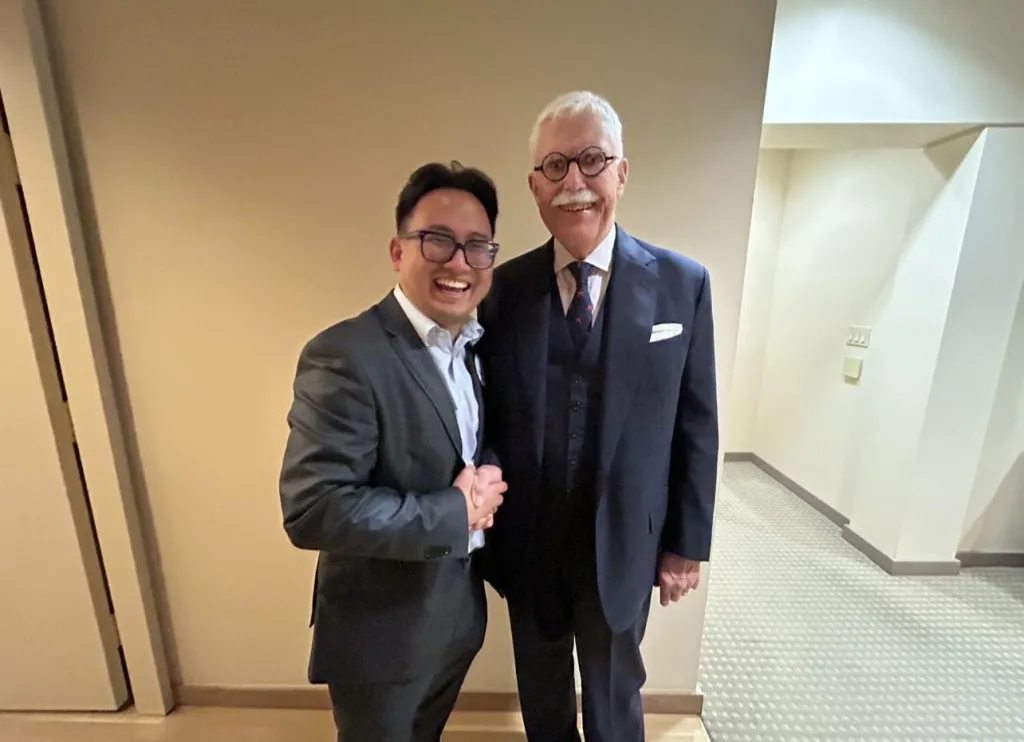
Daniel Chung (left) and James McManis (right), March 2026 San Jose, California. Photo by Susan Bassi
According to a later lawsuit, Rosen read the op- ed the night it ran, was furious, and had Chung reassigned out of the Violent Felonies Unit within hours.
Chung kept speaking publicly about problems he said he saw inside the office, including claims that evidence went undisclosed and campaign money was used improperly.
Rosen placed him on leave, then fired him. A personnel board ordered him reinstated. Rosen’s office kept him from working anyway, while still paying his salary.
Chung ran against Rosen for the top law enforcement job twice and lost both times, but the margins tell their own story. This year, in a head-to-head race, he won close to 40 percent of the vote against a two-decade incumbent.
“Even 40% of the community is supportive of meaningful change.”
— Daniel Chung, June 2026
No single claim proves a pattern. Together, they read like an inside account of the same gap crime victims outside the office have described for years: a district attorney whose promises don’t survive his own prosecutorial decisions.
OUTSIDE HIS OWN CIRCLE
Some of the sharpest accounts of that gap come from ordinary people who ran into Rosen’s office on the worst day of their lives.
Paul Gackle, a former San Jose Mercury News sports reporter covering the San Jose Sharks, survived a 2017 attack in which he was stabbed 14 times.
Vanguard reporting in 2023 found Rosen’s office had offered Gackle’s attacker a plea deal that freed her nine days before she attacked him, then let more than a year pass before that became public.
Gackle said Rosen’s Victim Services Unit, then led by director Kasey Halcon, denied him state wage loss compensation for four years. The denial traced back to an employment verification form the San Jose Mercury News submitted to the state, claiming Gackle had quit his job without notice.
Margaret Petros, executive director of the nonprofit Mothers Against Murder and a victim advocate in the state for nearly 40 years, took on Gackle’s case in July 2021. She proved to the state that Gackle had in fact been fired, not that he’d walked off the job, while he was still fighting to get the DA’s office to honor his rights as a crime victim.
“Paul was referred to me in July 2021, and by October 2021, I had the denial of wage loss reversed and the full maximum award reimbursed. Some may think $70,000 is a lot, but the truth is the man’s career was ruined. That’s barely one year’s pay.” — Margaret Petros
While struggling to return to his full-time reporting activities, Gackle said the Mercury News fired him after he pushed editors to report more fully on Rosen’s handling of survivors of violent crimes.
The newspaper said Gackle’s firing was related to the PTSD he exhibited after surviving a violent crime that left him with 14 scars, and little support from a newspaper publisher, or his reporting associates.
After Gackle was fired, Mercury News reporter Robert Salonga and longtime newspaper editor Bert Robinson obtained a two-year restraining order against Gackle, preventing him from attending Rosen’s press conferences during the 2022 election.
The restraining order was pursued after Gackle had become a vocal critic of Rosen’s handling of the county’s crime victims, and how Salonga had reported on it.
The pattern isn’t limited to one case.
In 2014, prosecutors declined to charge 49ers lineman Ray McDonald after his fiancée was found with visible injuries. The district attorney’s office, who assigned Cindy Hendrickson to the case, cited the victim’s limited cooperation to justify not pursuing the high profile domestic violence case.
The following year, a grand jury indicted McDonald on a rape charge from a separate incident involving a different woman and charged a teammate with sexual battery in the same case. The sexual violence case was rolled up with domestic violence allegation involving two different women. Rosen took both cases as one to the grand jury. Despite a grand jury indictment, both cases disappeared from Rosen’s prosecution list shortly thereafter.
At the time, critics noted that local police worked secondary security jobs at the 49ers’ stadium, and argued the scrutiny applied to victims in these cases exceeded the scrutiny applied to the players.
In 2018, felony domestic violence charges against a different 49ers player, Reuben Foster, were dismissed after a judge found Rosen’s office hadn’t provided the evidence needed for trial.
While repeatedly failing to handle evidence in some cases, others see excessive delays.
Delay isn’t neutral.
Two Santa Clara County Civil Grand Jury reports, “Justice Delayed: Why Does It Take So Long to Resolve Felonies in Santa Clara County?” in 2017 and a follow-up continuity report the next year, found the county resolved felony cases slower than nearly every other county in the state.
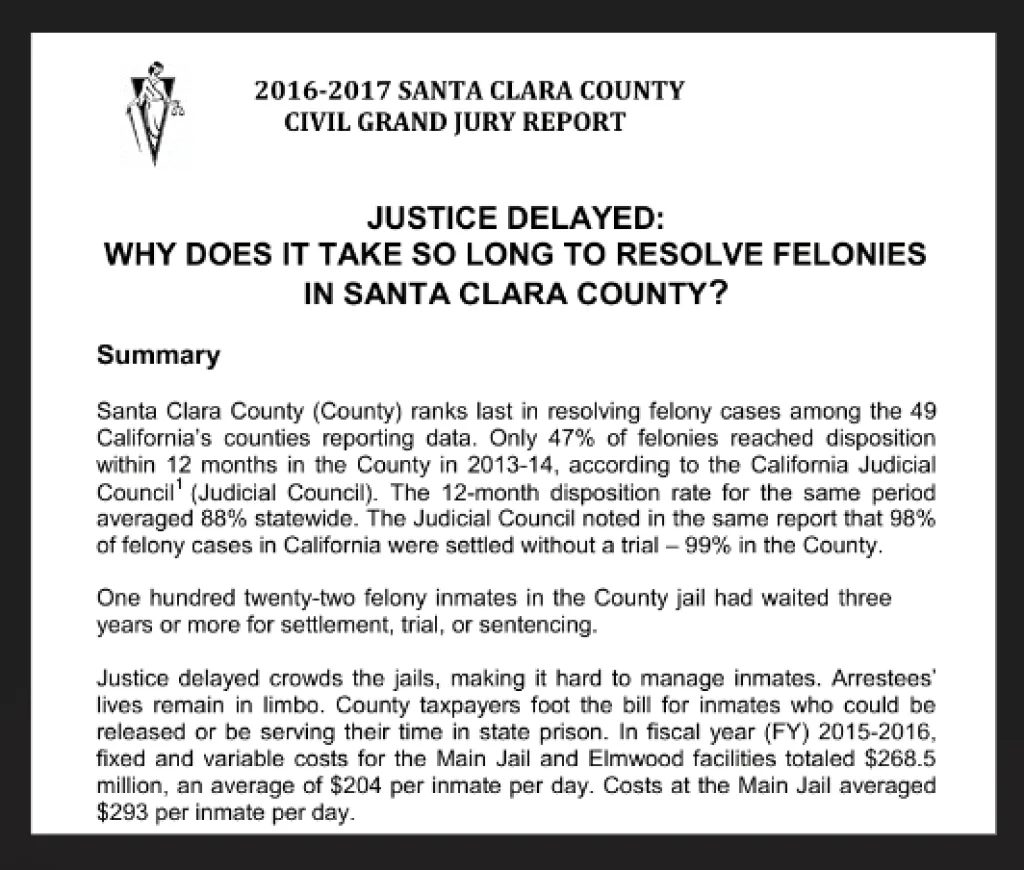
The reports focused mainly on the cost to defendants sitting in jail and to taxpayers footing the bill, but the same delay cuts against victims too: cases that drag on for years leave survivors waiting, testifying, and re-living what happened long after it should have been resolved.
Rosen’s ties to a different set of crime victims raised separate questions.
A 2023 Vanguard investigation examined WomenSV, a Los Altos nonprofit that says it serves wealthy Silicon Valley households dealing with domestic abuse.
One published critic alleged Rosen used the nonprofit’s wealthier clients as political validators, while more ordinary victims described a different experience. It’s an unproven claim, but the same shape as everything else here: treatment that depended on how useful a victim’s story was, not on what they survived.
A LAW FIRM VICTIMS KEEP FINDING
One law firm keeps showing up on the other side of that gap.
Attorney James McManis represented Chung’s lawsuit against the county, calling it hard to imagine a clearer case of retaliation for disliked speech.
This year, through attorney Miriam Pieters, the firm took a new client: the family of a woman murdered decades ago, fighting to keep her killer’s sentence from being quietly reduced through a process neither side wanted challenged.
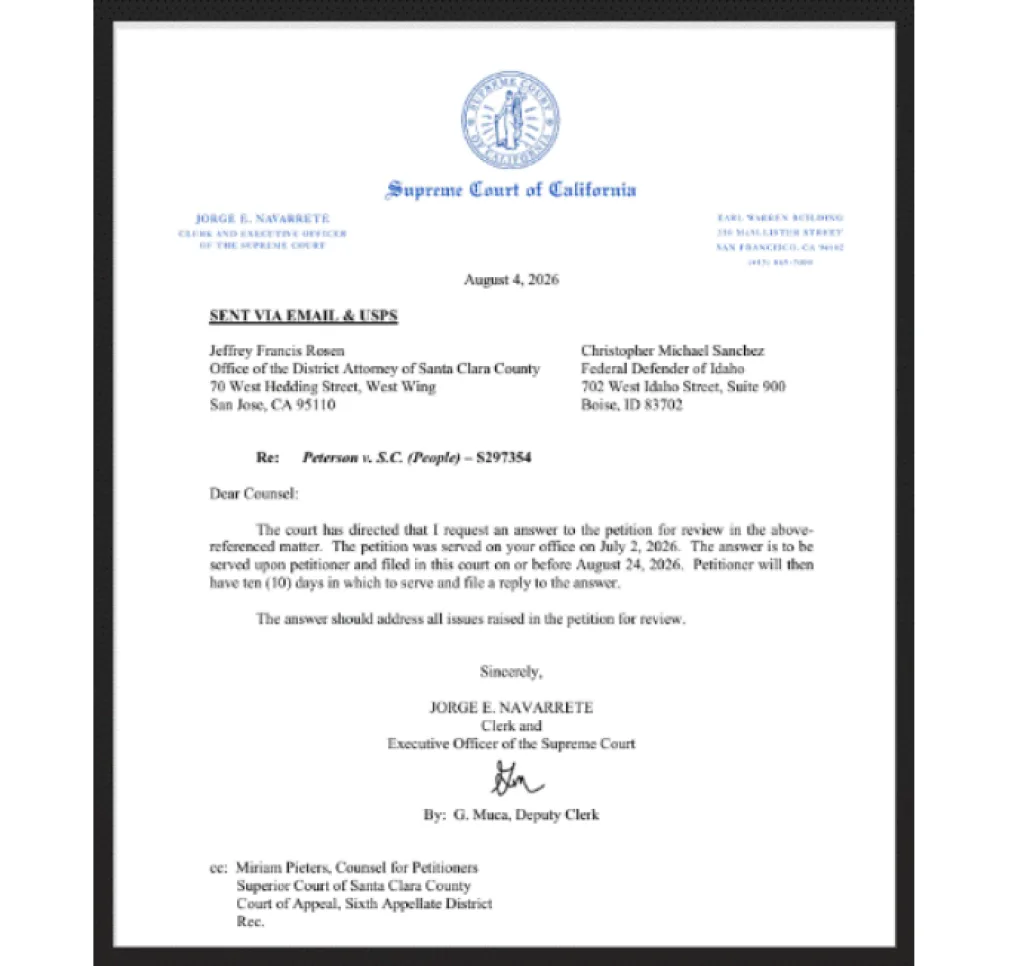
In early July, McManis and Pieters petitioned the California Supreme Court on two questions. Was a state sentencing law ever meant to apply to death sentences? Do crime victims have any right to be heard once prosecutors and defense stop disagreeing?
A month later, the court ordered Rosen’s office to answer both in writing.
It’s a small filing in a long fight, but the clearest legal argument yet for what Chung had already been saying from inside the building: Santa Clara County’s crime victims were promised a voice they don’t have.
THE NUMBERS DON’T MATCH THE SPEECHES
Rosen’s warnings about budget cuts and victim safety keep colliding with his own office’s numbers.
Two years before his February speech, San José Spotlight reported the office was struggling to manage a 142 percent rise in family violence cases over five years.
This year Rosen told supervisors his office needed protection from budget cuts, even as county records showed his budget had grown to $185 million, up from $177 million, while his own staffing projections fell.
An office that says it lacks staff to protect domestic violence victims is the same office that, for years, has paid a trained domestic violence prosecutor to not work, as previously reported.
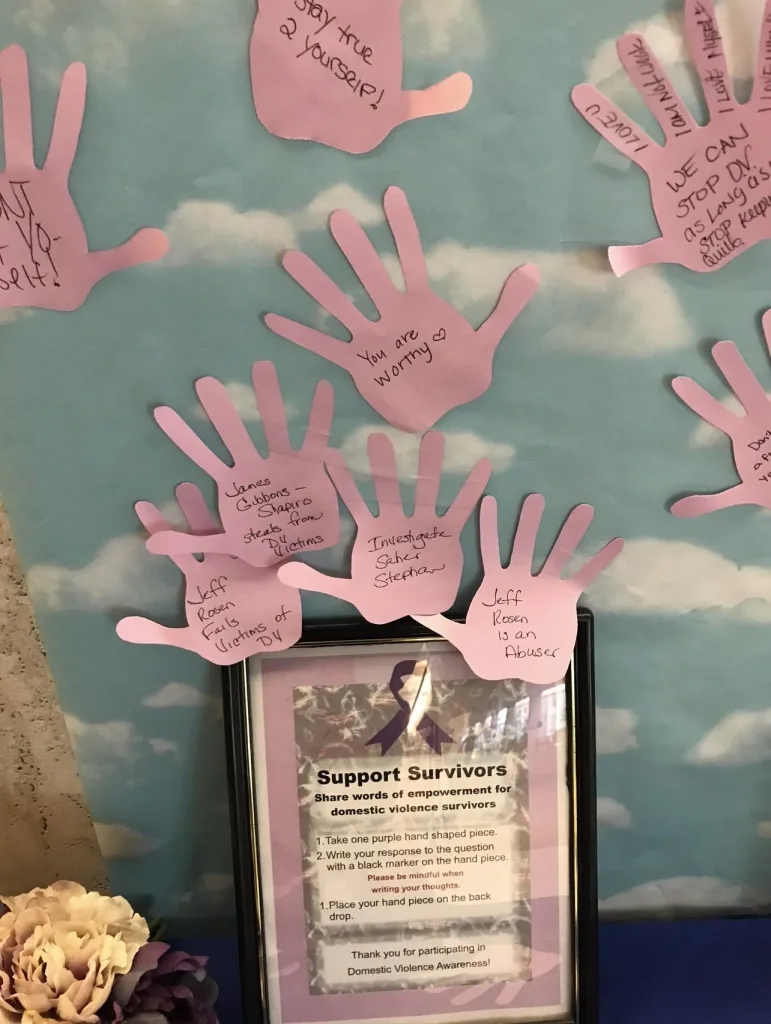
A CASE THE OFFICE DIDN’T WANT
Rosen sailed into his 2018 re-election on the national spotlight cast by his office’s prosecution of Brock Turner. Rosen’s office had convicted Turner in 2016, and though Rosen said publicly he was outraged by the light sentence Judge Aaron Persky handed down, the case became a #MeToo flashpoint largely because of Stanford law professor Michele Dauber, who led the campaign to recall Persky, helped publicize the viral victim impact statement written by Chanel Miller, then known only as Emily Doe.
Rosen cast himself as a champion for crime victims throughout the saga. Voters returned him to office without opposition in June 2018, the same day Persky was recalled.
Seven months later, Renee Doe, a woman in San Martin, said she was raped by a homeless man she had tried to help.
Initially, prosecutors first refused to file charges, calling the case too difficult, and released the suspect.
He disappeared for weeks. Only after public attention did prosecutors reverse course; by then, deputies needed a manhunt to find a man they’d already had in custody once.
Renee has said Rosen’s office struggled with mental health issues at the center of the case, and that Rosen’s Victim Services Unit, then led by director Kasey Halcon, offered her only a $250 cash card and told her there was little else the office could do to help.
It’s one case, but it follows the same shape as everything else here: a victim whose voice mattered only once the story became too public to ignore.
WHAT $66,000 MEANS TO CHILD SEX ABUSE VICTIMS
There’s a more recent example, and it comes down to numbers.
In March, a jury convicted Shannon O’Connor, known publicly as the “Los Gatos Party Mom,” on dozens of felony and misdemeanor charges for hosting alcohol- and sex-fueled gatherings for teenagers over roughly two years.
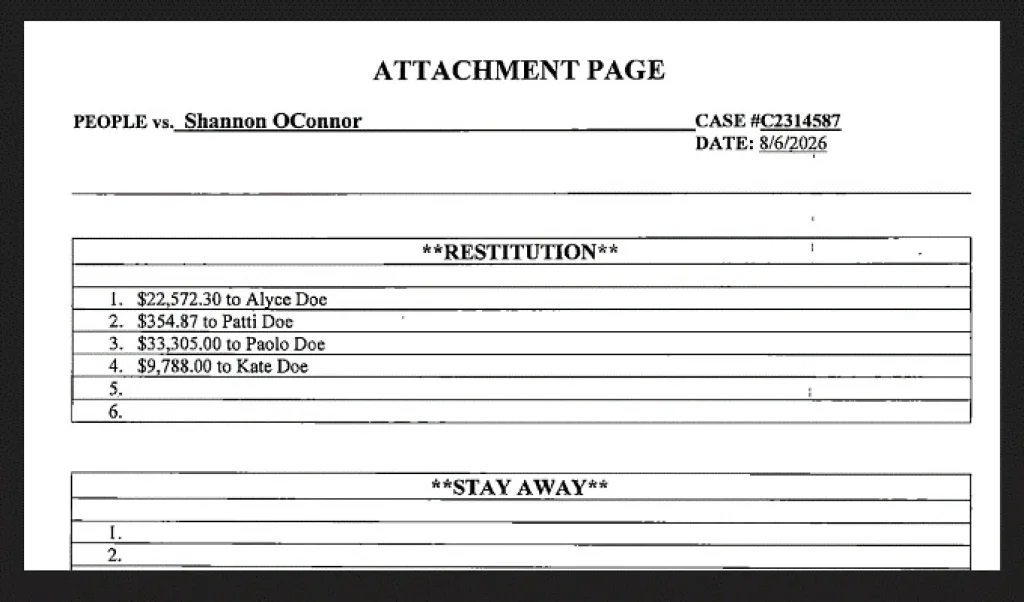
Restitution Order in Los Gatos Party Mom case issued August 6, 2026.
Sentenced in late May to more than 30 years, she was ordered in August to pay four teenage victims a combined total of just over $66,000, plus a smaller reimbursement to the state’s crime victim compensation fund. Some victims told this news outlet the process took too long, and the payout fell short of what they expected from a prosecutor who spoke at a press conference about justice and support for crime victims.
Compare that to a case Rosen used often in his own political messaging before the June primary: a former San Jose councilman, Omar Torres, convicted of molesting a relative decade earlier, sentenced to 18 years and ordered to pay his victim $780,000. A figure Rosen’s office cited again and again before voters went to the polls.
Two crimes against children, two sets of victims, wildly different outcomes for what the county’s justice system decided their suffering was worth. One case happened to arrive with a camera crew and an election on the calendar.
PROSECUTORIAL MISCONDUCT AND PUBLIC SAFETY
California’s Racial Justice Act exists for a real reason. Trials across the state, including old ones, sometimes happened inside a system shaped by racial bias, in who got charged, how juries were picked, and what prosecutors said in court.
The law lets a defendant raise a “colorable” claim, one serious enough a court can’t wave it away, and reopen the case if it holds up. That’s a reasonable answer to a real problem: a national report released last month found more than 600 death sentences nationwide overturned, or leading to exoneration, because of prosecutorial misconduct.
But the same rule that frees the wrongly convicted can also, quietly, reopen cases that were never in doubt, and not always for the people it was written to protect.
Consider Judge Stuart Scott who spent nearly a decade hearing family law and civil domestic violence cases in Santa Clara County. Stuart Scott spent two decades as a county prosecutor, working under Jeff Rosen’s supervision, before winning an uncontested judgeship race.
The state’s Commission on Judicial Performance has since publicly admonished him for violating judicial ethics rules related to improper conduct involving a female government attorney. As a prosecutor, appeals courts found some of his trial arguments unsupported by the evidence, and a federal appeals court overturned convictions tied to his conduct. The state bar shows no public discipline resulting from his misconduct.
Judge Stuart Scott decided custody battles, restraining orders, and family court outcomes across the county for years, before recently moving back into criminal assignments.
Every domestic violence victim whose case passed through his courtroom did so before a judge the state had already found violated basic fairness rules. If a colorable claim can unwind a death verdict three decades later, it’s hard to say why the same standard would stop there.

DA Rosen press conference set up in 2018 outside the Hall of Justice. Photo by Susan Bassi
SIXTEEN YEARS, FORTY PERCENT
For sixteen years, Rosen has stood before cameras describing himself as the person protecting survivors. That’s hard to square with the record: a prosecutor fired for saying victims deserved more, a rape case the office refused to file at first, a restitution order worth a fraction of a comparable case, a former prosecutor turned family court judge, disciplined more than once, still shaping outcomes for the domestic violence survivors Rosen says he fights for in the same county.
This spring, close to 40 percent of Santa Clara County voters told Rosen they were done taking his word for it. The Supreme Court’s letter is a smaller signal pointing the same direction: for the first time in years, someone above the district attorney’s office is making him answer, in writing, for the gap between what he says at the podium and what his record shows.
McManis, Pieters, and the family they represent didn’t create that gap. Neither did Chung. They inherited it, and now they’re asking, in a courtroom instead of a press conference, whether Santa Clara County’s crime victims will finally get the voice Jeff Rosen has been promising them for sixteen years.
Updated on 8/11/2026 to clarify reporting on victim compensation and assistance Margaret Petros provided to Paul Gackle after he was fired by the San Jose Mercury News and ignored by Kasey Halcon of the Victim Services Unit managed and supervised by DA Jeff Rosen.
To comment please go to one of these social media platforms:
Facebook: https://www.facebook.com/DavisVanguard
LinkedIn: https://www.linkedin.com/company/peoples-vanguard-of-davis-inc/
Instagram: https://www.instagram.com/davisvanguard/
X: https://x.com/davisvanguard
Bluesky: https://bsky.app/profile/vanguardnewsgroup.bsky.social
Subscribe to the Vanguard News letters. To make a tax-deductible donation, please visit davisvanguard.org/donate or give directly through ActBlue. Your support will ensure that the vital work of the Vanguard continues.
