
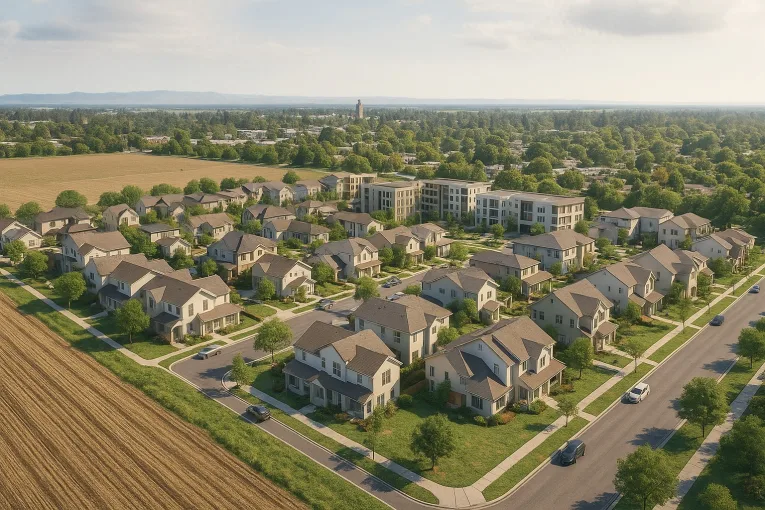
In a recent letter to the Davis Enterprise, longtime Measure J supporter Eileen Samitz expressed concern that discussions about reforming the citizen-vote requirement were being raised just as the controversial Village Farms proposal is heading toward the ballot.
Samitz framed this timing as suspicious, suggesting that the goal of amending Measure J is to help large projects like Village Farms bypass a public vote.
That is simply not an accurate representation of what is actually being discussed—or what is even legally possible in the near term.
For one, any Measure J reform passed now would almost certainly not affect a project already in the pipeline.
The timelines for placing a reform measure on the ballot, achieving voter approval, and enacting changes would ensure that no such exemption could apply to current proposals. Village Farms, a proposed 1,800-unit project at Covell Boulevard and Pole Line Road, and WillowGrove (formerly the Shriners site), are both moving forward under existing rules and would still be subject to Measure J’s voter requirement.
Moreover, one of the only proposals that has been seriously floated—adjusting the affordable housing exemption threshold from 100 percent to 50 percent—would not apply to either of these projects.
Both are proposing affordable housing shares in the range of 20 to 25 percent, which is consistent with standard project composition and nowhere near the threshold needed to trigger such an exemption. Even if the reform passed, these projects would not qualify.
So let us dispense with the implication that this is a developer-driven end-run around Measure J. The framing simply does not hold up.
The deeper issue is whether the community is willing to honestly confront the growing gap between the city’s housing needs and the current tools available to meet them.
Samitz asserts that Measure J already includes exemptions for affordable housing and that no amendment is needed.
That statement, while technically true, glosses over the reality that the existing exemption is so narrowly tailored and legally uncertain that no project has ever qualified for it in the 25 years since Measure J was enacted.
The current exemption applies only to 100 percent affordable housing developments, with additional conditions that are nearly impossible to meet in the real world.
In a city where land is expensive, infrastructure costs are high, and state and federal subsidies for affordable housing are dwindling, requiring 100 percent affordability without any flexibility is effectively a poison pill.
No such project has ever been proposed in Davis under this standard, and no serious observer believes one will be.
That is why some in the community, as well as city staff and policy experts, have suggested a more modest reform: allowing projects with at least 50 percent affordable housing to bypass the voter approval requirement.
While not a silver bullet—and likely not viable without major public subsidies—it would at least move Davis closer to being able to meet its affordable housing obligations in a practical and good-faith manner.
Samitz argues that any attempt to amend Measure J is for the benefit of developers, not the community.
But that statement ignores the reality that Davis, like every other city in California, is subject to state housing mandates.
Our Regional Housing Needs Allocation (RHNA) obligations include not just market-rate units but also low-income, very-low-income and extremely-low-income categories.
Suggesting that developers are the sole beneficiaries of meeting these targets dismisses the tens of thousands of Californians—including students, teachers, service workers, seniors and disabled individuals—who cannot afford current housing prices.
(Moreover, who benefits from the current conditions where new housing is scarce and housing is out of the reach of even most middle class folks?)
Make no mistake: the State of California has taken notice of Measure J. In a December 2021 letter to the City of Davis, the California Department of Housing and Community Development (HCD) explicitly identified Measure J as a governmental constraint to the development of housing.
“As recognized in the housing element,” the letter reads, “Measure J poses a constraint to the development of housing by requiring voter approval of any land use designation change from agricultural, open space, or urban reserve land use to an urban use designation. Since the ordinance was enacted in March of 2000, four of the six proposed rezones have failed.”
HCD requires cities to not only identify housing sites that meet RHNA obligations but also to analyze and address any regulatory or political barriers that might prevent housing from being built. In the case of Davis, HCD is demanding an honest evaluation of Measure J’s impact.
The city’s official response in the 2021–2029 Housing Element attempted to thread the needle.
It argued that Measure J was not a current barrier to RHNA compliance because all needed rezones for this cycle could be accomplished within existing city boundaries. The Housing Element identified several infill sites, such as 3500 Chiles Road and 4600 Fermi Place, that could accommodate the required lower-income units.
However, that response has not aged well.
In recent months, city officials have publicly acknowledged what many have known for years: infill opportunities are rapidly drying up.
In a recent statement, the city said, “The City of Davis has been able to meet its legal fair share of housing within the city limits. However, that fact is becoming more untrue as the years pass and lands become unavailable or developed… the Measure J/R/D process becomes applicable to all annexation applications.”
This is a significant shift in tone. It marks the first time the city has publicly recognized that Measure J will soon become the only gatekeeper for future growth. Once the limited pool of infill parcels is exhausted—many of which are already constrained by ownership issues, contamination, or infeasibility—the city will have no choice but to consider annexations. Every one of those annexations will require a citywide vote under Measure J.
This is why the conversation about reform cannot wait until 2030, when the next renewal of Measure J is scheduled to appear on the ballot.
Starting the conversation now means giving the community time to think, deliberate and debate what a more flexible, more equitable, and more sustainable Measure J could look like. It is an opportunity, not a threat.
Some have suggested that the best course of action is to wait and see how the next few projects fare.
If both Village Farms and Willowcreek are approved by voters, proponents of Measure J will claim that the system is working. If both are rejected, it may strengthen the case for reform or even invite state intervention.
But the worst-case scenario—the one that is most likely—is that one project passes and one fails.
That would leave Davis in a gray area: not in full noncompliance with state law, but also not building enough housing to meet future RHNA obligations. In that scenario, both court challenges and voter-led reforms could be harder to justify politically.
The reality is this: Measure J may have once served a purpose, but today it functions more as a structural bottleneck than as a meaningful democratic check. And if Davis fails to act, the state may do it for us—not by repealing Measure J, but by enforcing the housing laws we are currently sidestepping.
This is not about abolishing public input or handing the city over to developers. It is about aligning our policies with our values—values that include affordability, inclusion and sustainability.
Reforming Measure J is not a betrayal of democracy; it is a necessary step toward building a more just and livable future.
If we care about housing for students, workers, families and those who need it most, then the time for serious discussion is now. Not in 2030. Not when it is too late. Now.

I’ll just keep saying it, every article: there is no reform of Measure J. There is Measure J, and there is getting rid of Measure J and replacing it with something else that may have similarities to Measure J but is not the same as Measure J. And what a new Measure looks like, if any, is going to be one heck of a discussion.
That’s a possible outcome for sure
Kotkin on why infill has failed to meet demand and why the answer is and has long been peripheral development:
https://www.newgeography.com/content/008556-building-future-fixing-global-housing-crisis
Alan, your point is a technicality around semantics. Of course it won’t be Measure J, just as Measures R and D are not Measure J. The reformed version will likely include key elements of Measure J, such as requiring voter approval if a developer chooses not to comply with the developments standards established by the City through whatever process is used.
Can you point to one place where a 50% Affordable standard has been built?
That’s what I was getting at – I don’t see 50 percent as any different from 100 percent and we have 25 years of data on the viability of that.
We’ve been through this a number of times, haven’t we?
The state’s “mandates” are failing – statewide. The current ones, let-alone any future mandates. There’s still a number of cities that don’t even have an approved housing element, let alone the vast majority which aren’t meeting the targets outlined in approved housing elements.
https://cities.fairhousingelements.org/
So obviously, Davis isn’t going to be meeting current or future targets, either. However, it can create plans for meeting those targets within the city, which will never actually materialize. Just like every other city in the state. The idea that the state would then start analyzing each city throughout the state for land outside of their boundaries is not supported by any law whatsoever.
As far as this comment goes (from article), it is highly misleading in that no proposal has arisen in the first place: ” . . . the existing exemption is so narrowly tailored and legally uncertain that no project has ever qualified for it in the 25 years since Measure J was enacted.”
The truth is that the conditions which would warrant a proposal arising have not occurred. Davis has always had an approved housing element, unlike vast numbers of cities throughout the state.
Regardless, the issue is FUNDING (government subsidies) for Affordable housing; not LAND. That’s why it took more than two decades for Creekside Affordable housing to be built, despite getting FREE LAND.
And for those who actually do support more Affordable housing, it should be noted that every single dollar of government funding that is used in Davis is a dollar that’s not available in another community – which might have a greater need.
But again, there simply is no requirement for cities to sprawl outward in ANY of the state’s housing laws. Doesn’t exist – not even implied.
“But again, there simply is no requirement for cities to sprawl outward in ANY of the state’s housing laws. Doesn’t exist – not even implied.”
I never said there was.
Then stop with the fear mongering.
Also, in regard to speculation that the existing proposals “wouldn’t qualify” for a gutted Measure J, all they would have to do is to remove their proposals and re-apply under a gutted Measure J. (Personally, I don’t think it’s likely. However, I do think it’s more likely that those proposals will be rejected by voters if there’s a continuing effort to repeal Measure J.)
You could have, however, listed the exemptions for Measure J which do exist.
After notice and hearing as required by state law and after compliance with the California Environmental Quality Act, the city council may, without a vote of the electorate of the city, approve residential development on land designated agriculture, agriculture reserve or urban reserve if the city council finds that all of the following circumstances exist:
(1) The approval is necessary and required to meet the city’s legal fair share housing requirement;
(2) There is no other land already designated for urban use that can accommodate the City’s legal fair share housing requirement; and
(3) Not more than five acres per year in total area is designated under this exemption for residential development. Additional acreage may be designated under this exemption if the city council finds that the acreage is necessary to meet the city’s legal fair share obligation based on maximum multifamily densities.
Any proposal approved under this subsection shall be required to have all housing units permanently affordable to persons or families of moderate, low and very low income.
The intent of this exemption is to provide sufficient land for housing to accommodate moderate, low and very low-income housing, as may be necessary over time.
Any development project that has obtained a vested right pursuant to state law prior to March 8, 2000, the effective date of Ordinance 2008 adopting Measure J.
(Ord. 2008 § 3, 2000; Ord. 2350 § 3, 2010; Ord. 2581 § 3, 2020)
https://ecode360.com/44663275#44663311
As far as what would happen if both Measure J proposals are approved, only one is approved, or none are approved – it’s not going to make any difference. There will still be noise emanating from the development activists forever into the future – we already know that. And that’s true regardless of whether or not the population is declining, housing prices are declining, etc.
Money is a powerful motivator. And Davis is (just barely) desirable-enough compared to surrounding cities that there will always be at least some motivation to pursue sprawl. (Unless things really start collapsing in California and the country.)
But you then jumped the wrong way with your comment. What I have argued is that if the city lacks infill sites that measure J is a barrier to housing and the state does have the capacity to remove barriers to housing.
I didn’t jump in “any” direction, other than to note that none of the state’s housing laws (not a single one) require cities to expand outward. In fact, there isn’t even a process for the state to consider it. Most cities (even those along the coast) probably could expand outward, one way or another.
So the suggestion that the state is going to look at land outside of city limits is simply not supported by any law or process – anywhere in the state. There is no “inventory” of “available land” outside of city limits which is zoned for farming that the state is maintaining or examining for potential development. And if they started doing so, this would be in DIRECT CONFLICT with their goals of encouraging density.
The only reason that the state (HCD) mentioned Measure J is because the city brought it up. To which the state appropriately noted that the city cannot “count on” sites outside of city limits since the city government doesn’t control approvals.
At no point did HCD state that Measure J is a “constraint” to housing, UNLESS the city tries to include sites outside of city limits. (A point that you “conveniently left out” of your diatribe.) Now it could be that conditions will be met that will enable a developer to bypass Measure J, but again – that’s not something the city should be planning for in its housing elements.
My third comment.
Ron, I’ll give you another comment to respond…
You are misrepresenting my position so let me explain this again…
It’s true, in a narrow legal sense, that state housing laws do not explicitly require cities to expand outward. However, that’s a red herring. What the laws do require is that cities identify enough sites to meet their RHNA and if sufficient infill or redevelopment sites aren’t available or feasible, outward expansion becomes the de facto necessity.
That’s precisely where Measure J comes into play.
No, HCD didn’t say “Measure J is a constraint” in isolation—but it did say the city cannot count on land outside its jurisdiction unless the city demonstrates control and certainty. And under Measure J, that means a public vote—an additional political hurdle that doesn’t exist in other cities.
So while Ron is technically right that HCD doesn’t mandate expansion, he’s glossing over the actual function of Measure J as a structural barrier to meeting housing obligations when buildable land within city limits is scarce. HCD didn’t bring up Measure J out of nowhere. They mentioned it because it functionally matters—not just in theory, but in real planning decisions.
In short: if Davis wants to meet its housing goals and is looking beyond city limits to do so, Measure J is relevant—and not just because the city brought it up, but because it shapes whether those sites are real or imaginary in the eyes of the state
I’m not seeing much disagreement regarding your comment.
That is, the city cannot count on land outside of city limits to address its RHNA targets. (Why would anyone think otherwise?)
It is not actually possible (from what is actually written) to determine “who” first brought up Measure J, but it appears that the city “voluntarily” did so in anticipation of future housing elements.
Another concern is “why” the city is speculating regarding future housing elements in its conversations with HCD. Is approval of CURRENT housing elements dependent upon speculation regarding FUTURE housing elements these days? Nor is there any explanation regarding staff’s insertion of language regarding a potential weakening of Measure J. (Did HCD ask them to insert that? If so, there’s no evidence of such a request. And if they actually did so (which seems unlikely), what law are they basing that on? It’s certainly possible that HCD staff doesn’t fully understand the multiple laws that the state has enacted recently – most of which haven’t been effective or tested in court.
Again, probably most cities throughout the state technically “could” expand outward, and most cities (also) aren’t going to be meeting current or future housing “mandates”. As such, where’s the law, process and inventory for the state to start considering sites outside of city limits? Or is someone just making that up on the fly, based on what they “think”? (And that’s a question for all parties involved with this.)
That is correct, the city cannot count on a land outside of city limits to address RHNA targets. You are however, missing a very very critical point which is the city has a cure for that and that is right now to go through the measure J. process and measure J were not there then it would be the annexation process. Measure J creates an additional step that the city has to jump through in order to annex land and that is the critical issue here and that is the issue that you keep dodging. Basically, the first part of what you claim is true but you’re missing the point that it’s not a permanent barrier even under measure J.
As for the rest…
First, it’s important to understand that Housing Elements are not just documents for the present moment—they are eight-year plans meant to demonstrate how a city will accommodate its share of regional housing needs. As such, HCD necessarily evaluates a city’s future intentions and strategies, not just current conditions. That’s not “speculation”; it’s planning.
The concern about “speculating regarding future Housing Elements” misses this basic function. Every Housing Element anticipates the next cycle and builds a framework that should evolve over time. If the city gives HCD reason to believe that it won’t remove barriers to housing production—like overly restrictive land-use policies—then it risks noncompliance. And yes, that can apply to potential future obstacles as well.
As for the reference to Measure J/R/D, it’s important to understand how state housing law views local growth-control ordinances. HCD has become increasingly assertive in scrutinizing whether these kinds of measures act as constraints on housing development. While no one is claiming that HCD directly asked staff to suggest weakening Measure J, the city is likely responding to prior feedback from HCD indicating that Measure J might be a constraint on housing production unless mitigated by meaningful exemptions or procedural reforms.
Finally, regarding HCD’s legal authority: it is grounded in Government Code §§ 65580–65589.11, which require cities to affirmatively further fair housing, remove constraints on housing production, and provide realistic development capacity. Courts have begun to uphold the state’s expansive interpretation of these powers (e.g., California Renters Legal Advocacy v. City of San Mateo), and the evolving legal landscape strongly favors the state’s authority in enforcing Housing Element law.
David says: “That is correct, the city cannot count on a land outside of city limits to address RHNA targets. You are however, missing a very very critical point which is the city has a cure for that . . .”
Why would the city need a “cure” for something that you just acknowledged is not “required”?
Regarding San Mateo, that had nothing to do with land OUTSIDE of city limits. NONE of the state’s actions have to do with land OUTSIDE of city limits.
You seem to be stating that the state (HCD) has an undefined “expectation of continuous annexations”, which isn’t supported by any law, process, or inventory. And if you’re claiming it does exist, wouldn’t a documented exception need to be inserted which exempts places like San Francisco? Otherwise, wouldn’t San Francisco be in non-compliance with the law you’re claiming that HCD would rely upon to overturn Measure J (which doesn’t exist in the first place)?
I suspect it’s headed to court if the state tries to claim that an “undocumented expectation” to continue sprawling outward exists. States/government agencies are governed by process and law, not what someone “thinks” should be the case.
My final comment today.
The city has to build housing. They need to put that housing some place. You can respond to that point whenever you are ready.
I see that you’re allowing me to continue, so I’ll take you up on that.
The city doesn’t have to build housing. The state’s mandates (current, and future) are failing, statewide.
They do have to come up with a fake plan. And if the state acknowledges that it (along with every other housing element) is fake, that’s the point in time at which a conversation with cities across the state would occur. Essentially, “you tell me where to put it, then” “And while you’re at it, you tell me how you’re going to fund the Affordable components”.
And if the state then says (uniquely, to a place like Davis) to “plan for it outside of city limits”, that’s when legal issues will arise. But again, most cities aren’t going to meet current or future housing elements, and most cities probably could expand outward (if it wasn’t for agricultural zoning, urban limit lines, agricultural/open space mitigations, etc.). I suspect that most of those cities don’t even have an exemption for affordable/moderate-priced housing, as Measure J does.
The state’s mandates have as much chance of success as trying to re-implement the 55 mph speed limit law from some 45 years ago. (You’d likely get a ticket for driving “too slow” these days, if you drove 55 mph.)
But getting to the “key” point that you’re trying to raise, you’re claiming that the state would single-out Davis because the state has an un-documented (unlawful) “expectation” of continuous expansion of city boundaries – statewide, and that Davis is hindering that unlawful expectation.
“The city doesn’t have to build housing. The state’s mandates (current, and future) are failing, statewide.”
Your policy preference hinges on this – that the only reason to build housing is the state’s mandates and that the state will not attempt to enforce their mandates and if they do will not succeed. I respectfully disagree on all points.
David says: “Your policy preference hinges on this – that the only reason to build housing is the state’s mandates . . .”
You’re conflating two different issues.
David says: ” . . . and that the state will not attempt to enforce their mandates and if they do will not succeed. I respectfully disagree on all points.”
O.K., though I do agree that the state will attempt to enforce their mandates unsuccessfully (within city limits), which is already the case:
https://cities.fairhousingelements.org/
(Never thought I’d “appreciate” YIMBY Law, but I do have to thank them for proving what a miserable failure the state’s mandates ALREADY are.)
The problem with all of this is that the state doesn’t consider/examine “demand” (which is actually declining). Of course, the businesses which fund the YIMBYs and their political allies aren’t too happy when demand drops – which exposes their actual motivation (continued growth, no matter what).
Demand is dropping due to demographics (fewer children) and an exodus of some businesses and residents to other states.
One other thing I’d note is that there isn’t any documented “expectation” that a city council (anywhere in the state) would approve expansion of a city, based upon RHNA targets. Otherwise, a city council (made up of individuals like me for example) might “also” be viewed as hindering state targets, per the arguments put forth on here.
In other words, it wouldn’t be something like Measure J holding up such “progress” in that case. According to the arguments put forth on here, the undocumented expectation is that the only alternative is “approval” – regardless of which entity does it (e.g., a council or voters).
I’m pretty sure that some councils within the state have been, or are more-resistant to peripheral approvals than the “average” Davis voter. As such, they would be more of a hindrance to “progress” than the Davis electorate (and Measure J), itself. We already know that some councils are FIGHTING the state – even in regard to housing WITHIN city limits.
For that matter, I’m not even sure if, for example, the Davis city council “approves” Measure J proposals in order to provide voters with a chance to decide, or if they’d approve those same proposals in the absence of Measure J.
Or, if the entire council is eventually replaced with those somewhat like me, in the absence of Measure J. (My guess is that there’s an HCD prison somewhere in El Salvador, for people like me.)
Ron O
First, to point out yet again you are a resident of Woodland with no apparent connections to Davis. You are simply an outsider who is not an actual stakeholder in the future of Davis.
Your speculation about whether the cities will meet their legal mandates is based on those cities willingly breaking the law and risking receiving funding for various programs from the state. You forget who actually holds the purse strings here. The cities who choose not to comply will have to go to court to order the state to send them the money that HCD says they are not entitled to because they were noncompliant. Most city attorneys are very risk averse on these types of issues (e.g., see the interpretation on the Brown Act related to City commissions.) The state is is the process of ordering several city councils to comply (e.g., Huntington Beach).
The section you cite as a potential relief valve still goes to 100% Affordable housing on a very small plot of land (i.e., <5 acres). No one will ever build 100% Affordable housing because there is no outside funding source of that size. Because you don't live in Davis, you probably haven't notice that we are undersupplied in housing for median income families. That is market provided housing everywhere else, not Affordable housing. And as I've reported here multiple times we have 20,000+ workers commuting in to town from elsewhere. Thirty years ago, those types of workers lived here and then Measure J choked off the housing supply, driving them out of town.
You also are ignoring the point I made that Measure J/R/D is a constraint because Yolo County requires new development to occur within incorporated cities. If that restriction wasn't present then these developers could build on the adjacent properties as was done with El Macero and set up community service districts to contract with the City. That option is no longer available.
As for demand for housing, the 50% price premium on Davis housing indicates that there is continued sustained demand no matter what is happening to population growth. (And I've shown that the average person per household has risen 10% in California showing your assertion is incorrect.) You have hypocritically said that the high price is just market forces at work, but then argued for restricting the market response to that higher demand. Are you for or against markets? Do you believe that you should be the housing czar of California dictating where each one of us should live, because that is what you are trying to assert.
And David is absolutely correct that looking ahead to the next RHNA cycles is not "speculation"–it's important planning. You have speculated that cities won't comply with state law and then asserted that the City of Davis should plan on your (largely uninformed) speculation. How is that different than what David is suggesting?
Richard says: “You are simply an outsider who is not an actual stakeholder in the future of Davis.”
I guess you feel that repeatedly making incorrect comments about me has some kind of impact on me or the arguments put forth? You’re certainly free to ignore what I have to say (but you somehow fail to do so).
Richard says: “Your speculation about whether the cities will meet their legal mandates is based on those cities willingly breaking the law and risking receiving funding for various programs from the state. You forget who actually holds the purse strings here.”
You seem to be making comments which have no relationship to anything I’ve said.
Richard says: “The cities who choose not to comply will have to go to court to order the state to send them the money that HCD says they are not entitled to because they were noncompliant. Most city attorneys are very risk averse on these types of issues (e.g., see the interpretation on the Brown Act related to City commissions.) The state is is the process of ordering several city councils to comply (e.g., Huntington Beach).”
I never said that Davis should “choose to not comply”. And again, neither Huntington Beach (nor any other city in the state) is being required to expand its boundaries.
Richard says: “The section you cite as a potential relief valve still goes to 100% Affordable housing on a very small plot of land (i.e., <5 acres)."
This is factually untrue – I've already cited the entirety of Measure J above which shows that you're purposefully making false statements.
Richard says: "No one will ever build 100% Affordable housing because there is no outside funding source of that size."
Again, a false statement based upon an earlier false statement. You're on a roll.
Richard says: "Because you don't live in Davis, you probably haven't notice that we are undersupplied in housing for median income families."
So again, nothing to do with anything I've said. But I never "realized" that one has to live in a given town to notice anything. (If that's true, maybe you should tell that to the governor, to Wiener, Bonta, etc.)
Richard says: "That is market provided housing everywhere else, not Affordable housing. And as I've reported here multiple times we have 20,000+ workers commuting in to town from elsewhere. Thirty years ago, those types of workers lived here and then Measure J choked off the housing supply, driving them out of town."
They are not "coming into town", and you already know that. Don't recall if your number is even correct, but commuters are BYPASSING Davis on their way to UCD.
And as noted on here by other growth advocates, some claim that more jobs need to be created in town so that OUTBOUND commuters will switch careers and work in town.
This type of argument is so ludicrous that I'd like to see you and other growth advocates repeat it as often as you can. (Same with the argument regarding the "need" for Davis to grow because its school system is too large.) Keep at it.
I look FORWARD to you and others attempting to eliminate Measure J, while you're simultaneously advocating for two proposals UNDER Measure J. ("Ludicrous" comes to mind, again. Or maybe "amusing" is a better word.)
Richard says: "You also are ignoring the point I made that Measure J/R/D is a constraint because Yolo County requires new development to occur within incorporated cities."
And yet, we're talking about land OUTSIDE of an incorporated city.
Richard says: "As for demand for housing, the 50% price premium on Davis housing indicates that there is continued sustained demand no matter what is happening to population growth. (And I've shown that the average person per household has risen 10% in California showing your assertion is incorrect.)"
"My" assertion? What assertion are you referring to?
Also, assuming that your assertion is even close to being accurate, wouldn't your logic mean that there's "no demand" in surrounding towns since they're cheaper? Maybe they should just tear down every other town, and build all of the replacement houses in Davis? Is that what you're stating?
Richard says: "You have hypocritically said that the high price is just market forces at work, but then argued for restricting the market response to that higher demand. Are you for or against markets? Do you believe that you should be the housing czar of California dictating where each one of us should live, because that is what you are trying to assert."
Honestly, Richard – you're about the only person whom I'd like to tell "where to live" (or "where to go").
Richard says: "And David is absolutely correct that looking ahead to the next RHNA cycles is not "speculation"–it's important planning. You have speculated that cities won't comply with state law and then asserted that the City of Davis should plan on your (largely uninformed) speculation. How is that different than what David is suggesting?"
Again, I'm not advocating for the city to ignore RHNA targets within city limits – just like every other city is required to account for.
But I'm not the one who "assigned" cities an impossible task.
Reply
x
David, Here we go again with your “build anything” no matter what the impacts are on Davis. The Village Farms project is a disastrous mess of a proposal and is a good example of why we need Measure J/R/D. Between the 200-acre flood plain, the toxics from the adjacent Old City landfill and Sewage Treatment Plant including carcinogen PFAS “forever chemicals” and the soil toxics like lead, and carcinogenic and neurotoxic toxaphene, unsafe access issues, the fact that DEIR could not even determine if a Pole Line Rd. under-crossing was feasible (plus the developer is trying to get out of paying the entire cost of it) , and massive infrastructure costs. So, projects like this need to be voted down because they are simply disastrous and a long-term liability to the City due to the toxics issues and flooding risks.
Eileen
Where has David written or said “build anything”? You’re against build anything–you have been on record opposing every single development proposal over the last two decades. We have no idea what you would prefer in a new development (other than the fantasy that UCD will go beyond housing 48% of its student population which is higher than any other large research university including other UC campuses as I pointed out in our thread on Nextdoor).
The old landfill is not “adjacent”–it’s more than a 1000 feet away. (Alan Pryor has previously rebutted your claims so I won’t go further on that.) But more importantly, why are you advocating for continuing to farm on the VF plot when supposedly contaminated groundwater is used directly to irrigate those crops? Aren’t you advocating for poisoning the consumers of those crops? You are advocating for using the land for an even higher risk activity instead. It’s like when you objected to building housing at Nishii because of air quality issues but then proposed building at a site across I-80 that has even higher risks due to the fact that prevailing north winds are associated with worse air quality conditions.
We do not like the current VF proposal (nor the Willowcreek one) because they will not provide the type of housing the community needs and will have unnecessary VMT impacts as a result. So we agree that we do not need to “build anything”–we need to build the right thing that will be a legacy for decades.
Richard,
Actually you are wrong since I supported Wildhorse, Cannery, Bretton Woods, and the Eleanor Roosevelt affordable senior housing facility. I also think that the Willowgrove looks like a well-planned project and it does not have all the problems Village Farms has.
Regarding Alan Pryor’s clams, he also said that there were no toxics issues on the Village Farms site, which is not so since it has high levels of PRAS “forever chemicals” and also high levels of manganese leaking from the unlined Old City Landfill and the Sewage Treatment plant complex which is next to Village Farms.
Further, Alan also claimed that the vernal pools on Village Farms were just “alkaline soils” , but he was wrong there too since the Village Farms DEIR revealed the endangered Vernal Pool Tadpole Shrimp protected by the U.S. Fish and Wildlife and very rare native plants like Astragalus tener var. tener in huge numbers at the Village Farms vernal pools site. Many environmentalists were defending the Village Farms vernal pools when Alan was claiming they were not vernal pools.
On the Nishi issue, Dr. Cahill Ph.D. was a UCD faculty member and world renowned expert on air quality impacts on health. He helped oppose the Nishi project due to the serious concerns about the air quality health impacts that would be imposed on residents from the I-80 vehicle traffic air pollution. I defer to experts on issues like this.
While I disagree with Eileen about the value of Measure J and the development of her neighbors property I do respect her for her advocacy on building student housing on campus. Eileen was extremely persuasive in demanding that UCD build thousands of beds on campus. Ironically it was Richard’s neighbors who sued UCD to stop West Village and cut off access to Russell Blvd.
Recently, there are a plethora of For Rent signs all over town, something I haven’t seen in a long time. This is the direct result of ADDING HOUSING SUPPLY in recent years much of which was built at the behest of Eileen.