
Key Points:
- Study shows colorblindness fosters racial inequality in children.
- Colorblindness obscures racial disparities and reduces empathy.
- Equal protection is about fairness, not sameness or blindness.
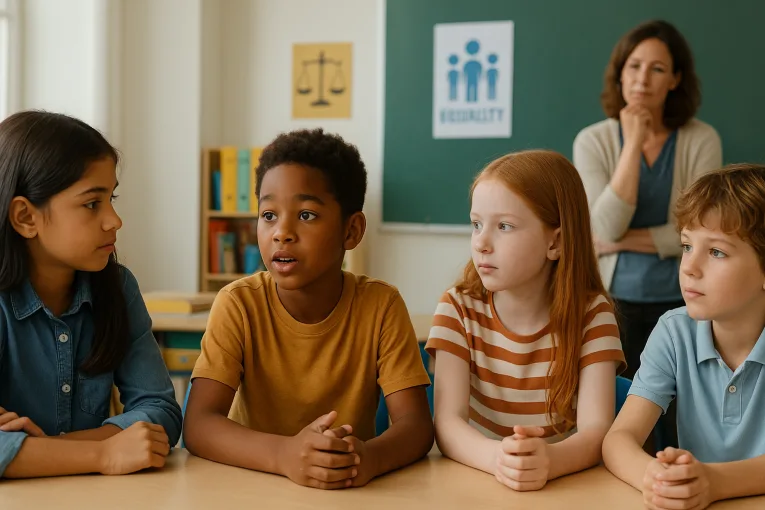
In a study led by psychologists Evan Apfelbaum and Nalini Ambady, the prevailing belief that colorblindness fosters racial equality was put to the test. Researchers showed mostly white fourth- and fifth-grade students in Boston one of two messages about racial equality. One group was encouraged to ignore racial differences and focus on how we are all the same. The other was urged to recognize and value diversity. The children were then asked to interpret racially charged incidents—such as a Black child being tripped during a soccer game because of his race.
The results were stark. Only half of the colorblind group saw the act as discriminatory. Nearly 80 percent of those taught to value diversity did. Teachers watching the students’ descriptions of these incidents rated the colorblind group as less credible, and they were less likely to intervene to protect the targeted child. The experiment revealed that colorblindness doesn’t level the playing field—it obscures it. It promotes racial inequality by leaving minority children to fend for themselves in environments where harms are unseen and unacknowledged.
This finding echoes a deeper constitutional and moral error embedded in modern colorblind ideology. The Equal Protection Clause of the Fourteenth Amendment promises equal protection under the law—not blindness to race. Yet in recent decades, conservative legal doctrine has recast the Constitution as demanding “race neutrality,” striking down affirmative action and diversity efforts as if they were equivalent to segregation.
But equal protection and colorblindness are not the same. As Robert McCloskey and Sanford Levinson remind us in The American Supreme Court, the Fourteenth Amendment was born out of the racial caste system of slavery and was expressly intended to remedy that legacy. Its authors were not imagining a future in which government would be forbidden from acknowledging race, but rather one in which it must act to undo the systemic subjugation of Black Americans.
Martin Luther King, Jr., himself understood this. “It is, however, important to understand that giving a man his due may often mean giving him special treatment,” he wrote. “A society that has done something special against the Negro for hundreds of years must now do something special for him, in order to equip him to compete on a just and equal basis.”
This is the moral logic of equal protection: not sameness, but fairness. Not ignoring race, but redressing the injustice historically and presently tied to it.
The doctrine of colorblindness elevates formal equality over substantive justice. It assumes that racial inequality can be overcome simply by ignoring race, as if centuries of discrimination will disappear if we stop talking about it. In practice, it prevents institutions from taking meaningful action to correct disparities that persist in education, housing, criminal justice, and health care.
Sociologist Eduardo Bonilla-Silva has labeled this ideology “racism without racists”—a veneer of neutrality that allows racial hierarchies to persist while denying their existence. When people say, “I don’t see color,” they may mean well, but they also make it harder to see discrimination, bias, and inequality. As the Apfelbaum-Ambady study shows, colorblindness blunts empathy, reduces intervention, and hides harm.
In contemporary politics, this false equivalence between race-conscious remedies and racial discrimination has reached the highest levels. In Students for Fair Admissions v. Harvard, the Supreme Court struck down affirmative action in college admissions, treating efforts to diversify campuses as constitutionally suspect. Chief Justice John Roberts famously declared, “The way to stop discrimination on the basis of race is to stop discriminating on the basis of race.”
But this tidy phrase ignores history, context, and impact. It confuses the tools of oppression with the tools of repair.
Reframing the conversation around equal protection rather than colorblindness would clarify what is at stake. It would reveal that affirmative action and similar policies are not exceptions to equality but expressions of it—ways to make the promise of equal protection real. It would ground public debate not in abstraction but in the lived reality of structural disadvantage.
To see race is not to be racist. To see race is to be capable of seeing racism. And to remedy racism, we must be willing to look it squarely in the face, name its harms, and take intentional steps to undo them. Pretending race doesn’t matter is not progress. It is a denial of reality.
Colorblindness also undermines multiracial solidarity by encouraging people to avoid difficult conversations about privilege, power, and identity. It casts race as a divisive topic rather than a social fact that must be understood and addressed. Research by sociologists like Karyn McKinney and Eileen O’Brien shows that white Americans who engage deeply with their own racial identity are more likely to support antiracist efforts than those who adhere to a colorblind approach. Far from fueling white grievance, this type of engagement can lead to greater empathy, accountability, and allyship.
Progressive political movements, too, must learn from these findings. Economic justice cannot substitute for racial justice. As scholars and activists have long argued, economic inequality and racial inequality are not interchangeable problems with a single solution. They are intertwined and mutually reinforcing. Focusing on class without acknowledging race flattens the problem and alienates those most harmed by structural racism.
This was the misstep of some populist progressive campaigns, which have evoked nostalgia for a mid-century economic order that, for many Black and Brown Americans, was defined not by prosperity but by exclusion. The golden age of the American middle class was also the age of redlining, exclusionary zoning, and Jim Crow. Policies that benefitted white families disproportionately did so by keeping others out. Any new vision of justice must grapple with that history.
Moreover, colorblindness does not prepare children for a diverse society. In the classroom, it fosters silence rather than engagement, confusion rather than clarity. The Apfelbaum-Ambady study confirms what educators and students of color have long known: when race is ignored, racism goes unchecked. Children who are taught to “not see race” become less equipped to recognize bias and less likely to act when they see it.
What would it mean to reject colorblindness and embrace color-conscious equity? It would mean supporting policies that are intentionally inclusive—in education, housing, employment, and healthcare. It would mean teaching honest histories of slavery, segregation, and resistance. It would mean examining how institutional practices continue to reproduce racial disparities. And it would mean creating systems of accountability to ensure that all people, regardless of race, are treated with dignity and fairness.
The goal is not to shame anyone for their identity, but to build a society where race no longer determines one’s outcomes. That requires vision, courage, and clarity. As Justice Harry Blackmun wrote in 1978, “In order to get beyond racism, we must first take account of race. There is no other way.”
The true spirit of the Fourteenth Amendment—and the only path to genuine racial equity—lies in seeing difference, acknowledging injustice, and acting to correct it. Colorblindness is not the answer. Justice requires vision.

There is so much “wrong” with that “experiment” that it’s hard to know where to begin.
You’re read it?
As described above (tried to add that, but your editing feature does not seem to be working correctly.)
I’ll repeat it, here:
“In a study led by psychologists Evan Apfelbaum and Nalini Ambady, the prevailing belief that colorblindness fosters racial equality was put to the test. Researchers showed mostly white fourth- and fifth-grade students in Boston one of two messages about racial equality. One group was encouraged to ignore racial differences and focus on how we are all the same. The other was urged to recognize and value diversity. The children were then asked to interpret racially charged incidents—such as a Black child being tripped during a soccer game because of his race.”
“The results were stark. Only half of the colorblind group saw the act as discriminatory. Nearly 80 percent of those taught to value diversity did. Teachers watching the students’ descriptions of these incidents rated the colorblind group as less credible and were less likely to intervene to protect the targeted child. The experiment revealed that colorblindness doesn’t level the playing field—it obscures it. It promotes racial inequality by leaving minority children to fend for themselves in environments where harms are unseen and unacknowledged.”
Should we begin to dissect this? Like I said, there’s so much wrong here (e.g., specifically stated assumptions) that it’s hard to know where to start. This is not a scientific experiment, as described.
Unless you have read the research itself AND have expertise in both research design and psychology, I don’t think you are qualified to offer summary judgments.
You’re the one who is presenting this – it’s not up to me to look up the study itself (and possibly pay for it) to analyze what you’re presenting as evidence.
I do have some education in research design. Granted, it was a long time ago – but you don’t even need an education to see the glaring flaws and assumptions, here. (The assumptions are presented as something your readers should just “accept”, without even thinking about it – or the ramifications, for example.)
Would you like to discuss any of them? Or do you feel that you’re not qualified to do so, either?
I’m not presenting new research here, this is some of the seminal work in the field that came out starting about 15 years ago.
So?
Again, would you like to discuss some of the assumptions/flaws I immediately noticed? Truth be told, any of your non-biased readers should be able to immediately recognize them, as well. For that matter, I suspect that you can also see them (but don’t seem to want to talk about it).
This is actually dangerous stuff to present as fact. It has negative ramifications if people start believing this type of thing. (Other than those already inclined toward bias – there isn’t much home for them in regard to objective analysis.)
So if you see everyone as equals and ignore their skin color as everyone has been told to do for a very long time now you’re acting like a racist? We’re being told that now as a society we have to give people of color special treatment?
Well, according to the “study”, the teachers were the ones who decided that (only) somewhere between 30-50% of the students (in the “colorblind”, “mostly white” group) were racist, while 50% were not. So that’s a good start at least, right?
Left unexplained is why 20% of those who were properly indoctrinated did not respond accordingly. I personally believe that more “lessons” are in order for that subgroup, though they may not be reachable. (Something along the lines of what happened in Clockwork Orange, perhaps.)
“I personally believe that more “lessons” are in order for that subgroup”
Like indoctrination camps…