
By Vanguard Staff
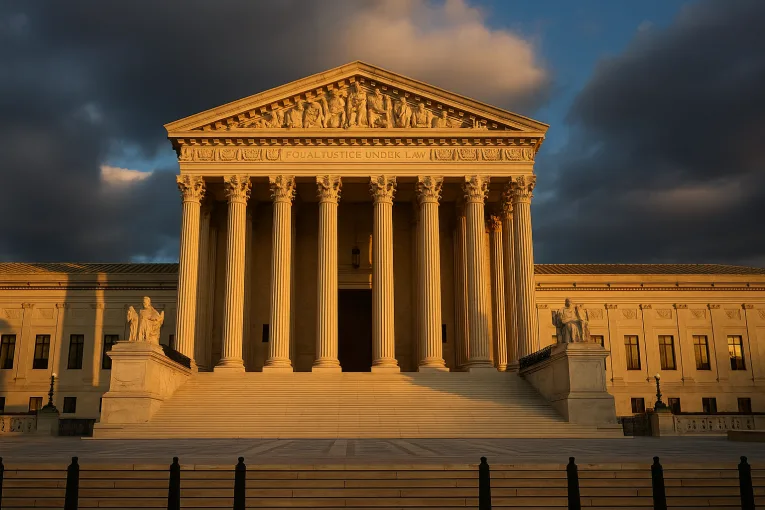
As Americans prepare to celebrate Independence Day, legal scholars and civil rights advocates are warning that a recent U.S. Supreme Court decision has imperiled the very constitutional protections the holiday is meant to honor. In a sharply worded op-ed published this week, Stanford Law Professor Mark Lemley argues that the Court’s June 23 ruling in Department of Homeland Security v. D.V.D. has effectively gutted due process protections and undermined the judiciary’s role as a check on executive power.
At the center of the controversy is a case involving the Trump administration’s expanded deportation practices, which have come under fire for forcibly transferring immigrants — and in some cases, potentially U.S. citizens — to countries with which they have no connection, including active war zones like Libya and South Sudan. Legal experts say the transfers violate federal statutes and constitutional guarantees of due process.
In D.V.D., both a district court and a unanimous federal appellate panel had issued orders barring the deportations. But the Supreme Court stepped in to stay those rulings in a 6–3 decision, allowing the deportations to proceed immediately. While a stay is typically used to pause a lower court’s decision pending further review, critics say this ruling functioned as an endorsement of the administration’s actions — with potentially lethal consequences for those affected.
“This ‘stay’ has exactly the opposite effect of preserving the status quo,” Lemley wrote. “It means that D.V.D. and thousands of others will be sent to war zones where they can be tortured and killed with impunity… without any due process.”
The Supreme Court’s majority offered no explanation for its decision, a practice that has become increasingly common on what legal observers call the Court’s “shadow docket” — a set of emergency orders and summary decisions issued without full briefing or oral argument. The lack of reasoning, Lemley argues, reflects a deeper abandonment of legal norms and accountability.
But the implications of the ruling extend beyond immigration enforcement. In a separate decision last month, the Court signaled that U.S. citizens could also be subject to wrongful deportation without effective judicial recourse, according to Lemley. While individuals may still challenge unlawful orders after the fact, the window for doing so is often measured in hours — and the Court has now narrowed the authority of lower courts to intervene proactively.
Civil liberties groups have expressed growing concern that the judiciary, long viewed as a backstop against unlawful executive action, is retreating from that role. The Trump administration has repeatedly signaled its intent to bypass or ignore laws it deems inconvenient, and the latest rulings suggest that the Court’s conservative majority may be willing to acquiesce.
“The Supreme Court just took much of [the courts’] power away,” Lemley wrote. “In the process, it made it clear that the court intends to side with the Trump administration — and illegality — rather than uphold the rule of law.”
The decision has drawn particular scrutiny due to the high stakes involved. Transfers to countries such as El Salvador — and specifically to facilities like the CECOT prison, where allegations of torture and inhumane conditions have been widely documented — raise serious human rights concerns. Earlier this year, the deportation of Kilmar Abrego Garcia, a Maryland resident, to El Salvador under similar circumstances triggered a federal lawsuit and national outrage after he reported beatings and psychological abuse.
Now, with the Court refusing to halt such practices, legal experts fear a chilling precedent is being set — one in which neither citizenship nor legal safeguards provide reliable protection.
Lemley warned that the moment represents a critical inflection point in American democracy. “There is a history in this country of Supreme Court justices — not all, but some — growing into the role, putting aside partisan preferences in order to uphold the broader principles of the law,” he wrote. “Those hopes have now been dashed.”
As the Court continues to decide major cases with little transparency or explanation, questions about judicial legitimacy and democratic erosion are taking center stage. For Lemley and others, the danger lies not only in the decisions themselves, but in the growing perception that the Court has abdicated its responsibility to safeguard constitutional rights.
“Whatever you call a government in which thugs roam the streets under cover of law and the court eggs them on just because it can — repressive, authoritarian, fascist — the one thing it isn’t is a constitutional democracy,” Lemley concluded.

Using the SCOTUS to decide these issues is what the Constitution is all about.
I think you miss Lemley’s point. You are framing the Court’s intervention – any intervention – as a good thing. But Lemley’s point is the opposite: he’s warning that these kinds of swift, unexplained decisions on what he calls “the shadow docket” are dangerous—they shift power away from lower courts, reduce transparency, and can have life-and-death implications. I think you need to engage on that point rather than blanketly assert as you did…
“they shift power away from lower courts”
So do we want lower courts making binding national rulings? We’ve seen what’s been happening when lower courts make their rulings according to their political bias.
Political bias doesn’t seem avoidable.
That’s why we have SCOTUS to overrule these types of rogue decrees. It’s how the Constitution works.
Thankfully we have 6 mostly sensible justices on SCOTUS.
If the left doesn’t like it win more elections. Remember what Obama famously said…
Unless I’m being duped here by the politics, I tend to agree that when the stakes are this high for those being deported — i.e. can’t get them back if the policy shifts or new evidence comes up — the default shouldn’t be deportation without due process.
You can’t give due process to everyone who came into the country without doing it legally.
Clinton didn’t, Obama didn’t and Biden didn’t do it either.
The numbers are too overwhelming.
From article: “Whatever you call a government in which thugs roam the streets under cover of law and the court eggs them on just because it can — repressive, authoritarian, fascist — the one thing it isn’t is a constitutional democracy,” Lemley concluded.”
Although not directed at a particular skin color, this type of comment is essentially “hate speech” toward a specific group of federal employees.
It wasn’t too long ago that these same type of people were “outraged” when DOGE/Musk fired a bunch of federal employees.
I guess it depends upon job title, in regard to whether or not we’re supposed to be outraged.
As for process, it sounds like they do have one. Now, whether or not it’s adequate is a different question.
The article states that Americans are at risk of being deported by the current administration – can anyone provide an example?
In regard to Independence Day, it’s NEVER been about encouraging illegal immigration. Where did that idea originate from?
America was formed as a result of a tax revolt.
“Although not directed at a particular skin color, this type of comment is essentially “hate speech” toward a specific group of federal employees.”
No. Hate speech is defined as being against a protected class. Law enforcement is not a protected class.
Well, they’re certainly not protected on the Vanguard.
People can try to define words in whatever manner they want. But when federal agents are labeled as “thugs”, that’s hate. And it encourages the types of riots we’ve seen recently.
Regarding America, it just occurred to me that it was formed as a result of the “Ultimate Proposition 13”. (Truth be told – when I learned about that in elementary school, I didn’t find it all that inspiring.)
And of course, the colonists were akin to illegal immigrants, themselves. (I don’t recall if there was active resistance at that time.) Same thing with Spain, Mexico, France, Russia – all claiming parts of what is now the U.S. (Not to mention tribes taking territory from each other.)
“People can try to define words in whatever manner they want”
That’s why the law has specifically defined definitions.It’s also important to note that hate speech in the US is generally protected under the First Amendment, however overt acts can lead it to becoming a hate crime.
You’re stating that the term “hate speech” has a legal copyright attached to it?
Or is it more like “white supremacy”, “racism”, etc. – which no longer have much meaning?
But more important than the terminology is the fact that this type of speech encourages hatred. It should be denounced, rather than featured as a legitimate point of view in an article.
Last time I checked, it wasn’t particularly helpful to label federal agents as “thugs”. Nor is it helpful to suggest that the Supreme Court is enabling thugs “just because it can”, per the quote. The author (a Stanford professor, in this case) should know better than to state that.
There isn’t much mystery regarding the reason that Trump has been cutting funding to universities. In fact, I’d suggest that professors like this one are encouraging hatred toward their own institutions.
Professors are the only employees allowed to spout off whenever they want.
” . . . however overt acts can lead it to becoming a hate crime.”
Hate speech doesn’t subsequently “become” a crime based upon separate/subsequent overt acts. The speech is either protected, or it’s not at the moment it’s put forth.
Crime itself doesn’t work that way – legality doesn’t depend on what happens “afterward” (e.g., legal one minute, illegal the next minute).
If it did work as you claim, I suspect that someone like the local anti-trans activist would be charged with a crime (e.g., in regard to the bomb threats at the local school). And last time I checked, the only legal action involving her was the one in which she took legal action against the library. Even Facebook itself apparently found that she didn’t violate any of its policies, since her account has been restored.
“But more important than the terminology is the fact that this type of speech encourages hatred. It should be denounced”
Ron, like calling ICE the gestapo?