
- “You are disrupting this meeting.” – Hiram Jackson
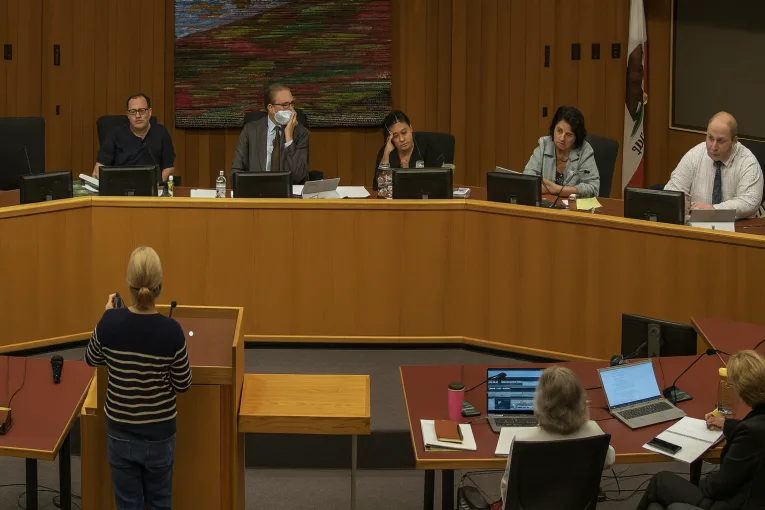
Twice on Thursday evening the Davis Joint Unified School Board was forced to recess its meeting after anti-trans activist Beth Bourne began disrobing during public comment.
Bourne, identifying herself as a parent in the district, approached the podium and began speaking on school policies regarding locker rooms at the junior high schools. “Parent in the Davis Unified School District, and I’m here today to talk about the policies you have for the locker rooms in the junior high schools. So Emerson, Holmes Harper Junior High. Right now we require our students to undress for PE class. So I’m just going to give you an idea what that looks like when I undress,” she said, before beginning to remove her clothing.
She continued, “So right now, this school district is saying that, depending on a child’s transgender identity, that they can pick which bathroom they want. So we have, right now at this school district, we have children self-identifying into different bathrooms just based off of their, no, you cannot. I have my bathing suit on. Excuse me.”
School Board Vice President Hiram Jackson, who was chairing the meeting in absence of President Joe DiNunzio, interrupted. “This is not allowed. We’re going to recess,” he said.
Bourne pushed back. “I’ve got to finish my comments. You are violating my first amendment right?” She then added, “I am putting on my (top).”
Jackson responded, “You are disrupting this meeting,” before the meeting was recessed for roughly five minutes.
When the meeting reconvened, Jackson warned Bourne. “You’re welcome to finish your public comment. If you disrupt the meeting again, I will gavel it in recess and you’ll be asked to leave.”
Bourne asked, “May I ask what I did to disrupt the meeting?”
Jackson replied, “You can start your public comment.”
Bourne pressed further. “Am I allowed to wear my bathing suit? I’m not sure if that’s why I disrupted.”
“Go ahead and start the time, Monica,” Jackson said.
Bourne attempted to continue. Hiram stated, “Oh, okay. So right now in our schools … this meeting is in recess.” “I’ve started,” and she began to disrobe again. She exclaimed, “This is a bathing suit top. You can’t wear a bathing suit?”
At that point, Jackson again recessed the meeting.
Trustee Cecilia Escamilla-Greenwald, reflecting on the incident in an interview, said, “I saw a woman stripping down at public comment. Her name is Beth Bourne, and she claims that she had a swimsuit on, but how are we to know? And even if it’s just a swimsuit, still, it is not appropriate for members of the public to strip down in a public comment to make their point. We had to ask a few times to not do that.
“Our vice president Hiram Jackson, who was running the meeting, asked her and she didn’t stop. And we paused the meeting once we came back and told her she could make her comment and she did it again. So we had to pause the meeting again and the police were called.”
Escamilla-Greenwald added, “We were in a separate room, but it’s my understanding that the police escorted her back into chambers to gather her possessions and then asked her to leave. It’s my understanding that they did not arrest her, but they warned her and asked her to leave.”
When asked about possible next steps, Escamilla-Greenwald explained, “That I don’t know. We are going to be meeting about this, about what to do in such situations and we’re going to, I know that our superintendent is going to be speaking with counsel to see what can be done because it’s very inappropriate for anybody to be coming before the board and behaving in such a manner. It’s very inappropriate.
“She could have made her statement without stripping down. (Certainly) not doing it twice. She was asked by Trustee Hiram Jackson to not do that, and we stopped the meeting and then we came back and we thought she would comply, but she did not.”
She concluded, “So we need to be advised by our legal counsel or what to do in such situations. It’s very disruptive to the meeting. We have business to conduct and it’s very disruptive to us and to the public.”

I remember a guy dressed in plastic bags that addressed the council.
Just saying…
So what are the dress code rules in place in order to attend or comment at DJUSD school board meetings?
Beth said she was wearing a bathing suit so are bathing suits not allowed in the published dress code rules?
(edited)
Some of the comments in this article have been deleted, so this reply is specifically directed at one of the points Keith made in one of the missing comments.
There really are two issues in play. One, disrobing in public, is neither speech nor protected. The other, making public comment, is indeed speech, and as such is protected.
The School Board took exception to the process of disrobing. They asked Beth to stop, but she chose not to do so, and the School Board responded. As best as I can tell, they never took exception to what Beth was saying, just the delivery method she was using.
Keith also made the point that respect for free speech was just as bad in the Biden Administration. Whether or not that is true, I have to ask Keith, “Do two wrongs make a right?”
With that said/asked, there are two significant differences between the curtailment(s) of free speech during the Biden years and the current curtailment(s). Specifically, the Biden Years curtailment(s) were created by citizens expressing their own speech, and the collective power of those voices was sufficient to bring about change. The current curtailments(s) are happening by unilateral authoritarian governmental action. One is bottom up. The other is top down.
Appreciate you covering this incident last night, David.
Could you tell me how my behavior was disruptive per GOV § 54957.95? What was my behavior during the school board meeting “that actually disrupts, disturbs, impedes, or renders infeasible the orderly conduct of the meeting”?
California Code, Government Code – GOV § 54957.95
Current as of January 01, 2024 | Updated by FindLaw Staff
(a)(1) In addition to authority exercised pursuant to Sections 54954.3 and 54957.9, the presiding member of the legislative body conducting a meeting or their designee may remove, or cause the removal of, an individual for disrupting the meeting.
(2) Prior to removing an individual, the presiding member or their designee shall warn the individual that their behavior is disrupting the meeting and that their failure to cease their behavior may result in their removal. The presiding member or their designee may then remove the individual if they do not promptly cease their disruptive behavior. This paragraph does not apply to any behavior described in subparagraph (B) of paragraph (1) of subdivision (b).
(b) As used in this section:
(1) “Disrupting” means engaging in behavior during a meeting of a legislative body that actually disrupts, disturbs, impedes, or renders infeasible the orderly conduct of the meeting and includes, but is not limited to, one of the following:
(A) A failure to comply with reasonable and lawful regulations adopted by a legislative body pursuant to Section 54954.3 or any other law.
(B) Engaging in behavior that constitutes use of force or a true threat of force.
(2) “True threat of force” means a threat that has sufficient indicia of intent and seriousness, that a reasonable observer would perceive it to be an actual threat to use force by the person making the threat.
Here is the code:
California Code, Government Code – GOV § 54957.95
Current as of January 01, 2024 | Updated by FindLaw Staff (a)(1) In addition to authority exercised pursuant to Sections 54954.3 and 54957.9, the presiding member of the legislative body conducting a meeting or their designee may remove, or cause the removal of, an individual for disrupting the meeting. (2) Prior to removing an individual, the presiding member or their designee shall warn the individual that their behavior is disrupting the meeting and that their failure to cease their behavior may result in their removal. The presiding member or their designee may then remove the individual if they do not promptly cease their disruptive behavior. This paragraph does not apply to any behavior described in subparagraph (B) of paragraph (1) of subdivision (b). (b) As used in this section: (1) “Disrupting” means engaging in behavior during a meeting of a legislative body that actually disrupts, disturbs, impedes, or renders infeasible the orderly conduct of the meeting and includes, but is not limited to, one of the following:
(A) A failure to comply with reasonable and lawful regulations adopted by a legislative body pursuant to Section 54954.3 or any other law.
(B) Engaging in behavior that constitutes use of force or a true threat of force.
(2) “True threat of force” means a threat that has sufficient indicia of intent and seriousness, that a reasonable observer would perceive it to be an actual threat to use force by the person making the threat.
I would say B1 is closest, granted it is a subjective standard. Also, it is not for me to opine. But that’s my immediate take.
What would have happened if they had just let me finish my 3 minutes of public comment?
In no way did I do anything that “impedes, or renders infeasible the orderly conduct of the meeting”
You should have kept your clothes on the second time.
Beth, having a nude woman standing in the middle of the meeting room would be disruptive. Imagine you were having a party at your house and one of the guests starts to disrobe in the middle of the room where all your guests are. Would you find that disruptive to your party and/or party planning?
In addition, as the hostess would you be at all concerned about what your guests would be thinking as the person is in the process of disrobing? Especially if many of your guests don’t know the disrober.
A public commenter is not a guest. It is the principal.
I had the same problem when I was the Chair of the Utilities Commission, and a member of the public became disruptive. The Commission agreed between us that the next time a member of the public became disruptive, we would adjourn the meeting until such time as the person left. This essentially deprives the disruptive person of an audience. The only problem with that solution that I can see is if Bourne ends up closing down the meeting because she refuses to leave. At that point, the police can be called to have her removed for disrupting a meeting. Just a thought.
“The Commission agreed between us that the next time a member of the public became disruptive, we would adjourn the meeting until such time as the person left.”
So is disrobing down to one’s bathing suit in order to prove a point considered disrupting? Or can removing that person be considered denying their free speech and expression rights? As David stated, it’s subjective and I agree.
I find it funny that were having this conversation on the Vanguard the same day we’re discussing protecting free speech rights in another article.
I’m gathering that the underlying point is that if makes the board uncomfortable, it likely makes students uncomfortable to be in the presence of someone undressing if they’re of the opposite sex. (And that this is exactly what school boards/districts are enabling, these days.)
In that sense, I’d say that there’s an underlying purpose regarding Beth’s actions – other than to disrupt.
Reminds me of the parents who read (out loud) the contents of some books that are assigned to, or otherwise available to kids in school. At which point, those parents are shut down, as well.
(Same type of underlying point.)
Ron, very good points.
Links to the code with proper indentation:
https://leginfo.legislature.ca.gov/faces/codes_displaySection.xhtml?lawCode=GOV§ionNum=54957.95.
https://leginfo.legislature.ca.gov/faces/codes_displaySection.xhtml?lawCode=GOV§ionNum=54954.3.
The apparent meaning of the law is that each public member of interest shall have their opportunity to state their view before a decision is made. And the meeting host can warn and then remove someone disrupting the public comment session. A warning is not needed if the disruptor is posing a true threat of force.
The point of the law was not that the meeting host can preempt someone speaking a public comment based on their behavior, but to ENSURE that a person using the public comment time is not being interrupted. In this case the presiding members have no grounds to say that the public comment is the person disrupting then remove them from commenting. You can’t accuse a commenter for disrupting their own commenting slot.
Even if this interpretation is not what the law actually means. Does this interpretation make ethical sense, that this is what the law SHOULD mean.
If you can interpret a piece of law in two ways, one that is not subjective and serves a purpose to protect individual rights, and one that is subjective and would allow a government abuse to suppress individual rights. Which interpretation is the correct one?
——–
Another ethics issue not yet mentioned, is that regardless of the manner of how a commenter expresses a complaint, the underlying complaint still needs to be logged and processed. If a comment artefact needs a lot of process to santize or understand, it might increase the processing time, but it is still being processed with a case or tracking number. For each complaint there should be a case number so that the public can see who is trying to process it and how is trying to stop it from being processed. If a government agency does not have means to make such case tracking and uses behavior/manner as a mean to disqualify complaints, then the fault would heavily rest on the government for depriving citizen the path to grievance. Such government behavior is anti-democracy.
——–
This type of conflict would not happen if the organization already has some kind of school choice. The lack of it and the lack of willingness to make progress when the concept is already known is another anti-democratic behavior.
Edgar says: “You can’t accuse a commenter for disrupting their own commenting slot.”
Well-said.
There’s a guy who apparently has a donkey costume – something like that (and sings at council meetings during his own public comment period) who would probably agree with that. (To be clear, I haven’t actually seen the donkey costume, myself.)
Edgar says: “If a government agency does not have means to make such case tracking and uses behavior/manner as a mean to disqualify complaints, then the fault would heavily rest on the government for depriving citizen the path to grievance. Such government behavior is anti-democracy.”
Also a good point.
Actually you can.
Well, you can’t say that they’re interrupting themselves, at least. I suppose that a case for indecent exposure could be made if someone appeared totally naked at a school board meeting, and that there’s probably other reasons they could be shut down, as well.
My guess is that Beth’s actions didn’t legally warrant a shut down, especially since she claimed to have a bathing suit on underneath.
More importantly, have you seen the donkey costume in question? Or am I imagining that?
I do recall some kind of costume outside of a Vanguard event, at least.
Also, what are the requirements for someone to actually have some ability to sing, before actually doing so during public comment? :-)
RO say, “Also, what are the requirements for someone to actually have some ability to sing, before actually doing so during public comment? :-)”
Let the Donkey sing!
There are numerous videos online of people singing in various government forums who, unlike me, cannot hold a tune. You can thank my training with the UC Davis Chorus in the 1980s for this plus my natural abilities and my humbleness :-|
I have spoken about the Donkey-Headed Adversary of Humanity at Council meetings, so perhaps that is your confusion. This is an entity summoned by the communal anger of the world’s beasts and plants to rise up and take revenge on the plague of mankind destroying the Earth.
I do not have a donkey costume, nor have I seen one at a Council meeting. Doesn’t mean there isn’t one. There was a developer who brought a costume frog once. I would think obscuring one’s identity while speaking would be a concern for security reasons. I was surprised the frog was allowed. I would be very disturbed if I arrived at a meeting and the audience was all anonymous — if in KKK hoods or heads wrapped in keffiyehs and cheap sunglasses it matters not. But I’m very glad I can’t disrupt my own comment, as I do that all the time.
The more anti democratic the society, the more the government “can” do that the citizens “can’t”.
Conceptually public comment session only needs the uncensored channeled with a viewer discretion advised notice. If there is a demand for a G-rated comment sessions, that session would exist without removing the R-rated session because a lot of time people in power to make decision is detached from how things work so you have to show them the truth to dispel their fantasy. If a decision maker cannot handle the truth of what their decision means, they should not recluse themselves from the decision and let someone not offended but the truth to review.
David, do you think this Texas father was disruptive when he disrobed to his swim trunks to make the point kids should wear masks at school? Do you think the board should have interrupted his comment and recessed when he took off his shirt?
https://www.youtube.com/watch?v=ynudt9tCwKQ
“A Texas father stripped out of his suit and down to his underwear during a Dripping Springs Independent School District Board meeting on Monday, in a creative attempt to argue for mandatory masking at his child’s high school.
James Ackers used his speech to sarcastically highlight the many rules that allow humans to function in society — rules that keep everyone safe, so long as each individual stick to them.”
“I’ve got to finish my comments. You are violating my first amendment right?”
The answer is no. City council meetings are considered limited public forums.
These type of public forums are allowed to set their own rules for decorum. People who are being distributive can be removed, even if those disruptions are related to free speech or protest.
This has been completely settled in Supreme Court case Cox v. Louisiana (1965). Tinker v. Des Moines (1969) deals with people being disruptive in public schools, but has been applied to similar cases as these.
In other words, keep your clothes on and wait for your turn to speak.