
Key points:
- Trump administration weakens Fair Housing Act enforcement, facing criticism from whistleblowers and civil rights advocates.
- Internal documents reveal coordinated effort to halt or curtail discrimination cases within HUD.
- HUD officials claim the department has handled over 4,100 cases since Trump took office.
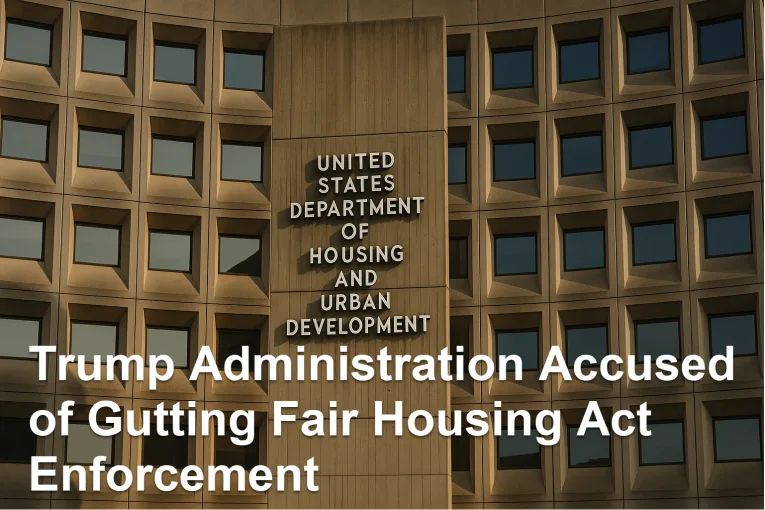
The Trump administration is facing criticism from whistleblowers and civil rights advocates who say it has drastically weakened enforcement of the Fair Housing Act, the landmark civil rights law that has prohibited housing discrimination for nearly six decades.
Internal documents, memos, and dozens of interviews reviewed by The New York Times reveal a coordinated effort inside the Department of Housing and Urban Development (HUD) to halt or curtail discrimination cases, reassign experienced lawyers, and impose new restrictions on the office responsible for enforcing fair housing protections.
Whistleblowers in HUD’s Office of Fair Housing and Equal Opportunity describe intimidation, gag orders, and sudden freezes on pending cases.
In one email, a Trump appointee described decades of housing discrimination cases as “artificial, arbitrary and unnecessary.”
Another memo directed staff to remove archival documents “contrary to administration policy” and announced that “tenuous theories of discrimination” would no longer be pursued.
Career staff say the changes amount to an abandonment of the government’s responsibility to enforce civil rights in housing.
“If you’re not enforcing the Fair Housing Act, then it’s just another dead law,” said Palmer Heenan, a longtime fair housing lawyer who has been told he will be reassigned next month without explanation. Heenan’s comments reflect the frustration of many career lawyers who say their work has been effectively shut down.
The scale of the cuts is dramatic.
Federal offices hit by the Trump administration’s Department of Government Efficiency typically lost about 10 percent of staff.
Within the Office of Fair Housing, the reduction was 65 percent. There were 31 employees in January; once the latest transfers are complete, there will be just 11. Before the reductions, the office had 22 lawyers handling about 2,000 new complaints a year. By October 5, only six lawyers will remain, according to several staff members who have received reassignment notices.
“I never thought I would be in this position,” said Paul Osadebe, another HUD fair housing lawyer. “We have people who are trying to destroy a baseline that people relied on.”
Osadebe, who is also active in the Federal Unionists Network, said the cuts have particularly affected enforcement of the Violence Against Women Act, which provides housing protections for survivors of domestic violence. About 500 women reach out to HUD each year under the law, but only two of the remaining lawyers have experience handling those cases.
“These are life and death requests,” he said. “These women are legitimately in mortal danger, and often without the government stepping in, nothing will be done.”
Whistleblowers describe how, during Trump’s first week in office, HUD leadership sent a stop-work order instructing fair housing employees to “cease and desist all work activities associated with environmental justice, diversity, equity, and inclusion.”
Many of their cases, they say, were reclassified as ideologically driven or “not a priority of the administration.”
The consequences were immediate, in each of the last five years, the office had collected between $4 million and $8 million in settlements for Americans who accused housing providers of discrimination. Between January and July, the office approved less than $200,000, according to Jacy Gaige, the office’s director of enforcement until she resigned in July.
“With one email, the entire process was shut down,” Gaige said. “It essentially stopped the settlement process, which is time sensitive because complainants and respondents come to an agreement about what they want to do to resolve a case. And often that is driven by specific deadlines that are occurring in people’s lives.”
Gaige wrote to Senator Elizabeth Warren before her resignation, warning that the nation’s fair housing laws were no longer being enforced. Warren has since asked HUD’s acting inspector general to open an investigation, calling the allegations evidence of “dire consequences.”
Charges of discrimination have also plummeted.
On average, HUD issues about 35 charges of discrimination annually. Since Trump took office, the office has issued just four.
Hundreds of pending cases have been frozen or dropped, including a Texas case where a homeowners’ association was accused of banning Black residents from using housing vouchers. That case had been referred to the Justice Department but was abruptly withdrawn by Trump appointees. “
The sudden abandonment of the case was a pretty significant about-face,” said Rebecca Livengood, a lawyer who represented the housing authority that sued. “There’s every reason to think that in another administration, what were, at that point, sustained allegations of widespread racial discrimination would have been pursued.”
The internal changes have stripped career officials of authority to approve settlements or bring charges. That power now rests with a small group of Trump appointees. Gaige, who worked at HUD for 13 years, said no prior administration — not even Trump’s first term — had monopolized the process so completely.
“It essentially stopped the settlement process,” she said, adding that time-sensitive agreements between complainants and respondents were derailed.
HUD officials reject the characterization that enforcement has been gutted. “It is patently false to suggest the department is looking to blunt enforcement of the Fair Housing Act,” said Kasey Lovett, a HUD spokeswoman.
She said the office “is using its authority to uphold the law, protect the vulnerable, and ensure meaningful access to housing.” Lovett argued that the Biden administration left behind a “deeply inefficient case system” and noted that HUD has handled more than 4,100 cases since Trump returned to office, on par with previous years. She did not address how many of those cases were investigated or led to legal action.
Staff say the official numbers mask a collapse in meaningful enforcement. Lawyers report being blocked from speaking with complainants without approval, barred from citing past civil rights cases in legal research, and warned not to pursue appraisal bias, zoning restrictions that block minority families, or gender-based housing discrimination — areas that had been central to the office’s work for decades. In memos, John Gibbs, the Trump-appointed principal deputy assistant secretary for fair housing, wrote that such cases involved “tenuous theories of discrimination” that would no longer be prioritized.
Some staff who objected were fired.
Erik Heins, a lawyer in charge of enforcement, warned in emails that staff cuts would “cripple HUD’s ability to enforce its civil rights protections.” He was dismissed six days later. “My staff was being retaliated against for being civil rights practitioners,” Heins said.
HUD managers told others who resisted reassignment that they would be “subject to removal,” according to memos reviewed by The Times.
On Monday, five HUD lawyers, including Osadebe and Heenan, filed a federal lawsuit alleging that they had been “unlawfully targeted by HUD leadership and forced to leave” their positions “against their will.” They are seeking an injunction to block the reassignments. Four other staff members have also shared documents with Senator Warren supporting their allegations.
Civil rights advocates warn the consequences will be severe. Fair housing cases have long addressed discrimination against families with children, religious minorities, disabled veterans, and survivors of domestic violence. The rollback, they argue, leaves vulnerable populations with little recourse.
“We took an oath to defend the constitution,” Osadebe said. “These are the moments we took that oath for.”
Follow the Vanguard on Social Media – X, Instagram and Facebook. Subscribe the Vanguard News letters. To make a tax-deductible donation, please visit davisvanguard.org/donate or give directly through ActBlue. Your support will ensure that the vital work of the Vanguard continues.
