
By Vanguard Staff
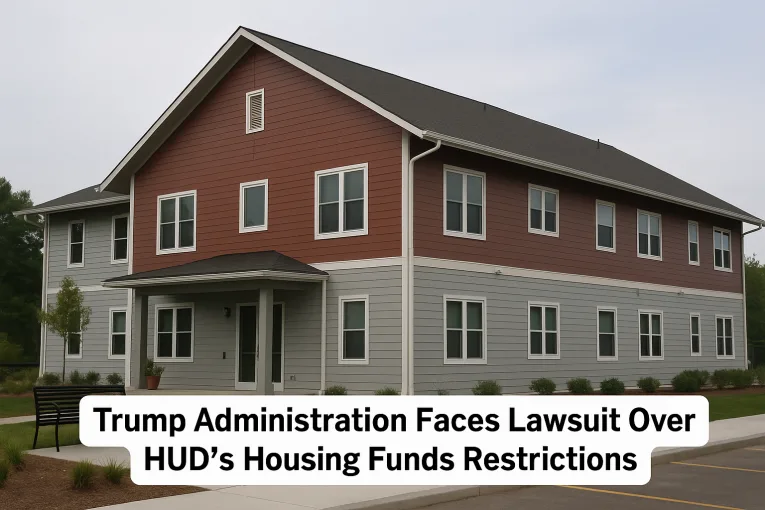
PROVIDENCE, R.I. — Two housing advocacy groups have filed a sweeping federal lawsuit accusing the U.S. Department of Housing and Urban Development of unlawfully hijacking $75 million in permanent supportive housing funds to advance the Trump administration’s social agenda.
The National Alliance to End Homelessness, a Washington-based nonprofit, and the Women’s Development Corporation of Rhode Island filed the 33-page complaint on Sept. 11 in the U.S. District Court for the District of Rhode Island. They are seeking declaratory and injunctive relief to stop HUD from carrying out what they describe as an unlawful and rushed award process.
The lawsuit argues that HUD was prepared to award the funds to qualified projects, having already reviewed applications and even notified members of Congress about which projects were selected. Days before the money was set to expire, however, HUD issued a new notice of funding opportunity with dramatically different criteria. The complaint says the change came with only a one-week application deadline and imposed “an ideological threshold” on applicants.
According to the filing, the new notice “disqualifies from consideration any entity seeking to build housing in a jurisdiction with policies the Administration disfavors.” That includes states and cities that have not adopted Trump administration positions on homelessness, immigration enforcement, and drug policy. The lawsuit alleges that the agency has gone even further by requiring applicants to renounce harm reduction practices such as safe consumption sites, and to affirm the administration’s stance that “sex is binary and immutable.”
The complaint said, “HUD does not have authority to do this—and the Constitutional does not permit it. In our constitutional system, Congress controls the purse strings and decides what funding to provide, for what purposes, and under what criteria. And states and localities decide what policies to adopt and implement in their own local jurisdictions. HUD has transgressed both these bounds.”
The plaintiffs said HUD’s new rules not only intrude on state and local powers but also violate federal statutes, the Administrative Procedure Act, the Spending Clause, the Tenth Amendment, and the First Amendment. The lawsuit contends the new requirements amount to “coercing” states and localities to abandon their own policies in order to secure federal funds.
The groups point to a series of executive orders issued earlier this year by President Trump, which directed agencies to withhold or condition funding from jurisdictions deemed uncooperative on immigration enforcement or insufficiently punitive toward people experiencing homelessness. HUD’s new criteria, the complaint argues, are a direct extension of those orders.
The filing details how the administration’s approach frames homelessness as a criminal issue rather than a social challenge, penalizes jurisdictions with sanctuary policies, and cuts off funding for organizations that provide gender-affirming services or harm reduction programs. The lawsuit alleges these conditions are unrelated to the purpose of the funding Congress appropriated and instead serve to enforce the administration’s political ideology.
The National Alliance to End Homelessness, which represents a broad coalition of providers, government entities, and advocates, said many of its members have been rendered ineligible either because of where they operate or because they refuse to abandon inclusive policies. The Women’s Development Corporation, a nonprofit that develops affordable housing in Rhode Island, was specifically identified. HUD had notified Congress earlier this year that WDC was selected for an award under a prior notice of funding opportunity, but under the September 5 notice, the group is now excluded because Rhode Island is listed among jurisdictions deemed noncompliant on immigration and sex offender registry enforcement.
The complaint describes the timeline as unworkable. Applications were due September 12, just one week after the notice was published, and HUD intends to distribute the funds to the first eight applicants who pass its new “threshold” and “merit” criteria. Plaintiffs argue that such a process leaves virtually no opportunity to redesign projects, secure local approvals, or line up funding partners, especially since the new criteria also narrow eligibility to projects focused on medical respite for elderly and disabled individuals.
The groups also argue that the new “sex binary” requirement directly conflicts with federal civil rights law, including the Fair Housing Act and Title VII, as well as HUD’s own regulations that guarantee access to housing and services based on gender identity. They say HUD’s conditions unlawfully target applicants based on viewpoint and suppress speech outside the scope of federally funded programs.
The plaintiffs warn that unless the court intervenes, they and their members will be irreparably harmed because the funds will be obligated to others by September 15, effectively shutting them out of competition. They are asking the court to block HUD from enforcing the new criteria, preserve the $75 million beyond its expiration date, and allow the funds to be awarded under lawful conditions.
The complaint notes the broader stakes, arguing that the administration is leveraging homelessness funding to reshape local policy nationwide. It says the criteria amount to a blacklist of jurisdictions — including California, New York, Rhode Island, and dozens of other states — and a loyalty test for nonprofits that operate programs serving unhoused people.
The case is being led by attorneys from Democracy Forward Foundation, the National Homelessness Law Center, the ACLU of Rhode Island, and cooperating local counsel. They contend the new HUD process is “shockingly unlawful” and must be halted before it causes further harm to providers and the communities they serve.
Follow the Vanguard on Social Media – X, Instagram and Facebook. Subscribe the Vanguard News letters. To make a tax-deductible donation, please visit davisvanguard.org/donate or give directly through ActBlue. Your support will ensure that the vital work of the Vanguard continues.
