
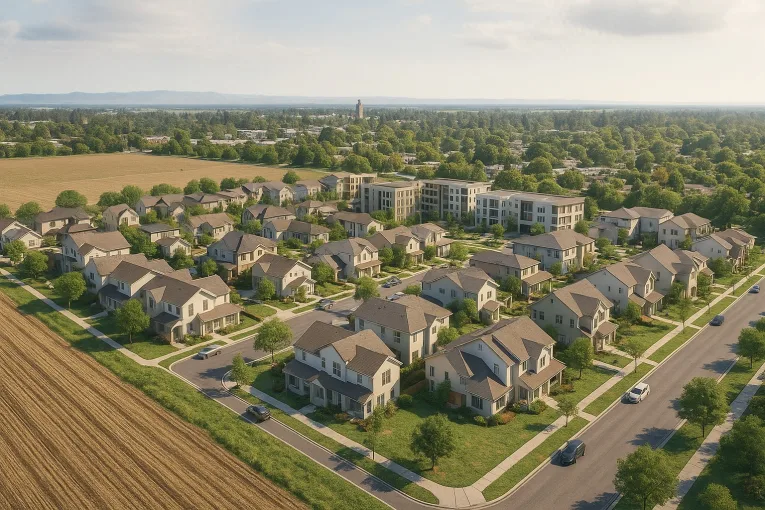
- Davis city commissions hold joint meeting to review Measure J/R/D amendments.
- State agencies are closely monitoring Davis’ compliance with housing mandates.
DAVIS — A rare joint meeting of five city commissions Wednesday night could set the stage for significant changes to Measure J/R/D, the voter-approved ordinance that has defined the city’s growth policies for a quarter century.
The Climate and Environmental Justice, Fiscal, Open Space and Habitat, Planning, and Social Services commissions will gather in the Community Chambers for what staff is calling “Commissionapalooza.”
The session will allow the commissions to jointly review possible amendments to Measure J/R/D and provide feedback to the City Council.
Measure J, originally approved by voters in 2000 and later renewed and amended as Measures R and D, requires voter approval before agricultural or open space land can be converted to urban uses. For over two decades, it has served as the city’s most powerful growth control measure.
Community Development Director Sherri Metzker explained in her report that the commissions will be asked to evaluate potential exemptions to Measure J/R/D’s public vote requirements. These exemptions could apply if a development project meets certain thresholds, such as providing substantial affordable housing, significant environmental mitigation, or community benefits that go beyond standard requirements.
Among the proposals to be considered are affordable housing provisions that would exempt a project from a Measure J vote if it dedicates at least half of its units as affordable housing, spread across income categories.
Another concept would allow exemptions for projects that achieve carbon neutrality, construct or connect to microgrids, or provide farmland mitigation above the existing ordinance. Community benefits, such as constructing shelters for extreme weather events, building renewable energy facilities, or financing city infrastructure, could also qualify.
In addition, commissioners will discuss the idea of creating an urban limit line, a planning tool that would establish boundaries beyond which the city cannot expand. This could be tied to the Measure J amendment as part of a broader General Plan update.
The timing is critical. The Davis Housing Element, approved in 2021, includes a program directing the city to amend Measure J to better support affordable housing. That amendment was originally slated for the November 2024 ballot but has been delayed. Now, the earliest opportunity would be June 2026. To make that deadline, the City Council would need to have drafted ballot language by January.
The city also faces new pressure from state agencies.
In August, Chelsea Lee of the Sacramento Area Council of Governments (SACOG) notified Davis officials that the California Department of Housing and Community Development (HCD) would soon begin reviewing jurisdictions for compliance with their Housing Elements. HCD’s oversight focuses on whether cities are removing barriers to housing development, including zoning constraints.
Lee wrote that HCD “prioritizes programs related to statutory rezones, significant zoning changes that accommodate large portions of the RHNA, such as through a Specific Plan or Downtown revitalization, AFFH, and zoning amendments that remove government constraints.”
She cautioned that incomplete progress on key housing programs could draw enforcement.
Days later, Fidel Herrera of HCD followed up with a letter formally notifying the city that the agency will be reviewing its Housing Element implementation.
Herrera emphasized that HCD “is proactively monitoring, reviewing and engaging with jurisdictions on the implementation of the housing element.”
He noted that under Government Code section 65585, the department can review “any action or inaction taken in relationship to the adopted housing element.”
Both communications underscore that the state is closely watching Davis’ compliance and is concerned about barriers posed by Measure J/R/D. HCD raised similar concerns during the city’s Housing Element approval process, pointing to the ordinance’s history of few successful outcomes in delivering affordable housing.
The staff report acknowledges that, while Davis has historically been able to meet its fair-share housing requirements within city limits, opportunities for doing so are now limited. Most vacant parcels are gone, and new state rules have narrowed the types of sites that qualify for the Housing Element.
As a result, future housing applications are more likely to require voter approval under Measure J/R/D, creating a potential clash between state housing mandates and local growth control.
The costs of placing an amendment on the ballot also weigh on the city’s decision-making. A standalone special election in 2025 would have cost Davis an estimated $380,000, compared to $116,747 for the November 2024 general election, when expenses were shared among multiple jurisdictions. The financial implications add urgency to placing any proposed amendment on a regularly scheduled election.
Ultimately, any changes to Measure J/R/D will require voter approval. The commission feedback gathered Wednesday will help shape the council’s decisions as it drafts potential ballot language.
For now, the joint meeting represents one of the most consequential steps yet in determining whether Davis will keep its longstanding growth control measure intact or adapt it to meet the state’s escalating housing requirements.
Follow the Vanguard on Social Media – X, Instagram and Facebook. Subscribe the Vanguard News letters. To make a tax-deductible donation, please visit davisvanguard.org/donate or give directly through ActBlue. Your support will ensure that the vital work of the Vanguard continues.

“In addition, commissioners will discuss the idea of creating an urban limit line, a planning tool that would establish boundaries beyond which the city cannot expand.”
LOL, until the city asks to reshape those boundaries with another “amendment”.
Another thing, if the state is going to demand that Davis keeps building how can there possibly be an urban limit line?
Once that line is reached and the state demands more housing doesn’t it stand to reason that the boundaries have to shift?
I hope voters don’t fall for this.
“Another thing, if the state is going to demand that Davis keeps building how can there possibly be an urban limit line?”
Someone described an urban limit line as more of a “goalpost” than a limitation. (A movable goalpost, at that.)
In some ways, I hope they put something on a ballot at the same time as one of these Measure J proposals. (Probably easier and more fun to kill two birds with one stone.)
Whatever they come up with (if anything) is going to have obvious weaknesses that will likely ensure its failure at the ballot box.
I don’t normally provide campaign advice, but the “best bet” for those trying to eliminate Measure J is to scare voters into dismantling it. In other words, convince voters to shoot themselves in the head, before the bad guy does so.
“Whatever they come up with (if anything) is going to have obvious weaknesses that will likely ensure its failure at the ballot box.”
Exactly, one can already see the cracks. Any “Save Measure J” political committee will have plenty of fodder.
One other alternative (since none of these people are actually developers) is to make the requirements to bypass Measure J “so strict” that it’s never actually attempted, regardless. In other words, never actually pencils out for a developer, or is too complicated/risky for them to even try – possibly opening themselves and the city to lawsuits if they claim that a proposal is exempt.
(At which point, there’d be yet another attempt to weaken Measure J.)
Another issue is whether or not the state would have a problem with whatever is (now) proposed. In contrast, Measure J (under a different letter) was created prior to Wiener and company.
(Assuming that voters somehow agree to shoot themselves in the head in the first place.)
“One other alternative (since none of these people are actually developers) is to make the requirements to bypass Measure J “so strict” that it’s never actually attempted, regardless.”
That describes the current situation.
There is the current exemption, which is sometimes forgotten about.
But since so much building is going on in the area/region in the first place, the demand isn’t high enough to make it pencil out.
More importantly, the exemption relies 100% on Affordable housing subsidies for both the property and any building, as I understand it. (And we know that it sometimes take 20 years or more for that to materialize – even when the Affordable housing developers are given “free land”. See Creekside, for example.)
The “unholy alliance” between Affordable housing developers and market-rate/sprawl developers is the primary reason I vote against any Affordable housing funding these days, when given the opportunity to do so.
Any funding provided “can, and will be used against you”.
(Sort of like acknowledging that you’re white on a questionnaire. At least make them “guess”, I say. Regarding the latter, I suspect that they just automatically add you to the “white” tally, if you fail to identify yourself. Even though it’s Asians who would be primarily hurt by Affirmative Action type of measures in regard to enrollments, at least.)
Affordable housing is about funding, not demand.
It “can” be about demand, if there aren’t enough poor people around to take advantage of it.
Though you are correct, overall.
And any funds used locally are funds that are then not available elsewhere (where the demand/need might actually be higher).
It reminds me of the school situation – the district wants to poach kids from other districts, and doesn’t even think about the impact of that on other districts.
In other words, Davis wants to “poach” Affordable housing funds that would otherwise be available to other cities/locales. (Possibly even poach “poor people” from other locales to live in them.)
How much Affordable housing does Davis already have, compared to other cities? And why is the goal to increase the percentage/number of poor people (locally) in the first place?
Seems to me that cities are generally better-off attracting wealthy people, instead of poor people.
Same concept regarding housing for homeless people – why Davis have to be the regional center of that?
Ron O
The 100% Affordable housing requirement is infeasible because it requires large subsidies from outside sources. It’s not about demand as Davis points out. Have you identified a clear source of outside funding that can build a 100% Affordable development? And is Davis a clear shoo in for winning that funding? A local tax increase if off the table for multiple reasons. You’re only offering fantasies and the state will not be fooled by this supposed “alternative.”
What are you talking about, Richard? Where did I say anything about supporting a “100%” Affordable housing development outside of city limits?
Though I understand that if an Affordable housing developer was able to convince a farmer to sell off his land for an Affordable housing development (rather than “cashing in” on a potential market-rate development), the Affordable housing developer could then obtain/buy the land and build a development on it.
Of course, any state/government Affordable housing funds that are used in Davis are then not available somewhere else.
It took more than 20 years for Creekside to be built – despite “free land”.
But again, the same type of issue exists where they’re not expanding boundaries (e.g., cities along the coast). And in that case, buildings might actually have to be TORN DOWN to accommodate an Affordable housing development.
Do you see now why the state’s targets are unachievable? (There are many officials who have already acknowledged that.)
Even the YIMBY organizations have noted that just about EVERY CITY in the state is failing to meet its “targets”. So apparently, they and any misguided state officials have a “lot of suing” to do – just in regard to the CURRENT round of RHNA targets.
Ron: the 100% Affordable Housing Development exemption is the status quo, so in effect, if you support the status quo, that’s what you’re supporting.
That’s right – I don’t think there’s a need to build housing of any type on farmland outside of Davis.
But I also wouldn’t conclude that it would “never” happen under Measure J. Also – there’s no need to “exempt” Affordable housing in the first place, since the proposals that have been approved already include a set-aside for Affordable housing.
There is NOTHING preventing developers from proposing a higher percentage of set-aside for Affordable housing in regard to proposals under Measure J. But if you think that won’t pass a Measure J vote, then it’s not likely that dismantling Measure J (to require a similar percentage of Affordable set-aside) would be successful at the ballot box, either. If anything, it’s likely to be LESS successful.
And again, any government funds used for Affordable housing on farmland adjacent to Davis are then not available to other locales. Obtaining Affordable housing funds is a competitive process (for Affordable housing developers).
But the city probably could point to the exemption, if the state suddenly enacts a law requiring cities to expand beyond their boundaries to accommodate “affordable” housing.
At which point the city might say, “take it up with the developer and land owner” – we have nothing to do with it. And while you’re at it, “fund it since we also have nothing to do with that, either.”
“In fact, why don’t we just turn over the entire planning process to you, state? Have at it. You figure out how sprawl fits into your climate goals, transportation, energy, water, sewer, utilities, etc. You seem to want the job – why don’t you take it on, fully” Or, do you just want the “power” to tell cities what to do, but don’t want to get your own hands dirty when it comes down to it”?
Just like every other landowner who doesn’t want to tear down their existing building, to accommodate more “density”.
In they enacted such a law (which doesn’t currently exist), they’d have to automatically provide an exemption for the vast number of cities along the coast which can’t expand outward. That’s probably a legal fight itself, if they start looking at some sites outside of other city limits which haven’t been developed for one reason or another.
If the state ever actually was successful in forcing their “requirements” upon cities (and without taking responsibility for the results), they’re going to see a constitutional amendment removing power from them – permanently.
Just like Proposition 13, which the state has been trying to undermine ever since (sometimes with some success).
Interestingly-enough, I recall a time when the state seemed to be more on the side of “reigning in” uncontrolled growth pursued by cities (e.g., the Williamson Act, etc.). (But they were never serious about it, of course – which is why we see the current development patterns.)
By the way, I drove through North Natomas a couple of days ago, and saw first-hand the latest round of sprawl adjacent to a major freeway, in a flood zone that taxpayers were on the hook for in regard to the levees. As I understand it, developers bought that land dirt cheap, and THEN used their political influence to get the “sheep” (taxpayers) to pay for it, by way of their unscrupulous politician friends. (Who are almost always Democrats, in this state.)
Part of the problem is you’re envisioning the state compelling something rather removing constraints
We’ve been through this, already. There are no laws (or even a “hint” of a law) requiring cities to expand their boundaries to accommodate RHNA targets.
In addition, you are PURPOSEFULLY misrepresenting what HCD actually said (as already noted, as well).
It is true that cities cannot “count” proposals outside of city limits that aren’t approved – whether that’s via council approval, or voter approval.
This reminds me of the reason that current RHNA targets are failing – you can’t force landowners to participate. (We’ve already seen that in regard to what the local churches have said.) So even though the zoning can be changed without “cooperation” from landowners, that doesn’t mean that anything will get built. In that case, the landowners have “approval”, but aren’t necessarily going to act upon it.
The other thing is that in a lawsuit the city is the defendant not you. And they’ve already acknowledged most of this.
But YOUR biggest problem (along with some of the others) is that you have no credibility, since you want to change Measure J REGARDLESS of the state’s position. Your goal is UNRELATED to the state’s position.
You’re not worried about “saving Measure J” – it’s the opposite that you’re trying to accomplish.
Now, if someone like Eileen, for example, was trying to dismantle Measure J for the purpose of saving it – she might have more credibility.
You guys (meaning those opposed to Measure J) are already in the minority in the city. How successful do you think you’ll be with a fear campaign? And what do you think will happen in regard to the current Measure J proposals, when you’re simultaneously working to undermine Measure J?
You guys are going to have your arses handed to you on a platter, so to speak. In a way, I can hardly wait for THIS campaign. “Go ahead, make my campaign season” to paraphrase Mr. Eastwood. Also, “do you feel lucky”? (That one is actually a much better line.)
:-)
I’m just prognosticating on what will happen. I’m in neither an actor nor stakeholder.
Regarding being a “defendant” – I think the state and their YIMBY friends should sue every city in the state for failing to meet CURRENT RHNA targets (or even coming close to meeting them), let alone future targets.
I’m on your side (as well as the state and YIMBY side), regarding that. (But for an entirely different reason.) I’d consider donating to the YIMBYs myself, if they sued every city in the state.
Make no mistake – these targets are failing, and will continue to fail. You’ve acknowledged it yourself – as have other YIMBY-oriented media sources.
In the meantime, they can rezone the entire city (if they want to) for development that will never, ever occur.
David says: “I’m just prognosticating on what will happen. I’m in neither an actor nor stakeholder.”
Statements like that are the reason you lack credibility. You ARE the campaign to dismantle Measure J, and have been for years at this point.
Just like how you’d rather see a different district attorney.
Do you think your readers are really that ignorant?
Keith O
You can try to pretend that the state won’t compel Davis to grow, but the facts show otherwise. Here’s how the state gets to overriding Measure J/R/D:
– The RHNA now compels Davis to grow in population by at least an allocated amount during every cycle. The state is now enforcing this mandate through lawsuits and court judgements and application of the builder’s remedy. Cities that have constrained boundaries are being required to meet their targets regardless of professed infeasibility. Despite your claims that the state won’t enforce these targets, the evidence strongly refutes your unsubstantiated assertion.
– Davis was able to meet its last Housing Element allocation by exhausting all of the available infill options, even with some property owners withdrawing their parcels. Davis no longer has any clear near term infill options. (We laid out a longer term option in our last article: https://davisvanguard.org/2025/09/op-ed-long-term-planning-corridor-development-beats-sprawl/)
– HCD and SACOG will allocate another large chunk of affordable housing units to Davis in the next RHNA cycle. Davis will not be able to meet this allocation solely with infill. The state will not accept a response that claims that meeting this is infeasible due to Measure J/R/D. Voters rejecting a development that might meet that goal will only trigger an enforcement response from the state. Several successful suits by the AG have shown that such excuses carry no weight against compliance.
– The state will then order Davis to come in compliance by either allowing infill through solutions such as the builder’s remedy or by voiding Measure J/R/D. If Davis hasn’t prepared for this event, this will come as a sudden change that opens the door to the sprawling developments that you rail against. Building in greenfields is less costly and easier than infill with higher density in brownfields.
So the bottom line is that the state will invalidate Measure J/R/D and hand control of Davis development back to developers with little community input unless we modify the measure. We can continue to pretend there’s no threat, sticking our heads in the sand, or we can enhance the measure so that we give more clear direction at the same time as providing developers a less risky path that reduces their costs.
If a given council (not necessarily a Davis council) were comprised of people like me, the council structure itself would be struck down by the courts, in light of the arguments put forth on here.
Councils would be illegal from that point forward, as a “constraint” against growth.
The only council (or voter measure) that would be “legal” under this argument would be those that result in automatic approvals regarding annexation and urbanization of farmland, or those who can convince the state that they have a “good reason” (whatever that means) to deny a given proposal.
(There periodically ARE people somewhat like me on various city councils.)
Ron stop being silly
I assure you I am not.
But again, put me on a council (and two others like me) and Covell Village and Shriner’s aren’t getting approved (Measure J, or not).
The fact that some want to eliminate Measure J demonstrates the need for its existence.
For the most part, this goes to the heart of the difference between the populace, and those who survive the political process to get elected.
I am confident that a majority of the residents in this state do not support the state’s “mandates”. I am confident that the majority on the Davis city council (and on most councils) do not represent the majority of the constituents they’re supposed to represent.
I am confident, for example, that most people (regardless of income, housing situation, or anything else) would have rather seen Lagoon Valley in Vacaville preserved.
I am confident that most Americans do not support housing illegal immigrants in Affordable housing (or at all – other than in their own country). And yet, I believe this is happening in Davis to a small degree, as well.
Our system is broken.
The state will not remove council members, but they will limit the autonomy of local jurisdiction if they fail to adhere to state law on housing.
That would be the same conclusion I’m putting forth.
That the state will remove power from councils as well (regarding sprawl outside of city limits), if using the same lack of justification to eliminate Measure J.
In other words, the only answer in that scenario would be “yes”. (You don’t even need Measure J, city councils, or anything else in that scenario that would be viewed as a “constraint” against sprawl.)
And it will bring us that much closer to a constitutional amendment to remove power from the state. (Maybe that’s for the best in the long run, now that I think about it.)
As I said, the populace has to suffer before they wake up. (This was also true regarding Proposition 13 – it took years to be approved. I was just watching a program regarding that last night.)
For sure, the political system will forever drift toward corruption, until they do something so egregious that it really angers the populace. At which point, the voters will remove power – causing a temporary but substantial impact regarding the corruptive influences in the political process. (In other words, the state will try to rebuild its nuclear weapons facility, but it will take time.)
What needs to happen is that any proposed change must be based in reality instead of wishful thinking. My guess is that a 50% affordable exemption standard won’t result in any projects being proposed just as a 100% exemption didn’t. Still I’m open to hearing ideas.
You are correct, my no-growth friend.
Nor is there any reason to believe that the state would approve any of that type of change. (Perhaps they’d say, “I’m thinking of a number – between zero-and-fifty. It’s your job to find out what’s feasible, and to guess what we’re thinking. Despite the fact that we have no idea, either.”)
It would be like an episode of “The Price is Right”.
“Bob – I’ll guess 20% semi-affordable, 10% affordable, and 5% really affordable. How’d I do?)
Also, I’ll get my kid out with his chalk to draw a future, temporary boundary for the city. I’m sure that everyone will agree with the result and will gladly vote down Measure J.
Let’s see – Shriner’s, or no Shriners? DISC, or no DISC?
Covell Village well-past the Cannery with no bicycle crossing (and into the vernal pools or former city dump) – or no Covell Village?
(Sorry, I meant “anti-choice friend”, in keeping with the terminology of the abortion controversy.)
In other words, “pro-choice” equating to “anti-life” when one plays with words. Alternatively, “pro-life” equating to “anti-choice”. (My guess is that these slogans were chosen pretty carefully.)
But seriously, you are at least one of the more-honest, respectful commenters on here – most of the time.
Probably has something to do with your first name.
Ultimately, different/opposite views should not be taken personally – regardless of the political issue. (I don’t know why that’s so hard for some people.)
Then again, I don’t actually view commenting online as a “sport/competition”, as some people apparently do. Or at least, I try not to, until provoked.