
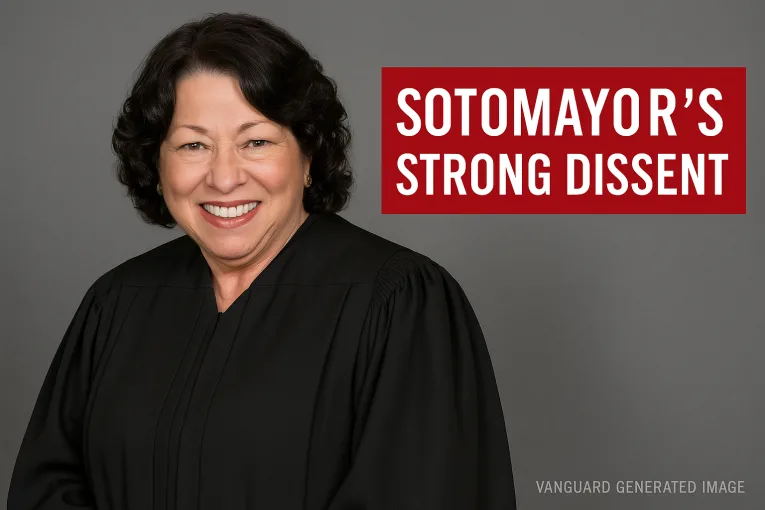
- “Boyd asks for the barest form of mercy: to die by firing squad, which would kill him in seconds, rather than by a torturous suffocation lasting up to four minutes.” – Justice Sonia Sotomayor
WASHINGTON, D.C. – In a forceful dissent Thursday, Justice Sonia Sotomayor condemned the U.S. Supreme Court’s refusal to stay the execution of Anthony Boyd, who was put to death in Alabama using nitrogen gas.
Joined by Justices Elena Kagan and Ketanji Brown Jackson, Sotomayor described the execution method as “torturous suffocation” and said the Court’s majority had turned its back on the Constitution’s ban on cruel and unusual punishment.
“Take out your phone, go to the clock app, and find the stopwatch,” Sotomayor began. “Click start. Now watch the seconds as they climb. Three seconds come and go in a blink. At the thirty-second mark, your mind starts to wander. One minute passes, and you begin to think that this is taking a long time. Two… three… The clock ticks on. Then, finally, you make it to four minutes. Hit stop. Now imagine for that entire time, you are suffocating.”
She described in haunting detail what Boyd experienced during his execution.
“You want to breathe; you have to breathe. But you are strapped to a gurney with a mask on your face pumping your lungs with nitrogen gas,” she wrote. “Your mind knows that the gas will kill you. But your body keeps telling you to breathe.”
Sotomayor wrote that Boyd would remain conscious for two to four minutes while gasping for air, convulsing, and thrashing violently before losing consciousness.
“Just short of twenty minutes later, Boyd will be declared dead,” she wrote. “Boyd asks for the barest form of mercy: to die by firing squad, which would kill him in seconds, rather than by a torturous suffocation lasting up to four minutes. The Constitution would grant him that grace. My colleagues do not.”
The dissent sharply criticized the Court’s refusal to intervene, saying it “turns its back on Boyd and on the Eighth Amendment’s guarantee against cruel and unusual punishment.”
Sotomayor argued that Boyd’s request for a firing squad was constitutionally justified, calling it a “readily available alternative” that would prevent unnecessary suffering.
Nitrogen hypoxia, the method used in Boyd’s execution, forces a condemned person to inhale pure nitrogen gas, depriving the body of oxygen. It was promoted by Alabama as a supposedly more “humane” alternative to lethal injection.
Officials claimed it would cause unconsciousness within seconds and be painless. Sotomayor, however, noted that “the method’s details were hazy” because the state released only a “heavily redacted protocol” before conducting its first nitrogen execution in early 2024.
She pointed to the growing record of nitrogen executions in Alabama and Louisiana, where witnesses reported prolonged suffering. She detailed the January 2024 execution of Kenneth Eugene Smith, the first person in U.S. history to die by nitrogen gas.
“When the nitrogen gas started flowing, Smith made violent movements immediately as he gasped for air,” Sotomayor wrote. His “feet and head left the gurney [and] his arms appeared to strain against his restraints.” His wife described it as “watching someone drown without water.”
Smith convulsed for up to four minutes before losing consciousness, and it took eighteen minutes before he was declared dead. His spiritual advisor, who had witnessed multiple lethal injections, said, “We didn’t see somebody go unconscious in 30 seconds. What we saw was minutes of somebody struggling for his life… It was the most horrible thing I’ve ever seen.”
Subsequent executions showed the same pattern. Aiden Miller “gasped, shook and struggled against his restraints” and remained conscious with his eyes open for minutes. Carey Dale Grayson “shook his head vigorously, struggled while clearly still breathing,” and lifted his legs off the gurney during his execution. Later executions of Demetrius Frazier, Gregory Hunt, and Geoffrey West produced similar scenes — minutes of visible distress, convulsing, and gasping for air.
Sotomayor said that despite these accounts, Alabama continues to defend nitrogen hypoxia as constitutional, ignoring that it “superadds psychological terror” to the process of death. “A person consciously experiencing the primal urge to breathe while knowing that breathing will cause death amounts to severe emotional suffering,” she wrote.
She argued that the firing squad would render a person unconscious in three to six seconds, while nitrogen gas causes prolonged conscious suffocation lasting up to seven minutes. The dissent cited lower court findings that Boyd’s suffering under nitrogen gas would involve both physical and psychological pain.
“There is a significant constitutional difference between three to six seconds of physical pain and terror and two to seven minutes of conscious suffocation with its associated psychological pain and terror,” Sotomayor wrote. “In gross numerical terms, nitrogen hypoxia risks extending the period of terror up to 140-fold.”
She also faulted lower courts for failing to apply the Supreme Court’s own precedent in Bucklew v. Precythe, which held that an execution method violates the Eighth Amendment if it imposes a “superaddition of terror, pain, or disgrace” without legitimate justification. She said the courts below ignored clear evidence that nitrogen gas does exactly that.
“The Eighth Amendment does not guarantee a prisoner a painless death,” Sotomayor acknowledged. “But when a State introduces an experimental method of execution that superadds psychological terror as a necessary feature of its successful completion, courts should enforce the Eighth Amendment’s mandate against cruel and unusual punishment.”
She closed with an ominous warning about the moral and constitutional stakes. “Allowing the nitrogen hypoxia experiment to continue despite mounting and unbroken evidence that it violates the Constitution by inflicting unnecessary suffering fails to protect the dignity of the Nation we have been, the Nation we are, and the Nation we aspire to be. Seven people have already been subjected to this cruel form of execution. The Court should not allow Boyd to become the eighth.”
Follow the Vanguard on Social Media – X, Instagram and Facebook. Subscribe the Vanguard News letters. To make a tax-deductible donation, please visit davisvanguard.org/donate or give directly through ActBlue. Your support will ensure that the vital work of the Vanguard continues.

I didn’t see what Boyd was convicted of in the article so I had to look it up:
“Anthony Boyd, 54, was executed on Thursday evening in the United States for killing a man by setting him on fire over a $200 drug debt.”
Sorry, but I can’t feel too much empathy for him.
We don’t have to become monsters
You mean like setting someone on fire and watching them die?
Cry me a river…
Two wrongs don’t make a right
Tell that to the guy that got bbq’ed
Actually the person need to be told is the one proposing retribution. Torturing this dude isn’t going to bring the other guy back, nor is it going to bring relief for his family, nor is it going to stop the next guy. All it does it put additional blood on our hands.