
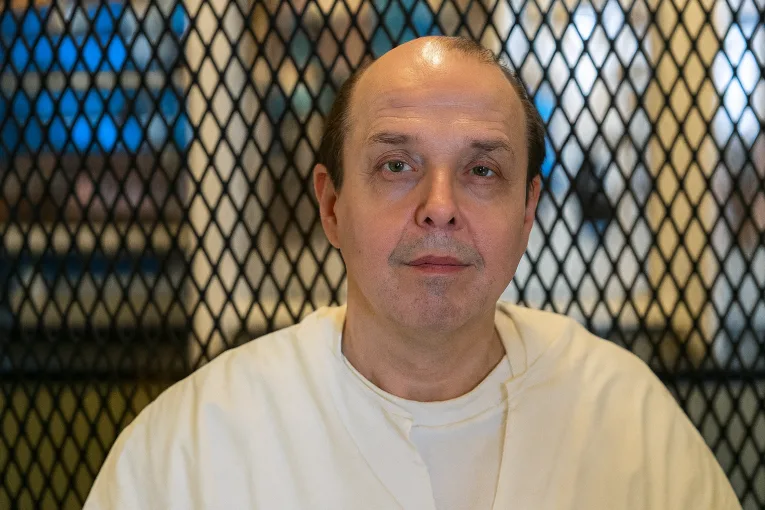
- “Our scientific understanding of what has become known as Shaken Baby Syndrome has significantly advanced.” – Judge Bert Richardson
The Texas Court of Criminal Appeals has stayed the scheduled October 16 execution of Robert Leslie Roberson III, a Palestine, TX, man sentenced to death for the 2002 death of his two-year-old daughter, Nikki Curtis, while ordering further evidentiary review in light of new scientific and legal developments. The ruling reopens one of Roberson’s long-pending habeas corpus petitions and remands the case to the trial court for additional proceedings.
In a 5–4 decision, the court granted Roberson’s motion for a stay of execution and reopened his fifth subsequent application for a writ of habeas corpus. The majority cited its 2024 decision in Ex parte Roark, which overturned another conviction based on the discredited “Shaken Baby Syndrome” theory, as providing a “new legal basis” for relief. The court’s action halts Roberson’s execution, which was scheduled for next week, and directs the Anderson County District Court to conduct evidentiary hearings on the new scientific claims.
Judge Bert Richardson, concurring with the majority, explained that “our scientific understanding of what has become known as Shaken Baby Syndrome has significantly advanced.” He noted that the State’s case against Roberson “was inseparably intertwined with Shaken Baby Syndrome as it was medically understood more than 20 years ago.” According to Richardson, the record “reflects, through the testimony of a medical expert, that ‘shaking’ falls into the definition of blunt force,” meaning the jury may have equated shaking with an intentional physical assault.
“Because of this deeper understanding,” Richardson wrote, “certain assumptions and conclusions that were once thought to be true may not be.” He added that the State’s theory at trial “was referenced over 130 times in the State’s case-in-chief and was discussed by both the State and defense.” Richardson concluded that the court’s 2024 ruling in Roark “provides a new legal basis for Applicant to overcome the subsequent writ bar set out in Article 11.071,” and that the facts Roberson presented “are at least minimally sufficient to bring him within the ambit of the new legal basis for relief that we announced in Roark.”
The court’s ruling marks the latest chapter in Roberson’s two-decade effort to prove his innocence. Roberson was convicted in 2003 after prosecutors claimed his daughter’s death was caused by violent shaking — a theory now widely challenged in the medical community. His defense team has argued that Nikki’s death was the result of natural causes, including undiagnosed pneumonia, medication-induced respiratory suppression, and a short fall from a bed the night before she collapsed.
The decision drew multiple separate opinions from the nine-member court, reflecting deep divisions over both law and science.
Presiding Judge David Schenck agreed with staying the execution but dissented from the majority’s decision to remand the case. He wrote that while he supported halting the execution “in view of evidence undermining [Roberson’s] conviction and sentence,” he believed that the case should proceed directly to a new trial rather than returning to the trial court for further hearings.
“The merits of Roberson’s claims and the cumulative effect of the evidence Roberson presents — in his fifth application as well as his previous and subsequent applications — would be more properly and more swiftly assessed at this point by a jury in a new trial,” Schenck wrote. “I believe the State is entitled to an opportunity to present this case on its merits to an actual jury without further delay or further speculation about what a jury might do when presented with all of (and only) the admissible, relevant evidence.”
Judge Schenck also argued that any constitutional system “requires this Court, not the Legislature, to apply its operative provisions aimed at protecting against a potentially erroneous deprivation of life at the hands of the State itself.” He wrote, “A new trial is necessary and mandated by our Constitution, irrespective of any statutory bar to the consideration of the writ.”
Judge L. Charles Finley wrote separately to concur in part and dissent in part, saying he agreed with reopening the case but would have also permitted Roberson’s actual innocence claims to move forward. Finley explained that he saw “little distinction between the bases for Applicant’s Article 11.073 claims and Applicant’s actual innocence claims.”
Finley noted that Article 11.073 of the Texas Code of Criminal Procedure allows post-conviction relief based on new scientific evidence and that the Roark precedent recognized “that changes in the scientific knowledge underlying SBS would have resulted in different expert opinions.” Finley added that the case “hangs over” the central question of whether Roberson was tried on a “shaken baby” theory, writing, “Based on the State’s arguments at trial, coupled with the evidence admitted to the jury, it is unquestionable that the State’s underlying theory was a shaken baby death.”
Judge Yeary, joined by Judge Parker, dissented sharply, accusing the court of overstepping its authority. “To reopen a subsequent writ application that has already been disposed of — if it is ever appropriate — may be justified only under the most extraordinary of circumstances,” Yeary wrote. “That a reasonable, good faith argument can be made that our prior decision to dismiss the application was, in hindsight, ‘incorrect’ does not count as an appropriate basis to entertain a suggestion for reconsideration.”
Yeary criticized the court for what he described as “ruling by fiat” and warned that the court’s action undermines procedural rules designed to prevent abuse of the writ process. He also rejected any suggestion that Roark established that Shaken Baby Syndrome was “junk science,” arguing that “arguably credible and reliable scientific evidence still exists to suggest that shaking a child can cause serious injury or death.”
Judge Michelle Parker, who joined Yeary’s dissent, authored her own opinion disputing the relevance of Roark to Roberson’s case. “Applicant’s case is not a ‘shaken baby’ case,” Parker wrote. “It is not even a so-called ‘shaken impact’ case. This case is a ‘blunt-force trauma’ case.”
Parker described the evidence of Nikki’s injuries in graphic detail. “A shaking or ‘soft’ impact cannot explain the ‘boggy’ spot on the two-year-old child’s head, the two different kinds of bleeding outside the skull, the bruising on the face and ears, and the bleeding from a tear in the mouth,” she wrote. “When one catalogues the extensive injuries suffered by the child, including two different types of fresh, inside-the-skull bleeding, the obvious conclusion to draw is that the child was beaten to death.”
Parker also contended that “shaken baby syndrome was Applicant’s defense,” not the prosecution’s theory. “He tried to convince the jury that the death was inadvertent by relying on the idea that the child could have been killed due to shaking alone,” she wrote. “Casting doubt on shaken baby syndrome actually hurts his case because it would make a jury even less likely to believe that the child’s death was unintentional.”
Judge Mary Lou Keel filed another dissent, joined by Parker, calling the court’s ruling “an unmerited and pointless remand.” Keel argued that Roberson “has not met Article 11.073’s unavailability or materiality requirements or overcome Article 11.071’s subsequent writ bar.” She said the court should have upheld the conviction and sentence, writing that “the remand is unmerited because Applicant has not met Article 11.073’s unavailability or materiality requirements or overcome Article 11.071’s subsequent writ bar,” and that “it is pointless to order factual development of a legal question, namely, the meaning of Ex parte Roark.”
Keel summarized her position bluntly: “Instead of rewarding Applicant’s abuse of the writ, the Court should — and in fact must — uphold again the trial court’s judgment and sentence of death.”
The ruling halts Roberson’s execution while the lower court reviews the new scientific evidence and legal claims. It comes as a growing number of experts and exonerees challenge the continued use of Shaken Baby Syndrome in criminal prosecutions. The stay marks a rare instance of Texas’ highest criminal court intervening in a death penalty case after years of litigation, signaling at least temporary recognition that the science underlying Roberson’s conviction may no longer withstand scrutiny.
Follow the Vanguard on Social Media – X, Instagram and Facebook. Subscribe the Vanguard News letters. To make a tax-deductible donation, please visit davisvanguard.org/donate or give directly through ActBlue. Your support will ensure that the vital work of the Vanguard continues.
