
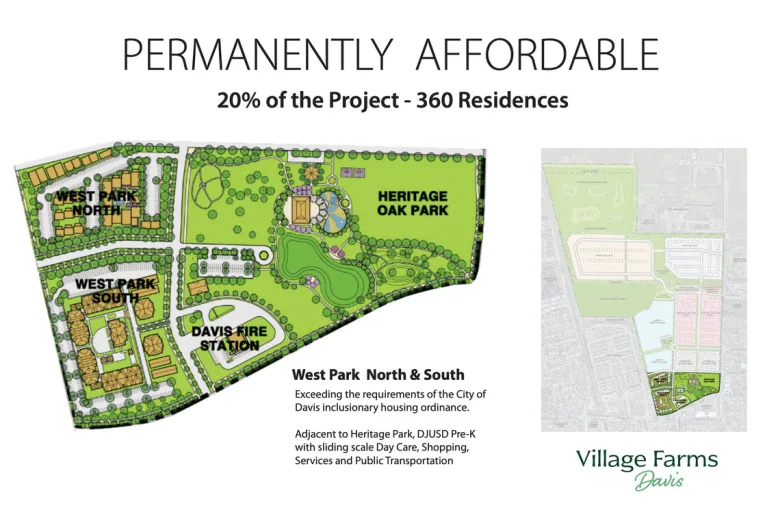
- “Not enough housing has been built in Davis, and prices are too high for families to locate in the city.” – Economic & Planning Systems (EPS) report
DAVIS, CA – A recent economic and demographic analysis by Economic & Planning Systems (EPS) finds that the proposed Village Farms housing development could play a crucial role in addressing two of Davis’s most pressing challenges—declining school enrollment and the high cost of housing.
The 1,800-unit mixed-use development would bring a range of housing types to the city, from higher-end single-family homes to high-density affordable apartments.
According to EPS, this diversity in housing options could not only strengthen the city’s economic base but also help stabilize enrollment in the Davis Joint Unified School District (DJUSD), which has been steadily shrinking in recent years.
EPS attributed the decline in part to “declining birth rates and housing unaffordability,” noting that many young families simply cannot afford to live in Davis. “Not enough housing has been built in Davis, and prices are too high for families to locate in the city,” the report stated.
The analysis quoted a Vanguard article from the spring, where DJUSD Superintendent Matt Best said, “The pipeline has slowed. And without new housing to attract young families, we’re heading into a prolonged decline.”
Chief Strategy Officer Maria Clayton added, “We’re not here to advocate for a particular project or type of housing, but we are here to make the consequences of inaction clear. The connection between housing and schools isn’t just abstract—it’s immediate, it’s financial, and it’s human.”
According to EPS, the Village Farms project would bring an estimated 701 new students into DJUSD schools—an enrollment boost of more than 8 percent compared to the district’s current 8,300 students. Analysts emphasized that this infusion could help the district avoid difficult decisions about staff reductions, program cuts, or even school closures.
Beyond its impact on schools, the Village Farms project could also shift the city’s housing market toward greater affordability. Davis currently has one of the highest proportions of renter-occupied housing in Yolo County—56.5 percent compared to 41.3 percent countywide—but lacks sufficient “missing middle” options such as townhouses and duplexes. Nearly two-thirds of the new Village Farms homes would be medium-density units, a category the report describes as “helping to fill a critical market gap.”
“High housing costs in Davis are principally the result of a supply and demand imbalance,” the report stated. “Generally, any additional housing units in Davis can help move the market towards more of an equilibrium between supply and demand.”
The report found that adding homes at different price points can relieve market pressure by allowing older homes to “filter” into more affordable price ranges. Current average sale prices in Davis hover around $866,000 for single-family homes and $505,000 for townhouses. Village Farms’ medium-density homes are projected to sell for about $740,000, while single-family homes would average $1.3 million.
The analysis also outlined the income levels required to afford these homes. A household would need an income of roughly $168,000 to afford a $740,000 medium-density home and nearly $296,000 to purchase a $1.3 million low-density home. By contrast, affordable high-density apartments would be accessible to households earning between $50,000 and $130,000, depending on the income category.
EPS noted that Village Farms’ combination of for-sale and rental housing could help a wide range of workers and families. For example, about 40 percent of current Davis jobs would provide sufficient income for a two-earner household to afford a moderate-income rental unit, and more than 80 percent could afford a low-income rental unit.
The study noted that housing and economic development are intertwined.
“For Davis to be able to diversify and expand its economy, and make itself more resilient, both availability and affordability of housing is essential to ensuring that businesses can attract and retain the labor force that their operations require,” EPS wrote.
The report also found that the project would have a positive fiscal impact on the city, expanding the property tax base by an estimated $1.24 billion and generating new retail spending potential of about $74 million. However, analysts cautioned that long-term affordability would depend on sustained housing supply and citywide planning efforts.
Ultimately, the authors concluded that Village Farms could help the city address structural challenges in both education and housing.
“Adding about 700 students to the district will help stabilize long-term enrollment numbers needed to keep schools open and adequately funded,” the report stated. “Much of the housing proposed for Village Farms will add to affordable housing options in Davis and provide medium-density units that are not well represented in the community.”
Tags:

So who asked for and paid for this analysis report?
So David, who was the client for this EPS report?
“VILLAGE FARMS PROJECT COULD HELP REVERSE DAVIS’ ENROLLMENT DECLINE AND EASE HOUSING AFFORDABILITY PRESSURES, REPORT FINDS”
I always kind of chuckle when I see the wiggle word “could” in any report. You often see that in stock news releases when a company is trying to hype its stock as it gives the company cover. Sure it could. Even if the project were to only add let’s say 5 children that “could” help reverse enrollment decline but only by a very small degree.
“High housing costs in Davis are principally the result of a supply and demand imbalance,” the report stated. “Generally, any additional housing units in Davis can help move the market towards more of an equilibrium between supply and demand.”
You needed a study to tell you that?
Ron G, that was my first impression when I read the headline.
“A recent economic and demographic analysis by Economic & Planning Systems (EPS) . . . ”
PASS! EPS is the same firm that did the economic report on the Yolo Rail Relocation. That report told me that EPS is one of those consultants you give big taxpayer money to for giving the client the analysis they want to hear. They lost me with that one.
” . . finds that the proposed Village Farms housing development could play a crucial role in addressing two of Davis’s most pressing challenges—declining school enrollment and the high cost of housing.”
The key word here is “could”. I could vote yes on Village Farms. I could even vote yes on Prop 50. But I won’t, and I won’t.
“The analysis quoted a Vanguard article from the spring, where DJUSD Superintendent Matt Best said, ”
The *analysis” quoted a Vanguard article and the schoolsoup who’s been floating this weird ‘don’t look at us when we’re closing the schools, campaign for housing instead!’ policy. How is quoting activist advocates an economic analysis?
“Chief Strategy Officer Maria Clayton added,”
Chief Strategy Officer of WHAT?
“The connection between housing and schools isn’t just abstract—it’s immediate, it’s financial, and it’s human.”
So it is partially abstract.
“Analysts emphasized that this infusion could . . . ”
My analysis is that they like the word “could” a lot.
“Beyond its impact on schools, the Village Farms project could also shift the city’s housing market toward greater affordability.”
True. It *could*.
“The report found that adding homes at different price points can relieve market pressure by allowing older homes to “filter” into more affordable price ranges.”
I *could* “filter” out all the BS language in this report using my brain.
“EPS noted that Village Farms’ combination of for-sale and rental housing could help a wide range of workers and families. For example, about 40 percent of current Davis jobs would provide sufficient income for a two-earner household to afford a moderate-income rental unit, and more than 80 percent could afford a low-income rental unit.”
What percentage of units will instead by taken over by Bay Area transplants a la Cannery?
“For Davis to be able to diversify and expand its economy, and make itself more resilient, both availability and affordability of housing is essential to ensuring that businesses can attract and retain the labor force that their operations require,”
Well, we tried Rob White, so I guess housing is worth a shot. Next, a glider field and canals for canoes.
“The report also found that the project would have a positive fiscal impact on the city, expanding the property tax base by an estimated $1.24 billion and generating new retail spending potential of about $74 million.”
And . . . . . wait for it . . . . they still won’t be able to pave the roads!!!
NOT MENTIONED in this article is WHO PAID EPS TO WRITE THIS?
Because THAT is the news. And without that tidbit, this isn’t a news report, it’s propaganda.
Oh wow, I hadn’t read KO, RG comments before I wrote my comment. I see great minds think alike and noticed the same things.
“NOT MENTIONED in this article is WHO PAID EPS TO WRITE THIS?”
This is a partial snippet of a client list posted on the EPS website:
Educational Institutions
ABC Unified School District
Auburn Union School District
Azusa Pacific University
Carnegie Mellon University
Chabot-Las Positas Community College District
Davis Unified School District
https://www.epsys.com/clients
BING-freakin’-GO
We spent taxpayer dollars to tell us what the school districts want us to believe, that just “happens” to also help the developers. Nothing wrong there. America! :-|
Too bad it’s untrue.
Lame response. What do you mean? And why do you say what you don’t mean, I mean you don’t say, or explain.
America!
The city handles the contracts and the consultants, but the city is then reimbursed by the applicant so there is no taxpayer expense.
You could have just said that :-(
The “real” problem arises from those who think declining enrollment is a city problem. (Or even a school district problem, in the long run.)
The population of school age children will stabilize, and will be based upon turnover of existing housing at some point (rather than continued growth). So the only real question is whether or not the city wants to stabilize it now, or after it adds a couple more sprawling developments.
But yes – I have the same question regarding who paid for this report. Was it part of the “sprawl for schools” campaign fund from the school district itself? Or was it from the developer or city?
It is interesting, however, that the school district realizes that even the continuing sprawl in Woodland is not going to be sufficient to prevent a DJUSD school closure or two. (They’re certainly accounting for those out-of-district students in their projections, as well.)
Meh, I’ll give my general opinion on the project and of this article.
Selfishly, I’m against the project because it’ll mess up traffic even worse on Covell. Where it crosses Pole Line is going to be horrible. I already don’t like the light that was added when the Cannery was built. And I don’t care what the traffic assessment says; unless the project shows new roads and a widening of Covell (which I don’t want to happen and won’t happen).
BUT, I know the city needs the housing to meet RHNA mandates. I don’t think I want the city to lose authority over development and land use to the state? (but maybe it would be a good thing?) So do I vote in my own self interest or for the long term good of the city?
What I do know that all this fuss about housing is BAD PLANNING without an integrated and viable economic plan to actually pay for stuff.
As for the article’s claims?
Affordability?
Does new housing stock push older homes into the “affordable range” for buyers? Relatively speaking I suppose so.
BUILDERS ONLY BUILD WHERE THE MARKET IS RISING AND WHERE THEY CAN ADD VALUE TO THE PROJECT. (translation: GENTRIFICATION). That effect supersedes any negligible addition the housing supply’s effect on home prices. 1. Newer higher end homes built. 2. Higher end buyers come in and buy. 3. Local market goes up. 4. More builders come to town to build more homes. 5. Wash, Rinse, Repeat. The “affordable” component to the project will have minimal effect on providing affordable housing in Davis (a true solution is a targeted public housing option….in much the way DJUSD is thinking about….which I advocated years ago….)
Will it effect school enrollment? Possibly in the long term. Remember, people that buy those 2000+ sqft homes….while pushing prices higher….are generally FAMILIES (ya know….adults with KIDS). Also, those higher end homes are less likely to be used as housing for college students. But will any of this impact DJUSD’s current situation? I don’t know…it seems pretty far off in the future (along with any other possible housing projects in Davis) so I don’t know if DJUSD can wait long enough to prevent it’s proposed contraction.
But again, this all CRAP PLANNING without an economic plan to pay for all this development’s infrastructure and services over the long term. The city should really be pushing new business parks and shopping centers to generate tax revenue to pay for stuff. Otherwise Davis will continue on it’s trend towards being a bedroom community for UCD and Sacramento…where people live here but work and spend their money (and generate tax revenue) elsewhere.
I spoke with a friend who has managed several cities and even built one from the farm field on up. He told me something similar. The city can’t make it on it’s share of the property taxes alone. He told me the city needs some sort of supplemental revenue stream from the houses. I don’t know how to structure something like that but it needs to get done.
The second thing he told me is that the fire station will break the city budget and deepen the structural imbalance beyond repair.
As for the economic plan I think its going to continue to be government service, agriculture and biotech. UC Davis and our proximity to Sacramento make government one of our largest sources of cash flow into the city and they bring lots of people with high incomes into our region. The question is how does the city capture some of that? Retail would be good but there is lots of vacant commercial property in town now. Although the newly remodeled U Mall seems to be doing well. So maybe its what kind of retail you have. And certainly Amazon has to be considered when planning retail.
“Retail would be good but there is lots of vacant commercial property in town now.”
The problem with infill solutions for commercial real estate is that often you’re forcing a square peg into a round hole. Where as many retail businesses would feel far more comfortable and be more willing to move into a new vibrant area….especially one off of the freeway. So I wouldn’t use downtown’s retail availability as a gage for possible new retail development.
Davis has a couple of miles of freeway frontage in and just beyond the city limits. Every other city along I-80 captures significant retail and restaurant tax revenues from the tens of thousands of cars that pass by each day. The west side isn’t available because it’s in Solano County but it seems there would be potential for commercial development on the east side.
On the south side of 80 off of Chiles? I could see that. I drive that way towards the Legacy fields multiple times a week. The land on the North side of 80 looks to be ag land? Maybe….maybe harder develop? (Williamson Act?)….I dunno….I just guessing.
Yes, the south side. North side probably has significant drainage issues.
David, where’s the link to the EPS report? (Please, please, please!) A web search does not bring it up.
Usually, its the developer who pays for this kind of report. I believe another firm is preparing a report for the City.
I would need to see the report to dive into it and see if the assumptions and analysis are consistent with impacting local housing prices and with the development serving the target market of local workers who can’t afford to live here now. Given the large number of interdistrict transfers and the eligibility requirements, we know that that these households represent a large portion of the potential VF market if it is designed correctly. Right now, it is not.
The better headline should have been “Report Funded by (Who?) Finds That Village Farms Project Could Help Reverse Davis’ Enrollment Decline and Ease Housing Affordability Pressures”.
“Report Funded by (Who?) ”
You would think wouldn’t you?
By the way, I’m absolutely convinced that all of this has “nothing to do” with a de facto school district campaign in support of Village Farms and Shriner’s. Wink-wink.
After all, I believe it’s illegal for school districts to engage in political campaigns, so I’m sure that they’d never try to get around that. Wink-wink.
They’re simply passing on objective, unbiased information via multiple “community outreach” meetings populated by their own people, etc., for Davis residents to consider.
I’m quite certain that they’d never set a bad example for the kids they’re responsible for educating.
And I’m also quite certain that they’re simply “rescuing” the students that they’re recruiting from other districts, via out-of-district transfers or outright moves to Davis.
Wink.
The school district is being very up-front about the enrollment issue and the impact that enrollment decline would have on facilities. They have to plan now for the next decade of enrollment. It is obvious that new housing development would increase the number of students in the schools. It is to their credit that they are making this very clear now.
When my kids were in the Davis schools, projecting enrollment was very challenging for the district. No disrespect to the adminstrators then, but it seemed they were whiplashed by enrollment numbers and were being reactive. That’s not good. Now they are being proactive. They’re stating simple facts: if enrollment drops, staff decreases.
Less staff equals fewer course offerings.
Fewer course offerings mean poorer quality schools as far as most parents and students are concerned. For those who care about the quality of Davis schools, this is important information.
Some schools would likely have to close.
Whether that matters to most voters, we don’t know, but given the long-time support of Davis voters for the school bonds and parcel taxes, I would imagine they’d want to know. It will just be one of many factors as they decide how to vote on the upcoming housing project proposals on the ballot. But nobody can accuse the district of being unprepared for this trend. They’re explaining what the outcomes will be.
Superintendent Best and Chief Strategy Officer Maria Clayton are doing their jobs here and deserve credit for being open and above-board about it.
I think it’s an outrageous scandal, but we’ll agree to disagree.
Once again, the apparent coordination of the school system’s messaging with significant events on the approvals roadmap for Village Farms is pretty suspicious.
Its “likely” that building more housing will bring more students, and that will “help” with our problems… but the real analysis needs to be WHAT KIND of housing do we want to product to have the biggest impact…
… and that is assuming that we even think that school enrollment should be driving our development decisions.. which they shouldnt.
School enrollment is an indicator of an unhealthy city. Approving sprawling tract homes blindly because they MIGHT help fill the schools is one of the worst reasons to rush to make a bad decision on housing.
Lets make the right housing decisions based on sustainability, economics, and traffic… the schools will grow if we do that, and thats all that we need to care about.
This study is deficient in showing which type of housing makes up the claim that 20% will be permanently affordable homes.
The study does not detail any of the categories set by SACOG’s RHNA required groups of extremely low. very low and moderate income units it creates.
Please show how many of the affordable units fit each of the required RHNA categories. Remember the 80-120% moderate income units have to be affordable to an average of 100% of median income.
We need to have water tight agreements on these categories rather that a heap of ‘coulds”. Coulds don’t count and should not be counted.
All I want to see is the back up detail by number of units and specify income categories instead of what at the moment seem vacuous promises.
I regret that the affordable housing numbers for Village Farms seem so misleading as well as unattainable and immeasurable.
Meeting ended at 1:45am.
I swear someone said at the beginning of the only item that there wouldn’t be any decisions made tonight. Must have said, ‘a lot of decisions need to be made’.
They made a lot of decisions.
I’ll let DG watch the tape and report to you, I don’t get paid for this carp.