
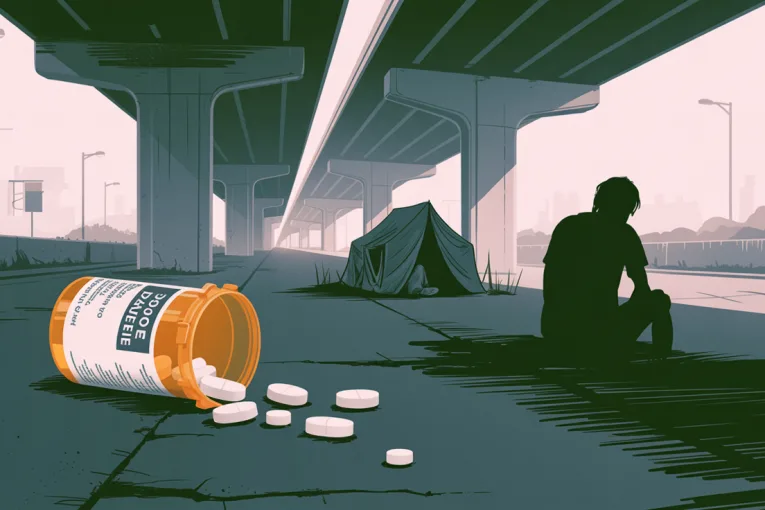
Editor’s note: David Greenwald is on vacation with his family for the Thanksgiving Weekend
We are living through a national debate where nearly everyone sees the symptoms of homelessness, but far fewer understand its root cause. The dominant storyline shifts depending on who’s talking: drugs, crime, mental illness, personal failure, even moral decline. It’s an easy narrative — it creates villains, avoids systemic responsibility, and offers the comforting illusion that homelessness is the result of individual choices rather than policy failures.
But the evidence — and the timeline — tell a different story.
If homelessness were primarily caused by addiction, then the places hardest hit by the opioid epidemic would be the epicenters of homelessness. And on that measure, the map is clear. Sam Quinones, in Dreamland, traces the explosion of opioid use to the communities along the Ohio River Valley — southern Ohio, West Virginia, Kentucky — places where pain pills, heroin, and later fentanyl devastated entire towns long before the crisis registered nationally.
Some of those places have the highest overdose death rates in the country.
And yet, those same places do not have the largest tents, encampments, or visibly unhoused population.
Meanwhile, homelessness surged in places where the cost of housing spiraled far beyond what wages, public assistance, or disability benefits could bear: California, Oregon, Washington, Colorado, and later portions of New England. The map of homelessness correlates not with addiction rates, but with housing prices.
People struggling with addiction exist everywhere. But homelessness rises sharply only where housing becomes unaffordable.
When rents rise beyond a threshold, the safety nets that once caught people begin to fray. A person with a substance use disorder in rural Ohio may still afford a trailer, a shared room, or a family home. That same person, in a region where the cheapest studio apartment rents for $2,000, has nowhere to fall but the street.
That conclusion is reinforced by the landmark 2023 UCSF California Statewide Study of People Experiencing Homelessness — the most comprehensive survey ever conducted on the issue.
Researchers found that the vast majority of people who became homeless in California were already living in the state before losing housing, and their descent into homelessness wasn’t driven primarily by addiction or mental illness.
Instead, the tipping point was financial: a sudden rent increase, loss of income, or an unexpected expense. The study found that even $300 to $500 in financial assistance at the moment of crisis could have prevented homelessness for a large share of those surveyed.
Most striking, UCSF researchers concluded that the housing market itself — not individual dysfunction — is the primary accelerant.
They wrote that “the high cost and low availability of housing” is the defining force pushing people into homelessness in California. People weren’t homeless because they had nowhere to go; they were homeless because there was nowhere available they could afford. In other words: the crisis isn’t about broken people — it’s about a broken housing system that leaves no margin for ordinary hardship.
Mental illness follows the same pattern.
Mental illness exists at similar prevalence nationwide. But encampments appear where housing supply collapses and rental costs soar — not where psychiatric conditions are most prevalent.
And that’s the uncomfortable truth: addiction and mental illness increase vulnerability, but they do not create homelessness on their own. It takes a second ingredient — the absence of affordable housing — to push people into public view.
There is also strong evidence that while mental illness can contribute to someone becoming unhoused, the relationship runs both ways.
Researchers have found that living without stable shelter — constantly navigating danger, sleep deprivation, weather exposure, policing, and public scrutiny — dramatically worsens psychological conditions.
What may begin as anxiety, trauma, or depression can evolve into full crisis when someone is forced to survive in public without safety, privacy, or rest. In many cases, the mental illness that appears visible on the street is less a cause of homelessness than a consequence of prolonged instability.
Studies routinely demonstrate that the longer someone remains unhoused, the more severe their mental health challenges become, particularly when paired with chronic stress and a lack of treatment access.
In fact, one of the most consistent findings in homelessness research is that shelter and housing stabilize people — not treatment first, not policing, not involuntary holds, but the basic foundation of a safe place to sleep.
Once people are housed, their mental health often improves dramatically, underscoring that homelessness is not just the outcome of illness — it is also the environment that deepens it.
When looking at proximate causes of homelessness, the sequence matters.
The opioid epidemic began in the late 1990s and early 2000s.
Homelessness — particularly unsheltered homelessness — began to spike again a decade later, tracking with the run-up in housing costs, the collapse of low-cost rentals, and the disappearance of boarding houses and single-room occupancies.
If addiction were the primary cause, places like West Virginia and rural Ohio would look like Los Angeles. They don’t.
But as soon as housing becomes scarce, expensive, and inaccessible, the population most vulnerable — including those with untreated mental illness or substance use disorders — becomes visible.
That is when homelessness becomes a crisis.
This distinction matters because it determines policy. If homelessness is viewed as a matter of personal failure, the response will be policing, punishment, or forced rehabilitation. But if homelessness is fundamentally the result of a structural housing shortage — worsened by disinvestment in treatment and care — then the solutions look very different: increasing housing supply, scaling up supportive housing, and rebuilding the systems that stabilize people rather than abandoning them until they collapse.
People often ask why the Vanguard covers housing so relentlessly. The answer is simple: because housing is not just about zoning and development proposals. Housing is healthcare. Housing is mental health intervention. Housing is addiction stabilization. Housing is dignity, safety, sleep, privacy, hygiene — the conditions required for recovery and stability.
In the end, the clearest evidence is on the streets in every major U.S. city: homelessness rises where housing costs rise. Addiction did not create the crisis — it merely became visible once we removed the last layer keeping people off the street: a place to live.
If we want fewer people living outside, fewer people caught in carceral cycles, and fewer tragedies unfolding under freeway overpasses and on sidewalks, we must start where the data — and common sense — point:
Homelessness is a housing problem first.
We ignore that reality at our own moral and policy peril.
Follow the Vanguard on Social Media – X, Instagram and Facebook. Subscribe the Vanguard News letters. To make a tax-deductible donation, please visit davisvanguard.org/donate or give directly through ActBlue. Your support will ensure that the vital work of the Vanguard continues.

From article: “And on that measure, the map is clear. Sam Quinones, in Dreamland, traces the explosion of opioid use to the communities along the Ohio River Valley — southern Ohio, West Virginia, Kentucky — places where pain pills, heroin, and later fentanyl devastated entire towns long before the crisis registered nationally.”
“Some of those places have the highest overdose death rates in the country.”
“A person with a substance use disorder in rural Ohio may still afford a trailer, a shared room, or a family home.”
So what I’m gathering from this story is that if you want to consume opioids (but don’t also want to end up as homeless right before you die), you should probably remain in or head to southern Ohio, West Virginia, or Kentucky.
Problem solved.
I hope this was meant to be sarcastic.
C’mon DG, you treat encampments as a simple price of housing problem and ignore reality. In places hit hardest by opioids that you site such as southern Ohio, West Virginia and Kentucky, law enforcement does not tolerate street camping, open air drug scenes or large encampments. The result is not fewer addicts, but far fewer tents. The contrast is not proof that housing costs cause homelessness. It is proof that jurisdictions with firm law enforcement never allow the behavior patterns that create large visible encampments in the first place.
The regions you cited with the highest concentrations of visible homelessness are also the bluest, and they build policy around permissiveness such as tolerating outdoor camping, providing services without sobriety requirements and embracing harm reduction as a replacement for basic behavioral conditions. That creates an attractor effect the article avoids acknowledging. It also lumps together every form of homelessness, including people staying with friends, living in garages or in temporary motels, to inflate the numbers used to argue that the visibly unsheltered are simply priced out. The people sleeping in doorways in Davis, San Francisco or Portland are overwhelmingly the same individuals cycling through addiction, repeated service refusals and arrests. Treating them as ordinary renters knocked out by a small emergency bill is not credible.
“People often ask why the Vanguard covers housing so relentlessly.” I resemble that remark. Although the terms I use is “obsessively” or “repetitively” or “yawningly” rather than ‘relentlessly’. “ . . . because housing is not just about zoning and development proposals” pretends the disagreement is over paperwork rather than the refusal to confront addiction and untreated mental illness. “Housing is healthcare” turns a political slogan into a medical falsehood, because healthcare is treatment, detox and clinical care, not a lease. “Housing is mental health intervention” ignores that intervention requires evaluation, medication and supervision, none of which materialize simply because someone is indoors. “Housing is addiction stabilization” skips the basic fact that addiction stabilizes with detox and structured treatment (and usually fails due to the toxic nature of addiction), not with keys to an apartment where the same destructive behaviors continue in greater comfort. “Housing is dignity, safety, sleep, privacy, hygiene” flips cause and effect, because those conditions emerge from sobriety, treatment engagement and consistent rules, not from unconditioned placement into units that many of the chronically homeless refuse, destroy or abandon.
The visibly homeless population in Davis is not one rent bump away from stability. Even if every proposed housing project in Davis were approved in the upcoming elections and vertical attrition created a wave of cheaper vacancies (which is unlikely to be significant enough to matter), these individuals would not suddenly pay rent, maintain sobriety or accept rules. Many already decline available shelter beds. The belief that new market rate or subsidized construction would transform the fentanyl/meth addicted encampment population into housed tenants is policy fantasy. The crisis people see on the street is not caused by a lack of units, but by a combination of addiction, untreated mental illness, service resistance and a political culture that allows visible behavior other regions refuse to tolerate.
“The visibly homeless population in Davis is not one rent bump away from stability. ”
I believe you are looking at this in the reverse direction. The question is not whether the visible homeless is a rent bump from stability, it’s whether the housing insecure are one rent bump away from homelessness.
Rents are going down; the vacancy rate is believed to be 7% for fall, after 4%-2%-1% the previous three years; housing prices are also down after peaking two years ago, with multiple price drops each month in order to sell – as opposed to multiple offers bumping up selling prices above asking prices two years ago. What do you want, a complete collapse of the housing market in Davis, or subsidized rent and subsidized downpayments for anyone who wants to live in Davis? And how do you see that not being an endless spiral?
This is a statewide problem, not just in Davis. People want to stay in their communities, even to the extent that they find some other escape hatch, whether through drugs or homelessness.
Importantly, it is NOT drug use that causes homelessness. Alan, your premise is wrong that somehow increased law enforcement will solve this problem. Ron O is correct that housing is so cheap in rural Appalachia that finding a place is relatively easy. In addition, many of those people are deeply embedded in their communities going back even centuries because they are the ones didn’t move away for better opportunities. So they have a place to land. Not so in states that have been economically dynamic and there are many fewer nearby familial ties like California. People have some ties but not enough to allow for shared couch surfing. In addition, housing in CA is already crowded because of high costs, so they can’t take in any more. All of this means that what happens in Appalachia is not relevant to California.