
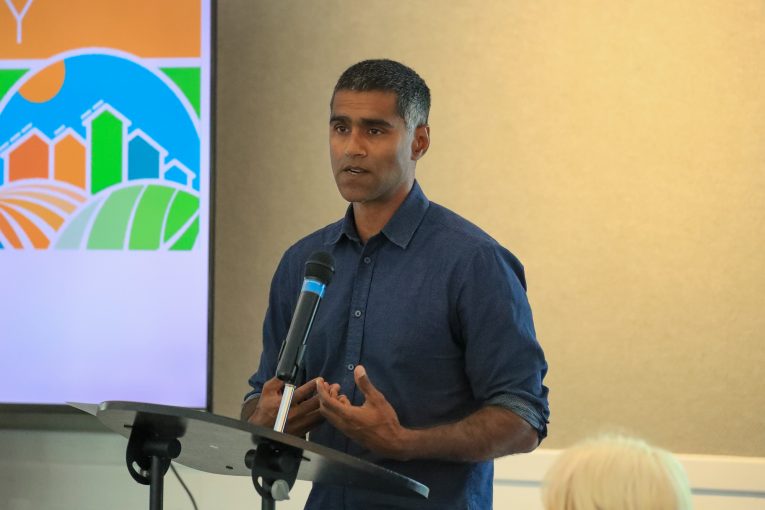
- “If Davis wants affordable housing, it must prioritize viability.”
DAVIS, Calif. – The Dec. 16 Davis City Council meeting exposed a widening fault line in how the city approaches affordable housing. While the subcommittee presented what it characterized as a major advancement — expanding the affordable housing dedication from nine to 16 acres and increasing the cash contribution to $6 million — the discussion quickly shifted away from progress and toward demands for hard guarantees.
The expansion from nine to 16 acres was the product of months of negotiation.
The increased acreage means more potential units, more flexibility in site planning and greater eligibility for funding. The difference between nine and 16 acres is the difference between a small, symbolic dedication and a meaningful one that could anchor a sizable affordable development.
It is also a point that underscores how far negotiations have moved. Instead of being recognized as progress, however, the expanded acreage was dismissed by Mayor Bapu Vaitla as inadequate because it was not paired with guaranteed unit delivery, which he argued could leave the city with “16 acres, $6 million and zero units.”
Likewise, the shift from $2 million to $6 million represents a tripling of direct financial support from the developer.
But more importantly, it changes the scope of the city’s leverage. When paired with public ownership of the dedicated land, the $6 million contribution can serve as gap financing to attract state or federal subsidy.
The package may be worth far more than its nominal cash amount, yet this nuance was lost in the effort to characterize the contribution as “zero.”
“It’s 6 million, it’s not zero,” former Councilmember Rochelle Swanson, who is part of the development team said, pushing back against the narrative that the city was receiving no tangible value.
One of the most significant but least discussed elements was valuation.
The finished-lot value of 16 acres in Davis, with infrastructure, streets and utilities, is not trivial. Conservative estimates place the contribution closer to $30 million. The argument presented is straightforward: public agencies, not private developers, are best positioned to leverage that land value into tax-credit awards.
The city’s advantage in pursuing subsidy is a core reason why land dedication can outperform mandatory on-site construction. Dismissing the acreage as merely land ignores the millions already embedded in site readiness.
The demand for enforceable triggers — especially time-based triggers — introduces a different problem.
Triggers may appear to promote accountability, but they can also shift liability in ways that expose the developer to obligations far beyond the intended contribution. If the city cannot secure funding within a given timeframe, a trigger could place the obligation squarely back on the applicant. Critics of time-based requirements argued they are arbitrary and potentially punitive.
Swanson said, “I think 10 years is just, that’s a number pulled out of the sky,” reflecting the concern that an inflexible deadline could undermine feasibility.
Alongside deadline triggers is the legal exposure question. If baseline guarantees are required and units are not constructed due to subsidy failure, the city or developer could face lawsuits.
When baseline features are codified into a Measure J vote, they acquire legal force which are enforceable. Demanding a baseline obligation with no clear financing path places both the project and the city in jeopardy. It also risks bogging the development in litigation rather than housing production.
A further challenge is voter clarity.
Baseline features exist to inform voters about what they are approving. When baseline demands exceed feasibility, the ballot asks voters to approve a project that carries unresolved risks. The distinction between enforceability and feasibility becomes blurred.
A baseline requirement that cannot be delivered is likely to lead to confusion. Voters may reject a project simply because its baseline conditions appear unrealistic or because the explanation of why they may not be deliverable becomes too complex to convey in a campaign.
Negotiations themselves have not been linear – what was acceptable last month was questioned this month. Conditions presented as firm were subsequently reframed or expanded. That dynamism has consequences.
Developers need predictability. Investors expect stability. When negotiating positions shift, the perception — fair or not — is that goalposts are moving. Uncertainty is costly. It affects design, engineering and legal preparation. When expectations shift mid-stream, trust erodes, and negotiations become adversarial.
Public negotiation of maximalist terms also has political implications. There is a strategic difference between privately negotiating terms and publicly demanding conditions that could imperil the project. When demands escalate in a public forum, opponents of development gain talking points.
A narrative emerges: if even the council says the project guarantees nothing, why should the public support it? The result is not only negotiation pressure but ballot vulnerability. Public rhetoric can weaken support long before a vote is cast.
We already saw a lot of confusion from people and opposition latching onto some of the rhetoric. If Vaitla is sincere in wanting housing and the project, he may have done irreparable harm.
Tax-credit positioning is often overlooked but critical. Publicly owned, shovel-ready land with gap financing positions the city to compete effectively for credits. Private developers are often disadvantaged in the credit scoring process.
By dismissing the land and cash contributions as insufficient because they lack guarantees, the council risks forfeiting the strategic advantage the package offers. The goal should be to structure a proposal that maximizes credit eligibility. Instead, the demand for guarantees threatens to undermine the foundation on which credit success depends.
One of the most concerning elements of the ongoing debate is its effect on investor confidence.
The Vanguard has learned more than twenty investors have already concluded that they would not pursue another project in Davis. They described the process as expensive, unpredictable and exhausting.
In past projects, applicants and even former councilmembers have referred to the Davis spanking machine.
Millions were spent on environmental review and redesigns, only to face shifting expectations. The risk is not one developer walking away.
The risk is the city continuing a reputation that discourages future applicants. In a Measure J environment, without interested developers, there are no future proposals to vote on.
The city lived with that when Measure J was first passed 25 years ago, but now they have a fully engaged state government and attorney general’s office potentially coming in to take away local autonomy and ability to stop projects.
Measure J, combined with an outdated general plan and growing state oversight, creates pressure on local planning. If Davis establishes precedents that no developer can reasonably meet, the result may not be more affordable housing. It may be fewer proposals, greater state intervention and less local control. When a city becomes known for rejecting projects that exceed code requirements, the state notices. And the state has tools — from builder’s remedy to lawsuits to funding penalties — to intervene.
Against that backdrop, the demand for guarantees risks looking less like leadership and more like brinkmanship.
Mayor Bapu Vaitla’s concerns about enforceability may be well-intentioned. His argument appeals to equity and responsibility.
But policies must live in the real world.
Affordable housing units are not created through uncompromising demands. They are created through workable plans. When a project exceeds code and provides land and funding valued in the tens of millions, the responsible reaction is to build on that progress, not dismiss it as “zero.”
Councilmember Josh Chapman recognized that balance.
His refusal to “kill a project” did not deny the concerns raised. Instead, it acknowledged them without turning negotiation into a dead-end ultimatum.
“I understand the frustration, but what came back, quite frankly, isn’t a process that gets units built,” he said.
At the same time, he made clear that he would not walk away.
“I’m just trying to figure out how we get to a point this evening that doesn’t, in any kind of way, kill this project.” That posture kept the door open.
The door matters. Because if Village Farms reaches a Measure J vote burdened by demands that render it infeasible, it will likely lose. And when it loses, the city will not only lose 16 acres and $6 million. It will lose credibility with investors. It will lose the opportunity to secure tax credits. It will lose momentum in addressing its housing shortage. And it will risk validating a narrative that Davis is a place where no major housing project can succeed.
Some commenters have suggested that this process was rushed – that’s always a complaint and part of that is that Measure J creates an artificial timeline because of electoral schedules.
But more importantly, there seems to be an assumption that somehow this project could get voted down and the voters could get another bite of the apple. That doesn’t seem to be in the cards unless the state comes in to modify or even eliminate Measure J.
In the meantime, Davis is running up against state pressure and its own failures over the last 25 years to build housing.
As we heard on Tuesday and Wednesday, this affects families priced out of the market, workers who commute long distances and young people unable to return after college. They affect revenues, school enrollment and demographic balance. They affect whether Davis grows in a planned way or faces growth imposed from above.
The city cannot afford to treat aspirational guarantees as more important than deliverable units. It cannot rely on rhetoric at the expense of feasibility. It cannot gamble that a project can survive these kinds of demands and still pass a Measure J vote.
Village Farms is imperfect. But so is any project. We cannot allow the perfect to be the enemy of the good if we hope to address the housing crisis and stave off efforts by the state to intervene.
The choice before the city is not between perfect guarantees and nothing. It is between a feasible path to units and a symbolic gesture that could kill the project.
If Davis wants affordable housing, it must prioritize viability. If it wants development interest, it must offer predictability. And if it wants to maintain local control, it must avoid turning Measure J into a mechanism that makes housing impossible.
The demand for guarantees may feel righteous. But righteousness does not build homes. Feasibility does. And unless the council pivots toward it, the only guarantee Davis will have is continued failure.
Follow the Vanguard on Social Media – X, Instagram and Facebook. Subscribe the Vanguard News letters. To make a tax-deductible donation, please visit davisvanguard.org/donate or give directly through ActBlue. Your support will ensure that the vital work of the Vanguard continues.

Vaitla has been obstructionist at every point in this process and his threats the other night of unbridled opposition only underscore that opposition. At the end of his bullying from the dais and telling the applicants he is okay with them walking away and that he will oppose them all the way he lost on his motion 4-1. It was shocking but unsurprising. I had several people tell me I had to watch the tape with one longtime observer telling me she had never seen anything like it.
In California politics city council is an entry level position. What I saw was someone who is unprepared to move up. In fact his re-election, should he decide to run again, should now be questionable.
Hasn’t Davis lamented not getting guarantees set in stone on past developments?
That tells me you have to find the sweet spot
That was more about public promises like the connection to the H Street tunnel connection to Cannery that most of us didn’t understand at the time was not in baseline and therefore bait to get you to vote for it and not enforceable (fool me once . . . ), not so much “affordable” housing build-it requirements.
Yes, this is why Davis doesn’t trust developers to follow through on Development Agreements. The unwillingness of Ramos to add convert DA provisions to Baseline Features on DiSC I in 2020 was a major reason why they lost the vote.
wasn’t traffic issues why they lost the vote?
And we should not forget that the same developer provided visualizations of an undercrossing for Nishi 2.0/Promenade when it came to a public vote but that the project agreements and documents only promised a grade separated crossing.
Within a matter of months after the vote, Union Pacific rejected the undercrossing proposal… but this wasn’t widely known for about 5 years.
Is Nishi officially dead, as a result?
The entire reason for that proposal was for students to have more housing easily-accessible to UCD.
Though I will say that I’m glad to (still) be able to have my garden tools sharpened at JB’s. (I figured that place and most of the other blue collar businesses were doomed, when Nishi was approved. Though it looked like the marijuana shop in the same complex might be gone.)
Like San Francisco and some other Bay Area cities, blue-collar businesses will likely increasingly get pushed out of Davis.
In any case, it is interesting that the rental vacancy rate has substantially increased, even without Nishi.
If they ever do change (not eliminate) Measure J, I’d suggest that Measure J approvals be rescinded after a number of years, if essentially no construction has occurred. So for something like Nishi, that could mean that the approval never occurred.
(I’d also suggest that no more than one proposal be entertained every XX number of years. I’d say once every 10 years, and that’s it. No one likes constant campaigns, though it is pretty satisfying to see most of them go up in smoke so to speak. Long like the spanking machine, if needed.)
It’s not “interesting” it’s math.
From UC Davis: “The survey results follow seven years in which UC Davis has made a net gain of more than 6,260 new apartment and residence hall beds on campus. The city of Davis has also contributed to this positive impact with the approval of numerous new apartment projects.”
It goes to show you that when you have scarcity and then add supply, you alleviate the shortage in housing. Oh snap.
The point was, there isn’t the shortage there was two years ago.
(has the ‘official’ fall vacancy rate been published? If so, I’d appreciate a link)
David, you are conspicuously silent on a couple of key points. (1) UCD hasn’t added 6,260 rooms. They have added 6,260 beds, many of which were accomplished by converting an existing single room into a double room. If you were practicing good journalism you would report the additional rooms UCD has added. (2) While UCD has added beds, they have also removed existing beds (e.g. Solano Park married student housing. (3) Trump’s immigration policies have resulted in a drastic decrease in International students, and the housing demand that they represent.
The VF developer’s understandable refusal to put the construction and timing of affordable housing into the baseline features means that there’s no feasible path to actually getting them built. If VF gets approved by the voters — an outcome I consider very unlikely — we end up with a boatload of high-end SF houses that will get snapped up by wealthy Bay Area retirees and well-heeled Sacramento commuters, and some vacant acreage where affordable housing was supposed to be.
If the voters turn down the project, the worst case and best case scenarios are the same: the state says, “That’s it! Measure J is contrary to state housing policy, and you, City of Davis, are now subject to the Builder’s Remedy!” Then we wait for the option holders of all the farmland surround the city to line up and say, “Me first! I want to build my project featuring 20% affordable housing, or 100% moderate-income housing, or 100% middle-income housing (take your pick)!” So the city gets its affordable housing, and as soon as it meets its RHNA obligations is can, under the Housing Accountability Act, deny approval of any additional projects as it sees fit. Win-win! What’s not to like?
Part of what I was trying to explain is that by the city acting a partner here, they can get funding that is not available to the developer and that will help ensure there is the financing for this to get built.
Based on the presentations I heard from city staff, “help ensure” is accurate, but “ensure” is light-years away from reality. They’re talking about lining up something on the order of $50M in subsidies to get it done, and I haven’t seen anything that can get within cruise missile range of that.
Yes, there are no guarantees. Basically, the city believe that with the $30 million donation, this project would be in a much stronger position to compete for state tax credits than almost any other project in California. Those tax credits could cover about 70 percent of construction costs. Without them, even an affordable housing developer might only be able to secure credits covering around 40 percent. The city believes this route gives the best chance of actually securing the funding.
Given everything, seems like the best way forward. And they’ve expanded the size of the land dedication.
How does the City get “tax credits” when it doesn’t pay taxes? This has been a big issue in renewable power project development where third parties build the projects and then sign power purchase agreements with the city municipal utility. The 2021 federal bill changed the credit provision to make it as direct payment to a municipality, but it is not a “tax” credit.
That said, the availability of state or federal subsidies are likely to be limited and shrinking at least in the near future. That’s why trying to find a guaranteed cash stream is so important. Taxpayers (and ratepayers) are tiring of subsidizing corporate investors by bailing them out of obligations (e.g., see the voter/ratepayer revolts in New Jersey and Georgia in the November election).
The other solution is as I point out below is to deemphasize subsidized Affordable rental housing (which we may not need more of) and instead require more market-rate affordable housing that can be purchased.
Developer to city: “Let us build our project. Maybe you’ll get something out of it other than a snowballing net loss after 15 years.”
What you get out of it is 16 acres of land with infrastructure where the city can build Affordable housing. If you think that is nothing and that there will be none built in 10 or 15 years if the project is ultimately approved I would like to take that bet if anyone is interested.
According to the Mayor there is a $60 million shortfall but the state has budgeted millions for building such housing and will likely appropriate much more considering the new consensus that we need more supply of housing. Also the Feds are supposedly going to have some sort of housing initiative in next year’s budget. My prediction is having the land dedication and infrastructure will grease the skids for the City to find funding going forward.
Funding for Affordable housing is going in the exact opposite direction of what you claim.
https://www.sfchronicle.com/sf/article/affordable-housing-sale-21251741.php
Wow, I agree with Ron O! (Because he provided valid documentation, thank you).
The Council also heard at the same session that 3 local affordable housing developers are in financial distress, to corroborate the Chronicle article.
Ron G or David G, please provide documented support for your statement about rising funding for Affordable housing and Davis being well positioned to gain that funding.
(The best solution for the state is to go back to the state providing the property tax increment increase to a city as it did with redevelopment agencies instead of just channeling it into state coffers. Those agencies were abolished because of corrupt eminent domain abuses, not because of “inefficiency” or excessive revenues.)
WEST SACRAMENTO, Calif. — Dec 17, 2025:
West Sacramento has been awarded a nearly $43 million grant from the state to make significant investments in long-term housing and eco-friendly transportation with an emphasis on affordable housing.
On Tuesday, the city announced the grant was awarded through California’s affordable housing and sustainable communities grant program.
https://www.kcra.com/article/west-sacramento-grand-gateway-district-affordable-housing/69803492
Dec 10 2025:
A Yolo County partnership has been awarded a $27,999,100 grant from the Affordable Housing and Sustainable Communities (AHSC) Program to transform a 2.4-acre underutilized site in Woodland into a vibrant mid-rise affordable housing community with 73 units across a diverse mix of unit sizes. This transit-oriented development, currently referred to as Tupelo, represents a longstanding collaboration between the City of Woodland, Yolo County Housing, and Yolo Transportation District—alongside development partners Brinshore and Operative Office—to address critical housing needs while providing affordable and accessible transportation options.
https://cityofwoodland.gov/m/NewsFlash/Home/Detail/1001
March 16, 2023:
The California Statewide Communities Development Authority (CSCDA) is pleased to announce the issuance of $20,940,000 in tax-exempt and taxable affordable housing bonds for Silvey Villas at Homestead in Dixon, California. About Silvey Villas at Homestead: Silvey Villas at Homestead (the “Project”) is the new construction of 72 affordable housing units by The Hampstead Group (“Hampstead”). The benefits of the Project to the City of Dixon include the following: • 100% of the rental housing units will be rent restricted for low and very low-income senior residents. • The Project consists of one-bedroom and two-bedroom units. • Units will be reserved for seniors earning less than 30%, 50%, and 60% of the area median income.
https://cscda.org/wp-content/uploads/2023/03/CSCDA-Silvey-Villas-Announcement.pdf
That is pretty impressive, but I’m wondering when those funds were first allocated/applied for. (In other words, did the funding originate from previous years, when funding was more available?) And if it’s from current year funding, then why does it seem so challenging to get funding now?
Relevance of that question?
This round of AHSC grants (the 9th round to date) opened in March 2025, applications closed end of May, grants being awarded now in December. These are funded by the state’s climate initiatives and are done annually. They are competitive grants and go quickly, I gather.
https://www.grants.ca.gov/grants/ahsc-round-9-nofa/
“Relevance of that question?”
Did you not listen to Bapu’s comments, regarding available funding for Affordable housing? The entire subject of your article?
These are AHSC projects that come from AB 32 Cap & Trade Allowance funds. This means that the entire development needs to meat the requirement listed in one of the articles. “The proposed housing project is all-electric, net-zero energy, and features thoughtful climate adaptation strategies to mitigate extreme heat risks.” VF does not meet this requirement, which will make funding more difficult.
Further, new state law is raiding this Strategic Growth Fund to give bigger refunds to electric and gas customers to counter the rising utility rates that the CPUC has unleashed through its incompetence and lack of fortitude. So this fund may be much smaller in the future.
And yes they are highly competitive. Winning requires substantial negotiation ahead of time.
Thanks for clarifying that, though it is interesting that the developments in both West Sacramento and Woodland are apparently meeting climate adaption strategies.
I guess none of the new residents will be commuting to UC Davis – which is your primary concern? (I do believe the one in Woodland, if I’m not mistaken, is not a particularly direct commute to UC Davis. There’s a truly massive new Affordable housing development on the edge of the northwest side of town, so I assume that’s what this is referring to. In any case, I guess we’re hoping that the new residents don’t seek employment at UCD or in Davis at some point – or anywhere outside of Woodland in regard to climate change.)
:-)
Cities don’t build affordable housing. Builders do. (I wish cities developed and built property) Affordable housing builders need funds to build affordable housing….funds that are in short supply these days; banking on state funds to build any significant affordable housing is foolish. Or affordable housing is subsidized by builders building market rate housing.
In response to a question from the council (during the Village Farms “workshop”), staff stated that the Affordable housing developer at Bretton Woods is already begging for more money from the city itself to undertake that project.
One other point (that always gets lost) is that any external Affordable housing funds that Davis doesn’t “win” are then available to some other community – where the so-called “need” might be even greater.
Not sure why Davis has to be the center of the universe in regard to Affordable housing, school enrollment, etc. – at the “detriment” of other communities throughout the state.
(I use the words “win” and “detriment” somewhat humorously, here – in regard to Affordable housing and school enrollment.)
Pretty sure that Huntington Beach, for example, doesn’t view “winning/securing Affordable housing funds” as actually winning. Pretty sure they’d say “thanks, but no thanks”.)
“Not sure why Davis has to be the center of the universe in regard to Affordable housing, school enrollment, etc. – at the “detriment” of other communities throughout the state.”
No community can afford to build Big A affordable housing without subsidies in the post-Prop 13 and post-RDA world, and every community has to meet RHNA requirements, so in that sense every community is at the center of its own universe when it comes to the search for external resources.
” . . . and every community has to meet RHNA requirements, so in that sense every community is at the center of its own universe when it comes to the search for external resources.”
This is a demonstrably-false statement. If it was re-worded to state that every community has to “address” (rather than “meet”) RHNA requirements, it would be correct.
The state’s “requirements” are demonstrably unachievable. And that’s true for the current round; let alone the next round.
https://cities.fairhousingelements.org/
(Also, see my other comment below regarding what’s occurring in San Francisco.)
So unless Wiener, Bonta and all of the YIMBYs learn some carpentry skills (and start volunteering their time at Habitat for Humanity in mass), their lawsuits across the state aren’t going to address those so-called “requirements”.
And the Builder’s Remedy isn’t penciling out very well, either.
This is what happens when activists/extremists create unrealistic laws. (Sort of like the result of whatever the “advisory” speed limit is on I-80.)
“This is a demonstrably-false statement.”
Please demonstrate.
Meeting RHNA targets means the land has to be zoned and available for development. The state has not – so far – required cities to actually build anything.
I guess it depends upon what the definition of “meet requirements” is. And what the definition of “available for development” is.
Clearly, most of the housing contained in the current round of housing elements (statewide) is not going to be built in the current round, let alone whatever might be “required” in the next round.
https://cities.fairhousingelements.org/
Maybe Bill Clinton can define those terms (reference to when he questioned the meaning of the word “is”, back in the day).
But I believe there is also terminology regarding plans that have zero chance of being implemented. (I personally call them “fake plans”.)
There is a part of the requirements that says that there has to be some degree of likeliness that the homes will be built. What that specifically means I don’t know. But in the extreme sense it means you can’t zone for housing under ridiculous circumstances where it’s likely to not be built like requiring 10 parking spots per unit.
Agreed Keith, but according to Staff testimony at the Planning Commission meeting on Wednesday in response to Commissioner Troost’s question, the housing progress reports by the City to HCD have had more than enough approved and entitled sites to satisfy the RHNA requirements, but due to the tight financing market, many of those approved projects on viable sites are stalled. That is very different than the kind of non-viable sites you describe.
That is not a process issue that the State can find fault with, but rather a universal challenge all housing everywhere is running into.
The many lawsuits being brought by both builders and the state AG shows that the HE requirements now have teeth.
Richard, they have teeth with respect to process, but if a city’s process is clean, the State and the builders really can’t hold individual cities liable for constraints the financial marketplace is imposing before lending money.
Meanwhile, in San Francisco, a non-profit owner of several Affordable housing developments can’t even hold onto them, due to rising costs (and revenues that aren’t keeping pace).
And then there’s this (in that same article):
“Meanwhile, new affordable housing construction is facing similar financing constraints: 12,000 units across 313 projects are currently stuck in San Francisco’s affordable housing pipeline. Katie Lamont, TNDC’s chief operating officer, said that the organization is pausing work on two of its big projects: the 199-unit senior project at 1234 Great Highway and the 120-unit 149 Pennsylvania St.”
“San Francisco’s tenant protection laws generally shield renters from displacement when buildings are sold. But, there are no guarantees that a building’s affordability will be preserved under new ownership.”
https://www.sfchronicle.com/sf/article/affordable-housing-sale-21251741.php
Seems like there just isn’t enough funding to build/operate Affordable housing statewide – including for existing developments and already-approved proposals.
It was a through the looking glass projection for the Mayor to be talking about the proponents having skin in the game. I have been making that argument for a while about the people who are making all sorts of demands on the developers without risking a single dollar and threatening to defeat them by exercising their Measure J veto power at the ballot box. The developers already have Millions of dollars of skin in the game the pundits not one penny.
“Skin in the game” isn’t denominated solely in dollars and cents; quality of life arguably has even greater value, so every resident of Davis has skin in this game.
“Public negotiation of maximalist terms also has political implications. ”
Much of this is the result of the requirements of the Brown Act. On the other hand, the City has not been responsive to public input that turned out to be valid on previous negotiations, e.g. Recology sale, BrightNight solar lease.
Along these lines, we are much too focused on subsidized Affordable housing as our solution. That housing is will be largely rentals because people in that income range generally are not buyers. The city already has a lot of rental housing and the rising vacancy rate is a good indicator of the situation. Instead we need to be focused on more market-rate affordable housing that serves first time buyers. Too much subsidized Affordable housing squeezes that market rate affordable housing as a developer looks for bigger profit margins from McMansions to cover subsidy costs.
“The risk is the city continuing a reputation that discourages future applicants. In a Measure J environment, without interested developers, there are no future proposals to vote on.”
Yes, this is why we need realistic directions to developers on how to bypass a Measure J/R/D vote and even give future Councils clear negotiating parameters.
“Village Farms is imperfect. But so is any project. We cannot allow the perfect to be the enemy of the good if we hope to address the housing crisis and stave off efforts by the state to intervene.”
VF is so imperfect as currently configured that it will make us worse off. It’s focus on McMansions will not solve our housing affordability problem. Instead it will just cater to yet more commuters and won’t serve those workers who now commute into Davis but can’t live here. UC Davis alone now has 1,500 less employees who live here than in 2007 despite having the same workforce. If we extrapolate that tend to the rest of the city, that’s 4500 more people who now commute to work in Davis bringing with them traffic and pollution.
It doesn’t help that VF developers keep changing their story on how much missing middle attached housing they will offer. The summary document presented at the Planning Commission says 10% of about 100 units. Rochelle Swanson said about half or nearly 900. Which is it?
The problem is that developers want lots of wiggle room so they might be able to build another Mace Ranch (which we don’t need). That’s why they will put empty promises in the Development Agreement that can be negotiated away (see e.g., The Cannery) instead of being held to those promises in the Baseline Features. Davis has been burned too often by developers used to steam rolling other cities and just adding to regional sprawl and environmental damages.
But if we’re going to follow through on this, we need to provide concrete guidance with assurances that we will follow through on our promises. That can only be done with modifying Measure J/R/D to allow bypassing a risky vote. (We still need the vote backstop to keep developers in line if they choose not to comply.)
Willowgrove may be showing the way on how to design for the City’s affordability objectives if I’m reading the summary correctly. They plan to offer attached housing on half of their plots. That will be much better for supplying missing middle housing (and getting us more school children). VF should be looking there instead.
Remember that our affordability crisis is only a short term problem if we keep focused trying to achieve a greater housing supply. But we will be saddled with the decision for at least a century (see e.g., Old North Davis) and if we just add more high priced sprawl, we will just make our situation worse, not better. Simplistic rationalization that “we just need more housing” will not get us to our goals–it needs to be the right kind of housing.
“Instead we need to be focused on more market-rate affordable housing that serves first time buyers.”
There really isn’t “market rate affordable housing”. If you build a bunch of duplexes, fourplexes, and apartment/condos….you’ve just created more rental housing anyway…..and likely just more student housing.