
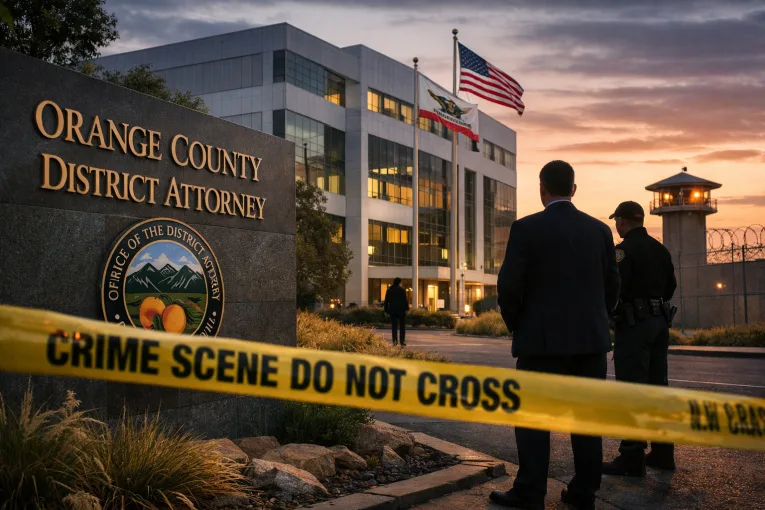
- “The violation of a single defendant’s constitutional rights calls into question the fairness of the entire criminal justice system.” – District Attorney Todd Spitzer
SANTA ANA, Calif. — More than a decade after a jailhouse informant scandal rocked the Orange County District Attorney’s Office and nearly derailed the prosecution of the deadliest mass shooting in county history, the U.S. Department of Justice announced Tuesday, Dec. 23, that it has ended federal oversight of the office’s informant practices, citing reforms implemented under District Attorney Todd Spitzer.
The decision ends a yearlong agreement between the Justice Department and local prosecutors that required the office to reform how it uses jailhouse informants in criminal cases. Federal officials said the agreement was satisfied after concluding the changes had been implemented and sustained.
“The Orange County District Attorney’s Office has implemented and sustained extensive reforms that demonstrate an enduring commitment to protecting the Sixth and Fourteenth Amendment rights of those in its jurisdiction,” Assistant Attorney General Harmeet K. Dhillon of the Justice Department’s Civil Rights Division said in a statement.
According to previous Davis Vanguard coverage, the oversight stemmed from a 2022 Justice Department report that found the Orange County district attorney’s office and sheriff’s department had systematically used jailhouse informants from at least 2007 to 2016 as “agents of law enforcement to elicit incriminating statements” and concealed evidence of the practice in dozens of trials, including information that may have been exculpatory.
The practice came to light during the prosecution of Scott Dekraai, who killed his ex-wife and seven others in a 2011 shooting at a Seal Beach hair salon. The revelations raised questions about how evidence in that case and others had been obtained and cast a shadow over the final years of Sandra Hutchens’ tenure as Orange County sheriff and Tony Rackauckas’ reelection bid as district attorney.
The Sixth Amendment to the U.S. Constitution protects the right of the accused to counsel. Federal investigators determined that using jailhouse informants after a defendant had been charged and represented by an attorney, without notifying defense counsel or disclosing the information obtained, violated that constitutional protection.
When Spitzer was elected district attorney in 2018 after defeating Rackauckas, he vowed to overhaul the office’s approach. “The violation of a single defendant’s constitutional rights calls into question the fairness of the entire criminal justice system,” Spitzer said in a statement quoted by both the Vanguard and the Orange County Register.
“After nearly a decade of investigation by the Department of Justice, the ‘win at all costs mentality’ chapter of the prior administration can finally be closed once and for all,” Spitzer said.
Under Spitzer’s leadership, the office initiated investigations that resulted in the firing of one prosecutor and the resignation or retirement of two others, according to the Register. The office also created an internal integrity unit to review cases involving potential Sixth or Fourteenth Amendment violations, required Spitzer’s approval before jailhouse informants can be used, and expanded disclosures to defense attorneys regarding when and how informants are deployed.
The use of jailhouse informants is not illegal or uncommon, according to the Los Angeles Times, but strict constitutional limits apply. Informants may not be used to elicit information from defendants who are represented by counsel, and prosecutors are required to disclose all informant-related evidence to the defense.
Despite the Justice Department’s decision, critics argue the reforms remain incomplete. Former longtime Orange County public defender Scott Sanders, who uncovered the illegal use of jailhouse informants during the Dekraai case, said the scandal’s full scope has yet to be addressed.
Sanders previously convinced a judge to overturn the 2010 murder conviction of Paul Gentile Smith and strike special circumstances after finding “reprehensible conduct” by prosecutors, including the concealment of 23 informant-related pieces of evidence. Smith’s case is scheduled to be retried in February.
“This is the nation’s largest snitch scandal by far,” Sanders told the Los Angeles Times. “So if the DOJ really wants to stand for justice, it doesn’t flee the scene of the crimes but rather demands that Orange County stakeholders create a meaningful review for the dozens of additional cases likely infected by those who wantonly committed prosecutorial law enforcement misconduct.”
Sanders said at least 61 cases have been affected by the improper use of informants and withheld evidence, many of them homicide prosecutions. While acknowledging improvements under Spitzer, he criticized the Justice Department for ending oversight when additional tainted cases could still emerge.
More work is needed, Sanders said, not only to prevent future misconduct but also to provide relief to defendants whose cases were compromised.
Kimberly Edds, a spokesperson for the district attorney’s office, told the Los Angeles Times that cases involving jailhouse informants continue to be reviewed. She said the office is reexamining, or has already reexamined, all cases identified during the investigation that involved in-custody informants used by the sheriff’s department.
Defense attorneys who believe a client was wrongfully convicted may also request a review by the district attorney’s office, Edds said.
Since the scandal, the office has expanded training requirements for prosecutors, paralegals and investigators, improved how informant records are stored and retrieved, broadened its conviction integrity review process, and adopted a new policy governing confidential sources. A spokesperson said the office also conducts annual audits with the sheriff’s department to ensure compliance with informant policies.
Follow the Vanguard on Social Media – X, Instagram and Facebook. Subscribe the Vanguard News letters. To make a tax-deductible donation, please visit davisvanguard.org/donate or give directly through ActBlue. Your support will ensure that the vital work of the Vanguard continues.
