
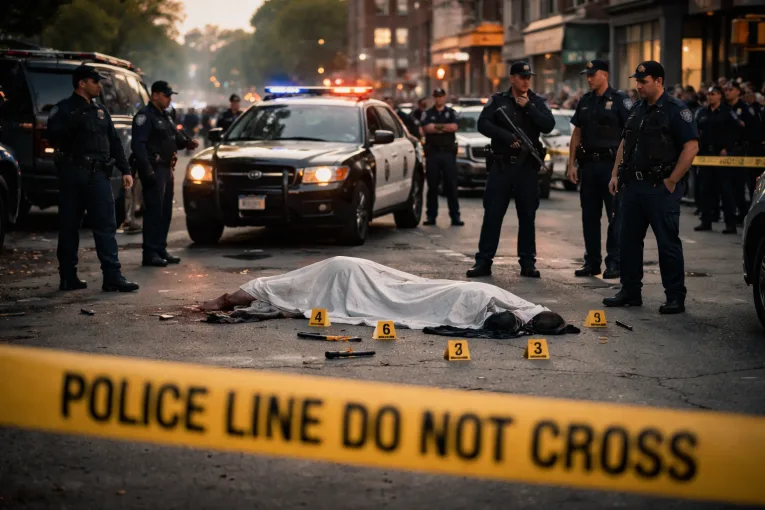
Washington — A comprehensive 2025 Police Violence Report released by the nonprofit research organization Mapping Police Violence shows that at least 1,201 people were killed by law enforcement officers across the United States, making 2025 one of the deadliest years for police violence since the organization began tracking data in 2013. The findings — based on media reports, obituaries, public records and databases such as The Gun Violence Archive — suggest a significant portion of these killings may have been preventable, even as police violence remained above pre-pandemic levels.
The 2025 Police Violence Report documents the number of killings by police declined slightly from the record 1,271 deaths recorded in 2024, but noted that the total remains higher than years prior to the COVID-19 pandemic. The report aims to provide the most comprehensive public accounting of deadly police violence and highlights the need for policy changes and accountability measures.
According to the report, Alaska recorded the highest rate of deaths involving law enforcement officers in 2025, with approximately 13.5 killings per 1 million residents. New Mexico followed with about 10 killings per 1 million residents, while Rhode Island recorded zero killings, according to the organization’s data visualization.
The report indicates that in 2025, approximately 95% of deaths involving police officers resulted from police shootings. Tasers, physical force and police vehicles accounted for most other deaths, and fewer than 1% of police-related killings resulted in officers being charged with a crime, with charges filed in only eight cases. Overall, fewer than 3% of police killings result in officers being charged with a crime each year.
Black prosecutors, particularly Black women, were disproportionately represented among those who pursued criminal charges in police-related deaths from 2013 to 2025. Although Black women make up about 1% of elected prosecutors nationwide, they accounted for 8% of prosecutors who filed charges against officers, 9% of those who secured convictions and 16% of prosecutors who brought charges in two or more deadly force incidents.
Mapping Police Violence identified officers in 342 cases in 2025, with records showing that at least 25 of those officers had previously been involved in shootings or other incidents resulting in death. The identities of the remaining 859 officers in these cases have not been publicly confirmed.
The 2025 report also found police deployed drones or robots against at least 24 people who were subsequently killed, using these technologies to enter buildings and locate individuals in barricade situations; in at least four of those incidents, the person allegedly shot at or disabled the drone before being killed by police.
The report states that most killings began with police responding to suspected nonviolent offenses or situations where no crime had been reported. Traffic stop-related killings often involved vehicle pursuits, prompting Hawaii to enact HB 227 in 2025, restricting police vehicle pursuits to serious offenses and banning officers from shooting at or from moving vehicles under most circumstances.
In 2025, at least 116 people were killed after officers responded to reports of erratic behavior or mental health crises. Other categories of incidents included 88 deaths during domestic disturbances, 125 involving individuals with weapons, 325 during violent crimes, 230 in connection with nonviolent offenses, 121 related to other crimes against people and 84 cases with unknown circumstances.
The report further notes that at least 25 states had official data collection or reporting requirements for police use of force in 2025, but many of these databases remain incomplete or not publicly accessible, underscoring persistent gaps in transparency.
According to Mapping Police Violence, 98 people killed by police in 2025 were unarmed, with the majority being people of color. Other reported causes of death included 56 deaths involving police vehicles, 224 involving knives or sharp objects, 677 involving firearms, 81 involving other objects and 65 cases with undetermined causes.
Racial disparities were stark in 2025 police killings. Black individuals, who make up about 12% of the U.S. population, accounted for 26% of deaths and were more likely to be unarmed and less likely to be threatening someone when killed. Hispanic individuals represented 18% of police killings while comprising 19% of the population. White individuals, representing 58% of the population, accounted for 37% of deaths, and people of other races, comprising 11% of the population, accounted for 21% of police killings.
Experts cited in the report say that many of these deaths could have been prevented through changes in policy and practice, such as adopting alternative response strategies for mental health crises and banning police shootings at moving vehicles. The ongoing effort to improve data collection and make use-of-force databases publicly accessible reflects broader calls for reforms to policing practices nationwide.
Follow the Vanguard on Social Media – X, Instagram and Facebook. Subscribe the Vanguard News letters. To make a tax-deductible donation, please visit davisvanguard.org/donate or give directly through ActBlue. Your support will ensure that the vital work of the Vanguard continues.
