
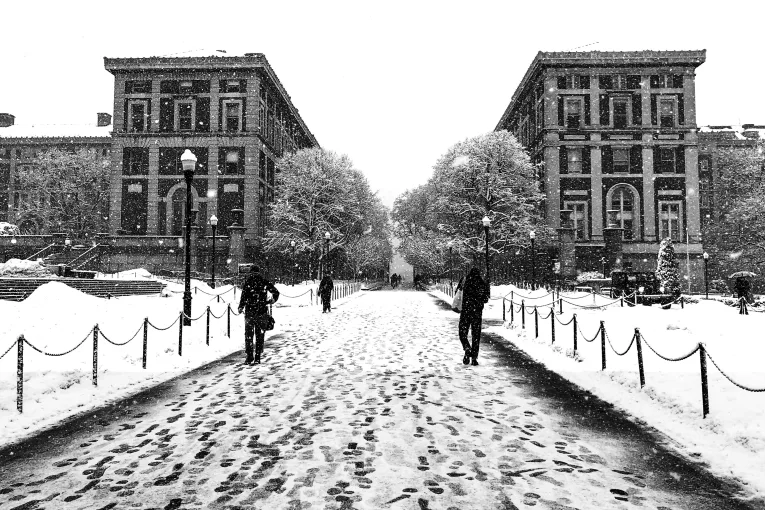
NEW YORK — Amnesty International on Thursday sharply criticized Immigration and Customs Enforcement following the reported detention of a Columbia University student inside a campus residential building, declaring that ICE “has no place in or around schools.”
In a statement released Thursday, Justin Mazzola, deputy director of research at Amnesty International USA, argued that Immigration and Customs Enforcement “has no place in or around schools” following the detention of the Columbia University student.
Reports indicate the student has since been released. In response, Mazzola criticized ICE’s actions and called for reforms to protect students from immigration enforcement on campus.
“ICE continues to target international students, and Columbia University is once again in its crosshairs — subjecting yet another student to arbitrary arrest and the widely documented inhumane conditions at ICE holding and detention facilities,” Mazzola said.
Mazzola further alleged that ICE used deceptive tactics to access the campus building. “ICE once again used tricks and ruses, hid their identity, and accessed a space without a warrant,” he stated.
He argued that enforcement actions near schools contribute to widespread fear among students. “As thousands of students across the United States are missing school or showing up to school in fear, this is just another example of ICE lying and targeting people for seeking an education,” Mazzola said.
“ICE has no place in or around schools — period,” he added, urging Columbia University to “affirm its commitment to be a sanctuary campus” and adopt policies to safeguard students and faculty from federal immigration enforcement.
Mazzola also called on Congress to intervene. “Congress must not give ICE another dollar,” he said, insisting that lawmakers should cut funding to ICE and Border Patrol and prohibit immigration enforcement in “sensitive locations like schools, hospitals, places of worship, and polling places.”
Recent research has examined how immigration enforcement actions affect school communities. A study by Thomas S. Dee, published in the Proceedings of the National Academy of Sciences, found that immigration raids in California’s Central Valley coincided with a 22% increase in daily student absences.
According to the study, “these increased absences underscore the broader policy relevance of this immigration enforcement in terms of their impact on schools, childhood stress, and opportunities to learn.” The research analyzed daily attendance data across five school districts and found particularly sharp increases in absences among younger students.
The study reported that the estimated effect of immigration raids among students in grades K-5 was more than three times larger than the effect observed among high school students. The findings also suggested that increased absenteeism may reflect broader stress and instability affecting students and their families.
Dee noted that the increase in absences was not temporary. In the study’s discussion, he wrote that the effects of immigration raids “have endured over the 2-mo period for which post-raid data are currently available,” adding that such increases “can also be understood as a leading indicator of broad and developmentally harmful stress these raids create for students and their families.”
The study further emphasized that immigration enforcement may have educational consequences beyond immediate attendance, as “the pacing and character of classroom instruction” can be affected by elevated absenteeism. Dee further noted that “developmental implications of a social climate of fear and mistrust may also extend to other children,” including those who are connected to legal immigrants or demographic groups associated with immigrant status.”
The Columbia incident adds to the ongoing national debate regarding the scope of federal immigration enforcement and its effect on students and educational institutions. While ICE maintains authority to enforce federal immigration law, civil rights organizations such as Amnesty International continue to argue that enforcement in and around schools undermines student safety and access to education.
Follow the Vanguard on Social Media – X, Instagram and Facebook. Subscribe the Vanguard News letters. To make a tax-deductible donation, please visit davisvanguard.org/donate or give directly through ActBlue. Your support will ensure that the vital work of the Vanguard continues.
