
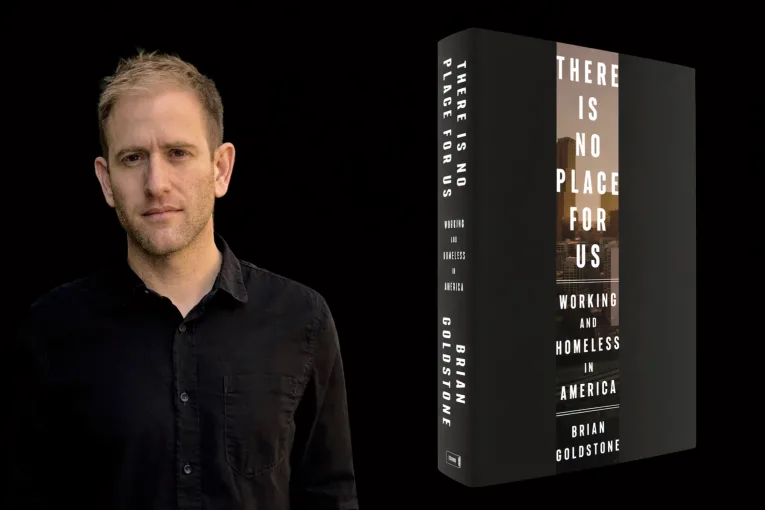
When Americans talk about homelessness, the mental image is often immediate and visual: people sleeping on sidewalks, tents clustered beneath freeway overpasses, makeshift encampments that signal visible poverty and social failure.
Those images are real, but in There Is No Place for Us: Working and Homeless in America, journalist Brian Goldstone argues they represent only the most exposed edge of a much larger and more insidious crisis.
His reporting, and the interviews he has given about the book, challenge the deeply ingrained assumption that homelessness is primarily about joblessness or individual dysfunction. Instead, Goldstone makes the case that homelessness today is increasingly a condition produced by work itself, by housing markets shaped around profit, and by public policies that systematically fail to recognize or count those pushed into instability.
Goldstone’s central intervention is conceptual. He urges readers to stop equating homelessness solely with life on the street and to reckon with a far broader population that remains largely invisible. In interviews with Vox, he has emphasized that the narrowness of popular definitions obscures the scope of the crisis and distorts public understanding of its causes.
“The only thing worse than being homeless in America is not being considered homeless in America,” Goldstone said, underscoring how families living in cars, extended-stay motels or doubled up with friends are routinely excluded from official counts and policy responses.
This invisibility is not a trivial technicality. It shapes who receives assistance, which crises register as emergencies, and which families are left to navigate instability alone. Goldstone’s reporting shows that many people experiencing homelessness today are working full time, sometimes holding multiple jobs in sectors essential to urban life.
Home health aides, delivery drivers, child care workers, retail employees and hospitality staff appear throughout the book, not as exceptions, but as representative figures. Their stories challenge the moral narrative that has long framed homelessness as a failure to work hard enough.
“Hard work is not enough in this country,” Goldstone told Vox.
That framing runs directly counter to the American promise that employment offers stability, dignity and a path upward.
Goldstone does not argue that work has lost its moral value; rather, he shows how the economic and housing structures surrounding work have changed so dramatically that wages no longer correspond to housing costs. In interview after interview, he has stressed that homelessness today often emerges not from economic collapse but from economic success measured in conventional terms.
“I argue in my book that the immense wealth accumulating in cities across America isn’t just sort of existing alongside this deprivation and precarity, but that it’s actively producing it,” Goldstone said.
Goldstone situates homelessness within booming metropolitan economies, places where unemployment is low, construction cranes dominate skylines and corporate profits are strong.
In these cities, rising rents, the disappearance of low-cost apartments and speculative real estate investment have combined to make housing unattainable even for those steadily employed.
Goldstone’s interviews stress that families are not merely unlucky casualties of a volatile housing market but are instead, as he puts it, being pushed out by structural forces.
“There’s this language of ‘falling into homelessness,’ which almost makes it seem like someone tripped,” Goldstone said. “I argue in my book that people aren’t ‘falling’ into homelessness. They’re being pushed.”
This framing helps to shift responsibility away from individual behavior and toward systemic forces.
Goldstone’s reporting documents how rent increases have consistently outpaced wage growth for decades, how affordable units have vanished from urban cores and how safety net programs have failed to keep pace with rising need.
Many families profiled in the book exhaust every available option before losing stable housing, cutting expenses, relocating repeatedly and enduring long commutes until nothing remains to cut.
The result is a largely invisible but widespread form of homelessness in which families sleep in minivans at safe parking lots, cycle between relatives’ homes, or become trapped in motel rooms that consume nearly all their income.
These arrangements are unstable and costly, leaving households unable to save for deposits or first and last month’s rent and, because they lack the visibility of street homelessness, politically marginal.
Goldstone’s critique extends to how data is used to reinforce this invisibility.
Federal definitions of homelessness focus on shelters and unsheltered populations, a framework that systematically excludes many working families.
In interviews, Goldstone has pointed out that this approach produces an artificially low count that shapes funding decisions and policy priorities.
A key point is that when homelessness is defined narrowly, policy responses inevitably follow, prioritizing emergency shelter beds instead of structural housing reform.
“Many people in this country have needed to believe a story about poverty and homelessness that says if people just work harder, they will be okay,” Goldstone said. “Yet in some cases, certain jobs can actually make it even more likely that homelessness will be waiting for you.”
That observation underscores a deeper cultural resistance to understanding homelessness as a failure of policy rather than a moral failing of individuals.
For decades, public opinion surveys have shown that Americans tend to attribute homelessness to addiction, mental illness or unwillingness to work, even as research consistently points to housing shortages as the primary driver.
Goldstone’s work confronts that disconnect directly by centering people whose lives contradict the stereotype: parents who clock in every day, pay taxes and still cannot secure a place to live.
By reframing homelessness as a spectrum rather than a fixed condition, Goldstone also challenges the way interventions are designed.
The line between being housed and unhoused, he suggests, is far thinner than commonly acknowledged.
A medical bill, a rent hike, a missed paycheck or a lease termination can push a working family from a cramped apartment into a motel room, then into a vehicle, and eventually onto the street.
Seen this way, street homelessness is not an isolated category but the visible endpoint of a much larger process of displacement and exclusion.
Goldstone’s interviews emphasize that focusing narrowly on the most visible homeless populations allows policymakers to avoid confronting the housing system itself, as temporary shelter, policing and behavioral interventions may manage symptoms but leave the underlying shortage of affordable homes and the financialization of housing intact.
In discussing solutions, he has pointed to structural approaches that remove housing from speculative markets and treat it as essential infrastructure rather than a commodity.
His work does not offer easy answers or quick fixes. Instead, it demands a shift in how homelessness is understood.
If homelessness is primarily a housing problem rather than an individual one, then solutions must be scaled accordingly.
That means grappling with land use, tenant protections, public investment and the role of large corporate landlords in reshaping urban housing markets.
What makes There Is No Place for Us particularly unsettling is its insistence that homelessness is no longer a marginal problem but is increasingly embedded in the mainstream economy, affecting people who work hard, remain employed and contribute to their communities.
Goldstone’s interviews strip away the comforting illusion that homelessness happens only to “other people” and replace it with a more disturbing reality.
As cities continue to celebrate growth and revitalization, Goldstone’s reporting raises a difficult question: prosperity for whom, and at what cost?
By forcing readers to confront the lives of the working homeless, his work reframes homelessness not as a failure of individuals to adapt, but as a failure of systems to provide the most basic form of stability.
For millions of Americans, there is no place for them—not because they are unwilling to work, but because the economic order no longer makes room for them to live.
Follow the Vanguard on Social Media – X, Instagram and Facebook. Subscribe the Vanguard News letters. To make a tax-deductible donation, please visit davisvanguard.org/donate or give directly through ActBlue. Your support will ensure that the vital work of the Vanguard continues.

i think i largely agree with this. That’s why I’ve been saying ‘so-called homeless’ for many years. When the city, or a city, does a survey and it comes back that homelessness is a top concern, rarely do they distinguish if people are concerned about people being thrown into or already not in stable housing situations, or if their concern is about crime from street people who may or may not have a roof and pay rent. That’s not a minor distinction. With most people, there are probably degrees of both, the balance depending on their personal circumstances economically and in dealing with the latter in their own lives.