
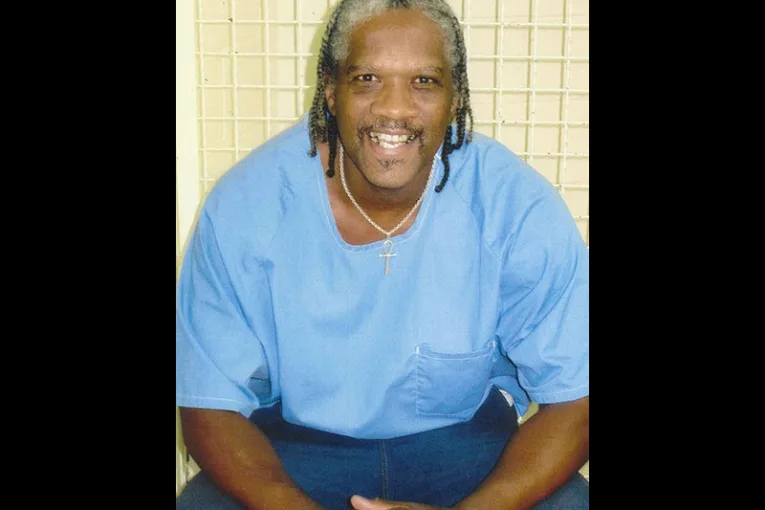
After more than four decades on California’s death row, Kevin Cooper says the question at the center of his case has never changed. He maintains that he did not commit the 1983 murders of four members of the Ryen family in Chino Hills and has spent the past 42 years trying to force the courts to reexamine evidence he says was tampered with, destroyed or withheld.
“I’m an innocent man on death row,” Cooper said during a recent phone interview from California Health Care Facility in Stockton.
Cooper, now 68, was convicted in 1985 and sentenced to death for the brutal killings of Doug and Peggy Ryen, their daughter Jessica, and family friend Christopher Hughes. A fifth victim, Joshua Ryen, survived the attack and became the only eyewitness. Cooper came within hours of execution in 2004 before a federal court granted a stay.
What followed were decades of appeals, forensic disputes and legal battles that have made his case one of the most contested capital convictions in California history. At the core of Cooper’s claims is the argument that the physical and DNA evidence used to uphold his conviction cannot be trusted.
“One person, especially me, weighing 155 pounds in 1983, could not do what the prosecutors say was done,” Cooper said. “To murder four people and attempt to murder a fifth person in three to four minutes is impossible.”
He has also consistently pointed to Joshua Ryen’s early statements to police identifying someone else as the attacker. Cooper said the child repeatedly told investigators that Cooper was not the man he saw. “If he had said I was the person who did it, I’d have been executed back in 2004,” Cooper said.
The prosecution’s case relied heavily on blood evidence and later DNA testing that purported to link Cooper to the crime scene. Cooper disputes both the origin and handling of that evidence. At the time of his trial in the mid-1980s, DNA testing did not yet exist, and blood-typing methods were used instead. Cooper said a criminologist waited until after his arrest to test a tiny drop of blood found at the crime scene next to his own sample.
“That pinhead drop of blood was supposed to have been used up, discarded,” he said. “So how could something that is no more come back into being?”
Cooper said that in 1999, the same evidence was removed from storage without a court order and held for a full day alongside his own blood and saliva. He said his attorneys were not notified at the time. When DNA testing was later conducted, the results were used to reaffirm his guilt.
“I’m the one that asked for the DNA testing,” Cooper said. “But how could something that was completely consumed, completely used up, thrown away, come back into existence?”
He also cited findings involving EDTA, a chemical preservative used in test tubes but not found naturally in the human body. Cooper said EDTA was detected on a beige T-shirt prosecutors said was linked to him.
“EDTA does not come from your body. It comes from a test tube,” he said. “Meaning that the blood that came from me came from a test tube that they put on that shirt.”
Federal courts later sent those EDTA findings out for further review, a decision Cooper said exemplified what he describes as a pattern of judicial avoidance rather than scrutiny.
Beyond the forensic disputes, Cooper has long argued that racial bias and political pressure shaped every stage of his prosecution and appeals. He described the handling of his case as part of a broader historical pattern in the United States.
“This is the DNA of this country,” Cooper said. “If they’ll do this to white people in 2026, what they was doing to Black people all throughout the history of this country.”
Cooper referenced what he sees as contemporary parallels in federal law enforcement actions and said misconduct is not confined to the past. “Their police are some lying motherfuckers, excuse my language, but they are, and the prosecutors too,” he said.
In 2021, California Gov. Gavin Newsom ordered an independent review of Cooper’s conviction, a move Cooper initially welcomed. His legal team had requested the formation of a full innocence commission, similar to those operating in other states, to review every aspect of the case.
“We asked him to form a commission to look at every aspect of my case,” Cooper said. “But he gave me the bogus ass innocence investigation.”
Cooper said the review failed to conduct meaningful testing or inquiry and instead relied on reports prepared by hired experts. While one expert validated the reliability of Joshua Ryen’s childhood memory, Cooper said that conclusion missed the point.
“This is not a memory case. This is a DNA case,” Cooper said. “That’s not for him to say.”
Cooper said the failure of the state review directly led to his current legal strategy, which centers on California’s Racial Justice Act. His case is now being handled by faculty and students at the University of San Francisco School of Law’s Racial Justice Clinic along with pro bono counsel from a private law firm.
“They pick and choose what cases they take,” Cooper said of the law school. “What happened to me is so outrageous to them.”
Under the Racial Justice Act, Cooper’s attorneys are seeking discovery from law enforcement agencies and the San Bernardino County District Attorney’s Office to demonstrate racial bias in charging and sentencing decisions. Cooper said he knows the effort will be resisted.
“They’re going to fight like hell not to get it,” he said. “But we got to keep fighting.”
If successful, Cooper believes the litigation could lead to an evidentiary hearing and eventually a new trial. “If I get that, then it’s all about getting a new trial,” he said.
Throughout the interview, Cooper repeatedly returned to the destruction of evidence, including bloody coveralls and a blue shirt he said police initially logged as evidence but later claimed never existed. He said internal records show the coveralls were destroyed under orders from a supervisor, a fact not disclosed at trial.
“That’s a Brady violation,” Cooper said, referring to the constitutional requirement that prosecutors disclose exculpatory evidence. “The jury didn’t know about that. The judge didn’t know about that.”
Cooper also pointed to unidentified DNA found on other items, including an orange towel, that he says does not belong to him or the victims. He said that evidence suggests multiple perpetrators.
“That’s three people,” Cooper said. “That ain’t me.”
Asked what he wants the public to understand beyond his claim of innocence, Cooper did not hesitate. “This criminal justice system is fucked up,” he said. “America claims that it don’t torture or convict its innocent people. But that’s a damn lie.”
He described daily life on death row as a form of ongoing punishment. “They tortured me for murders that I did not do,” Cooper said.
Cooper said the political dimensions of his case have only intensified in recent years. He accused former California Attorney General Kamala Harris of denying earlier requests for DNA testing. Cooper noted that Harris later apologized publicly after becoming a U.S. senator.
“She ended up apologizing after she became a senator,” Cooper said. “But she didn’t apologize to me. She didn’t apologize to my family.”
Even after DNA testing was finally conducted, Cooper said most of the samples were degraded. He said only one bloodstain, identified as item A-41, was deemed a match, a result he disputes.
“How could that drop of blood not be as degraded as what was in the test tube?” Cooper said. “That don’t make no sense.”
Now 68 years old, Cooper said he has spent most of his adult life awaiting execution.
“I have came within three hours and 42 minutes of being strapped out to that gurney and executed,” he said.
What he says he wants now is not special treatment, but a trial free from misconduct.
“Grant me a new trial,” Cooper said. “A trial that is free from prosecutor and police misconduct. Put all the evidence out there. Everything.”
Whether the courts will agree remains uncertain. But Cooper said he intends to keep fighting.
“I am alive. I am still fighting,” he said. “If I do die in prison, it won’t be because I didn’t try.”
Follow the Vanguard on Social Media – X, Instagram and Facebook. Subscribe the Vanguard News letters. To make a tax-deductible donation, please visit davisvanguard.org/donate or give directly through ActBlue. Your support will ensure that the vital work of the Vanguard continues.
