
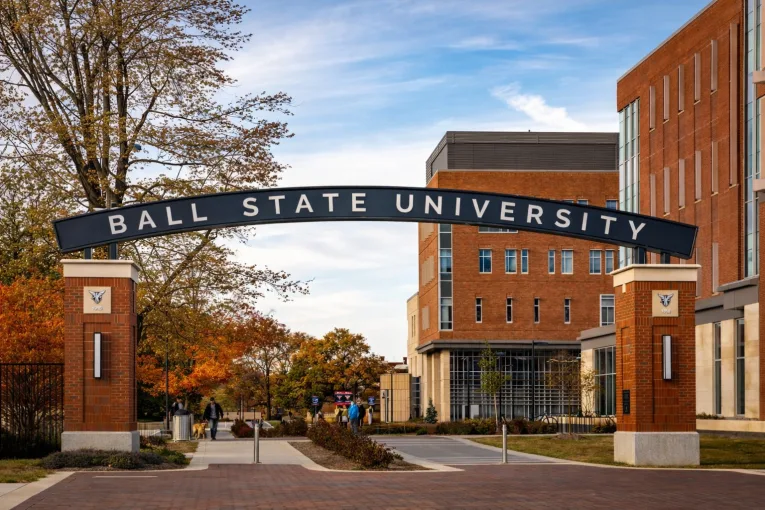
INDIANAPOLIS — The American Civil Liberties Union of Indiana filed two federal lawsuits Monday against Ball State University on behalf of 11 undergraduate students, alleging the university violated the First and Fourteenth Amendments by enforcing a campus policy that restricts expressive activity within 50 feet of most campus buildings.
The lawsuits claim Ball State violated constitutional protections through its enforcement of the university’s “50-foot policy” and its Failure-to-Comply provision.
The lawsuits stem from events that occurred on Nov. 19, 2025, when 11 undergraduate students entered the administration building on the university’s campus to hand-deliver notes to President Geoffrey S. Mearns.
These notes outlined their objections to the university’s support of and financial ties to Israel, according to the ACLU.
This legal action follows escalating tension between student activists and university administrators, as several of the plaintiffs had previously attempted to contact President Mearns and other administrators to communicate similar concerns through emails and formal requests for meetings.
According to the complaint, “They hoped that making the effort to appear in person in the Administration Building and to leave physical notes for President Mearns would help to stress the gravity of their concerns.”
The ACLU states that though the students were at first instructed to leave the building, they were allowed to remain in the hallway outside the president’s office to write the notes.
All students left the building once it closed at 5 p.m.
However, Ball State University states that the students had violated the 50-foot policy established in its Non-Commercial Expressive Activity and Assembly on University Property policy.
This policy forbids protests and demonstrations within 50 feet of most buildings on campus, including those with instructional or research space, computer labs, testing centers, administrative offices, or any university residence.
Furthermore, Ball State also asserts that the students failed to comply with directives from university officials.
As a result, the university imposed various disciplinary sanctions on the students, including semester-long suspensions.
The lawsuits filed by the ACLU seek declaratory relief, injunctive relief and damages.
Declaratory relief is a court declaration that defines the legal rights and obligations of both parties, often aimed at avoiding further litigation.
Injunctive relief, on the other hand, is a court order that requires the defendants either to take a specific action or to refrain from engaging in a specific action.
In this case, the ACLU seeks both to prevent enforcement of the 50-foot policy and Failure-to-Comply provision and to expunge all students’ disciplinary records, stating that the students’ conduct was “fully protected expression.”
As declared by Gavin M. Rose, deputy legal director at the ACLU of Indiana, “The First Amendment protects students’ right to engage in peaceful political expression, whether that means demonstrating on campus or delivering written concerns to university leadership.”
He added that universities, as public institutions, cannot impose “broad, unconstitutional policies” that unlawfully restrict constitutionally protected speech.
Both complaints filed by the ACLU request declaratory and injunctive relief; however, they differ in the specific defendants named and the damages sought, the financial compensation awarded to a plaintiff for harm caused by the defendant’s actions.
The first suit, filed by student Cooper Archer, seeks damages against Geoffrey S. Mearns, the president of Ball State; Kaleigh Richardson, the director of the Office of Student Conduct; and Mark Liebling, the vice president for people and culture at Ball State.
The second suit, filed by the 10 other student plaintiffs, was brought against Geoffrey S. Mearns; Kaleigh Richardson; T.J. Brecciaroli, the associate vice president for student affairs; and Melissa Rubrecht, the director of employee relations at Ball State.
The outcomes of these lawsuits could have significant implications for the extent of expressive activity allowed on public university campuses, particularly concerning how educational institutions balance administrative policies with constitutional protections.
As of the time of publication, Ball State has not formally responded to the lawsuits or publicly indicated whether it plans to revise its policies.
Follow the Vanguard on Social Media – X, Instagram and Facebook. Subscribe the Vanguard News letters. To make a tax-deductible donation, please visit davisvanguard.org/donate or give directly through ActBlue. Your support will ensure that the vital work of the Vanguard continues.
