
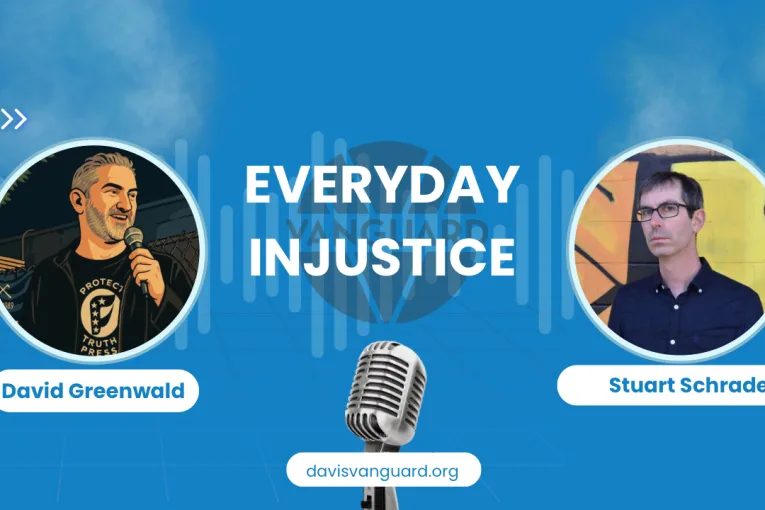
On the latest episode of Everyday Injustice, host David Greenwald sits down with historian Stuart Schrader of Johns Hopkins University to examine the political rise of police unions and their growing influence in American public life. Schrader’s forthcoming book, Blue Power: How Police Organized to Protect and Serve Themselves, traces how police organizations transformed themselves from fraternal associations into formidable political actors capable of shaping legislation, contracts and public narratives about crime and public safety. The conversation situates that evolution within a broader history of the “war on crime” and the bipartisan embrace of tough-on-crime politics.
Drawing on his earlier work, Badges Without Borders, Schrader explains how federal crime legislation in 1968 and the creation of the Law Enforcement Assistance Administration poured resources into local police departments. What began as a moment of federal expansion became a catalyst for police leaders and rank-and-file associations to see political advocacy as essential to protecting institutional power. The episode explores how national organizations such as the International Association of Chiefs of Police and later police unions leveraged Washington relationships while simultaneously reshaping local politics.
The discussion moves city by city—from Detroit and New York to Baltimore, Milwaukee and San Francisco—to show how police labor organizations refined tactics ranging from contract battles and strike threats to media campaigns and coordinated political pressure. In Baltimore, a failed experiment with an AFSCME-affiliated union and a subsequent strike reshaped the trajectory of police representation. In Milwaukee, a combative relationship between union leaders and a powerful chief helped export organizing strategies nationwide. Across these cases, Schrader identifies a consistent pattern: police organizations blending labor-style mobilization with a distinctive form of political leverage rooted in public fear of crime.
In the final segment, Greenwald and Schrader turn to the present moment, including the aftermath of the Black Lives Matter protests and the renewed politics of “law and order.” They analyze how police groups use news cycles, viral incidents and public safety narratives to assert bargaining power, even as other unions have declined. The episode offers a historically grounded framework for understanding contemporary debates about crime, reform and accountability—highlighting how decades of organized political engagement have positioned police institutions at the center of America’s justice discourse.
Follow the Vanguard on Social Media – X, Instagram and Facebook. Subscribe the Vanguard News letters. To make a tax-deductible donation, please visit davisvanguard.org/donate or give directly through ActBlue. Your support will ensure that the vital work of the Vanguard continues.
