
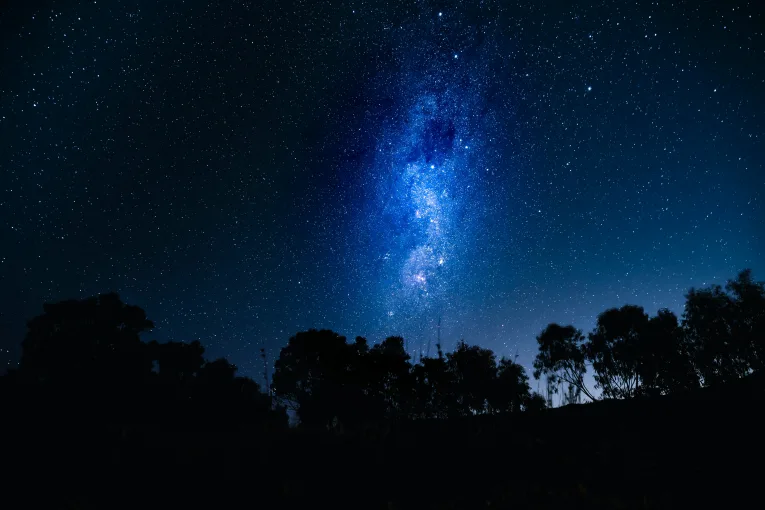
Astronomers look back in time with space-based telescopes and see stars and galaxies as they were millions and even billions of years ago. But what does it mean when they say: “Using the Hubble or James Webb telescopes we’re observing early galaxies, near the beginning of the universe, before the Earth even existed?”
They often refer to Hubble or James Webb as time machines. But the idea that “it took the light from a galaxy seven billion years to reach us,” when the Earth is four and half billion years old, is nonsensical.
When astronomers say telescopes are time machines, it means that all events in the universe, from the Big Bang to the present, are present in the present.
And it means the universe does not progress along an “arrow of time,” but seamlessly unfolds, with the entirety of the past enfolded in the present.
Einstein famously said, “Time is a tremendously persistent illusion.” In a 1955 letter, he added, “For those of us who believe in physics, the distinction between the past, present and future is only a stubbornly persistent illusion.”
However, is that true where the future is concerned, both with respect to cosmic and terrestrial evolution, and with consciousness?
Given that the past is enfolded in the present, cosmically in the birth and death of stars and galaxies, and sub-consciously in the scrolls of personal and collective memory, is the future also enfolded in the present?
That is, is the future, like the past, already determined, or is there a degree of indeterminacy about the future? Clearly, there is.
Measured in terrestrial time, the universe is estimated to be nearly 14 billion years old. As reported, “The earliest and most distant known galaxy discovered by Hubble dates to a time only 400 million years after the Big Bang. The infrared James Webb Space Telescope has looked back even further, to about 200 million years after the Big Bang.”
These astronomical reflections and questions on a cold, wet and foggy day in this part of northern California brought to mind an event that occurred some years ago during a meditation at dusk along the rain-swollen stream that runs through town.
Late one afternoon at dusk I sat on the ground beside the raging, white-capped stream. I was well layered against the cold, and insulated from the damp by foam pads under my butt.
The meditation deepened as the light faded. An admixture of mystery and subtle primal fear that comes over one alone in nature as dusk deepens came over me.
The fear dissolved by remaining with it in passive observation. Then thought yielded to attention, and there was the fact and feeling of timelessness. Effortlessly, the mind/brain left the stream of the known and entered into the immeasurable ocean of the unknown.
In the stillness and the last light on a cold, damp winter’s night, a question seized me: How did the indigenous people that lived here before they were killed or driven from their lands exist in such weather? Memories growing up in the Upper Midwest, where there are months of snow and weeks of sub-zero temperatures, intensified the question, since native people prospered in that climate as well.
Suddenly, a huge salmon sliced by, swimming upstream against the surging current. In over 20 years here, I had never seen a salmon in the creek, and the sight of the magnificent creature in its element was a shock.
In the second it took the big fish to swim by with such speed that it looked like it was swimming with the current rather than against it, time shifted, and a scene opened up across the little roaring river.
For some moments I stared into a Native American camp. It was full of physical and social warmth, with people who had plenty to eat and were warm and dry in strange-looking shelters barely visible through the fog.
I immediately doubted the experience — was I hallucinating? I hadn’t taken so much as a toke or a drink that day. And the mind, being completely quiet, was not projecting some imaginary scene, or conjuring an image from bits of knowledge.
Indeed, my images and ideas, knowledge and stereotypes of Indians were instantly obliterated. To this day, I feel there was a momentary tear in time, and I was given a glimpse into a bygone reality at that very spot.
I don’t understand how those moments of time travel happened, and I’ve never tried to repeat the experience. But if astronomers can see back a billion years with their instruments, isn’t it possible that a silent, questioning human being could glimpse the human past, which is enfolded in our collective consciousness?
Just as long dead stars and galaxies are present in the night sky, the human past, good and bad, lives on in the present. And because we humans haven’t faced and dissolved personal and collective darkness within, it has accumulated to the point that it’s eclipsing the heart of humanity.
If we are to survive and grow as human beings, a crucial distinction now needs to be between memory and thought on one hand, and direct perception and insight on the other.
True seeing and understanding occurs when we directly perceive the movement of what is, outwardly and inwardly, in the present. That’s the imperative of being present, since the present is the portal to insight, understanding and timelessness.
All human experience of conflict and war are of the cumulative past, which is smothering the living present. But we can bathe and be cleansed in the unknown. It is infinitely greater than our knowledge and experience, and cannot be encompassed by either.
When we are completely present, there is no such thing as time. There is only the present moment creatively unfolding within the human being, just as it is in the cosmos.
Follow the Vanguard on Social Media – X, Instagram and Facebook. Subscribe the Vanguard News letters. To make a tax-deductible donation, please visit davisvanguard.org/donate or give directly through ActBlue. Your support will ensure that the vital work of the Vanguard continues.
This story provides amazing insights and a way to practice that makes sense. It’s a inspired piece of writing, a gift. Thank you!
Thank you Jennifer, I appreciate it.