
I have been a fairly consistent opponent of most peripheral development projects in Davis over the past decade. For instance, I was the Principal Officer, Treasurer, and Chair or Co-Chair of the No on Nishi 1 (Student Housing), No on West Davis Active Adult Community (Senior Housing), and both the No on both DISC 1 and DISC 2 campaigns (primarily Commercial).
All of those peripheral annexation measures failed except West Davis Active Adult Community. But none of these projects provided for family housing for modest income buyers. I think Davis desperately needs that type of family housing and I believe the Village Farms Davis project provides it so I support the Project.
As a result, I recently both publicly endorsed the Yes on Measure V campaign and was a co-signer of the Rebuttal to the Argument Against Measure V that will appear on the June ballot.
Many folks that I had previously worked with opposing other projects have accused me of abandoning my slow-growth and/or environmental principles after hearing of my endorsement of Village Farms Davis or reading some of the articles I have published about various environmental aspects of the project. Some are saying it is inexplicable to them why I would make this seemingly sudden change in my views toward peripheral development and endorse this Project.
Well, the reasons are actually pretty simple. I opposed past peripheral development projects projects because I did not feel any met all of the 3 primary criteria that I look at when considering supporting or opposing a project. And the reason I can now support Village Farms Davis is because I can now check-off each of the boxes for the same 3 criteria – 1) the Features of the Project itself, 2) the Location of the Project, and 3) the Quality of the Developers of the Project.
Let me explain.
When I look at any major peripheral project I first take a broad view of the project and ask some basic questions.
1. The Project’s Location – I first look at the pros and cons of the project’s location:
- Is the location an in-fill location that is close to amenities such as schools, stores, and other amenities allowing for easy biking or pedestrian access?
- Is the project adequately served by existing and accessible public transportation routes?
- Is the project near local employment centers?
- Does the location of the project make it susceptible to unmitigated external environmental risks?
2. The Project’s Features – If the project is for family housing, I look for family-friendly project features:
- Does the project contain an appropriate mix of subsidized low income rental apartments and entry level housing in appropriate size and amounts to primarily serve low to middle-income communities in Davis?
- Does the project devote sufficient land to open space including parks and bikepaths/greenbelts?
- Does the project provide for other public needs in terms of on-site facilities?
- Does the project have sufficient environmental safeguards and mitigations to minimize any potential adverse environmental or undesirable impacts the Project might have on surrounding areas or neighbors?
3. The Track Record and Reputation of the Project‘s Developer – Perhaps the most important questions to ask are those relating to the development team:
- Does the developer have a long track record of successful development projects in Davis?
- Does the developer have a long history of philanthropic and other contributions and ties to the Community?
In my opinion, Village Farms Davis is the only peripheral project yet to come before voters that checks the boxes on each of these major evaluation criteria, as follows;
☑ THE PROJECT LOCATION
The location of the Project is one of the it’s main selling points.
1. Infill Development – Village Farms Davis fits very nicely into the natural borders of the City and is surrounded by residential development on 3 sides. It is truly infill development.
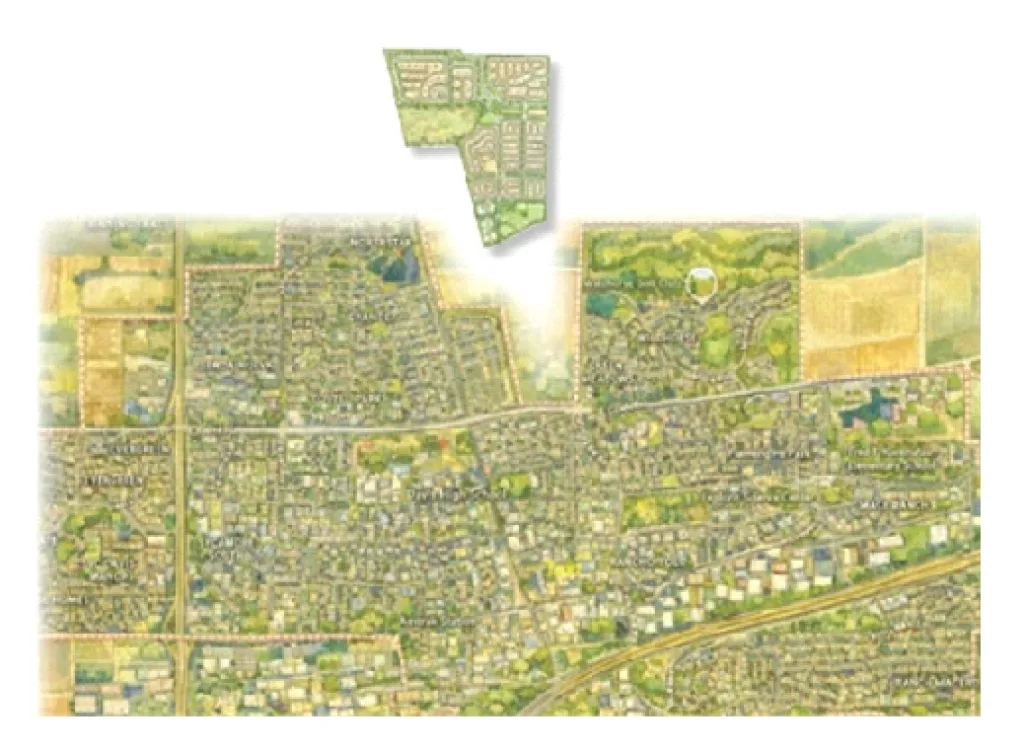
2. Pedestrian and Biking Accessibility – The Project’s location is within easy walking or biking distance of many destinations thus minimizing future commuting and intra-city automobile traffic. Nugget shopping center is directly across the street. There are four K-12 schools within ¾ mile. Downtown and UCD are each about 1.5 miles away; easily accessible by walking or bicycle.
3. Public Transit Access – Plus, the location of Village Farms Davis is immediately adjacent to or within a short walk of 18 existing dedicated bus stops for six Unitrans routes (E, F, L, P, Q, and T) and two Yolo Bus routes (43 and 230). There is no other location in the City where 1,800 units might otherwise be built that offers this many public transit options and close proximity to so many local destinations.
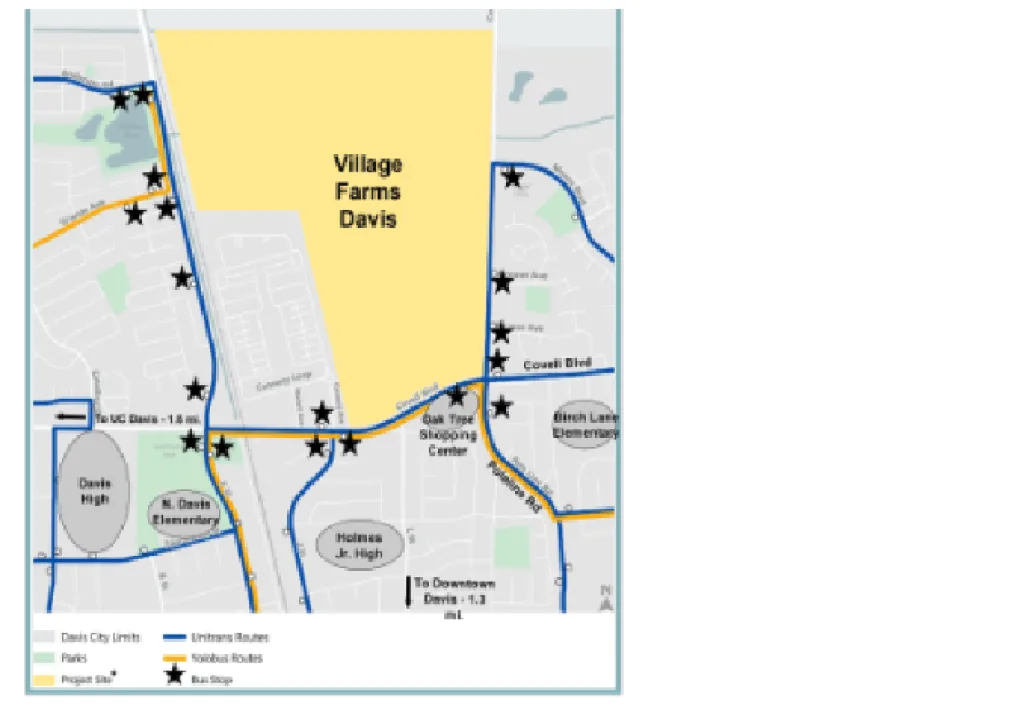
Neighborhood Connectivity – The Project will also have strong neighborhood connectivity by completing the Davis Bike Loop with an above-grade crossing over F St. and the railroad tracks landing near Northstar Pond and a below-grade crossing under Poleline landing near Nuggett Fields.
Impacts of the Local Environment on the Project – I am very aware of derogatory claims made by project opponents that the Project’s future residents will be at risk either 1) due to groundwater contamination as a result of it’s location near the former Old Davis Landfill and 2) due to risks of flooding because part of the project is now in a FEMA 100-year floodplain map. These claims are demonstrably false and made without any supporting 3rd-party, objective facts to support their assertions.
Firstly, the former Davis Landfill and the Project have undergone extensive groundwater testing since the 1980s which have conclusively shown that all of the volatile organic chemicals previously identified in past decades have completely dissipated and are no longer present at all.
Additionally, the California Water Quality Control Board sent a letter to the City stating there is “no risk” to future residents of Village Farms Davis from groundwater contamination providing that all of the water for the project is provided by the City of Davis municipal drinking water system – which it is!. Only Davis municipal drinking water will be used both for residents’ use and/or irrigation purposes.
Project opponents also claim there is a huge risk of future flooding because part of the project is in a 100-year floodplain. This is a red herring argument.. In fact, opponents are fully aware that the Project will meet 200-year flood protection standards (that more strict than FEMA standards) before construction even begins. While a portion of Village Farms is currently in a FEMA 100-year floodplain, the entire site will be engineered to provide protection for a 200-year flood event as now required by State law. All lot elevations will be certified by FEMA prior to authorization of construction and NO FEMA flood insurance will be required for any homes. As a result, Village Farms Davis will actually be more flood-resilient than almost all other subdivisions in Davis.
☑ THE PROJECT FEATURES
Diverse Housing Options – This 1,800 unit project is designed to provide many different housing choices primarily focused on missing middle-income housing needs. It will have a minimum of 100 townhouses starting at 800 square feet with prices starting in the $400,000s. It will also have hundreds of modest half-plexes and single-family homes starting at around 1,000 square feet. The Project also also includes a 16-acre land donation and a $6 million donation to the Davis Housing Trust Fund for construction of 360 permanently rent-subsidized low income housing units – the largest low-income housing contribution in Davis history
Green Space and Preserved Habitat – Over 50% of the project area is dedicated to open spaces, including parks, bike and walking paths, and accessible greenbelts and ag land. The development also preserves 47.1 acres of unique onsite alkali playa/wetlands habitat with a conservation easement and an endowment for permanent maintenance.
Climate Friendly – As a 100% all-electric community, every building will feature solar panels and be pre-wired for electric vehicle charging.
Community Amenities – The development includes land donations to DJUSD for both an early learning and daycare center and a learning farm for agricultural curriculum development. The Project will help sustain our beloved local public schools by providing housing for over 1,100 new students; helping reverse declining enrollment while minimizing out-of-district transfers.
Impacts on the Environment by the Project – I am also very aware of assertions made by project opponents that the Project itself will have a deleterious affect on the environment in terms of 1) PFAS contaminated groundwater migrating from beneath the Project site into a drainage channel that bisects the property, and 2) adverse impacts of traffic on local streets.. Both of these alleged adverse impacts have been extensively analyzed in the 5,000+ page, independently-prepared and reviewed Environmental Impact Report and the claims refuted”.
With regard to possible contamination by PFAS, other than a allegation that is “might” occur,. there is absolutely no quantitative evidence or studies that have been provided to even substantiate the possibility of such contamination much less the possible extent of the contamination. As more fully discussed in Appendix A below, these claims are simply not credible..
Project opponents also speak of a traffic Armageddon resulting from the Project and even claim in their ballot statement that the project will result in deterioration of traffic “Level of Service” to “F“. But this statement is completely misleading because it reflects modeling of traffic conditions assuming absolutely no improvements are made to any of the streets surrounding the project. In fact, tens of millions of dollars of mandatory street and traffic improvements on local streets must be made by the Project. And when these required improvements are made, modeled traffic conditions are substantially improved to acceptable Levels of Service as more fully discussed in Appendix B below
☑ THE PROJECT DEVELOPERS –
Local and Experienced – The Project is being developed by North Davis Land Company which is comprised of 7 local multi-generational families – The Whitcombe, Makley, Roe, Streng, Shepard, Schulze, and Buzbee families..But the vision for the project really came from John Whitcombe and his desire to provide middle income housing for more young families in Davis.
I’ve personally know John Whitcombe for about 20 years. He is a lifelong resident of Davis with family roots going back almost a century to when his parents met as students at UC Davis in the 1930s. John attended local public schools and was the senior class president in 1958 at Davis Senior High School. During his senior year, at 17 years of age, he built his first home in Davis. He then worked his way through UC Davis building homes and went on to Harvard Business School. Luckily for the Davis community, John returned home after a stint in the Army to begin his professional career as a local apprentice carpenter.
Leadership in Environmental Innovation – The other families in North Davis Land Company were equally influential in building many local housing projects utilizing local small builders that were on the forefront of environmental stewardship. These folks built our first Davis greenbelts and bike paths and were instrumental in preserving and increasing wildlife habitat within residential developments in Davis. Their legacy of environmentally responsible, family-oriented development continues with Village Farms Davis.
Local Philanthropy – The developers have also maintained deep philanthropic ties to Davis going back decades including establishing the Tandem Foundation for local school support, donating to a breadth of local causes, and funding and operating an organic farm that has donated over 500,000 pounds of produce to food banks and local non-profits. They actively support numerous community organizations including Davis Community Meals, Yolo Food Bank, and various sports and other youth programs. Indeed. there is hardly a major non-profit or civic undertaking in Davis that has not benefited from their support and financial contributions including the Bicycle Hall of Fame and the Farmers Market. These families were instrumental in building Davis to what it is today.
☑ CONCLUSION – For all of these reasons, I am an enthusiastic supporter of Village Farms Davis and hope others will join me in voting Yes on Measure V.
Appendix A – False Claims of Adverse Impacts by the Project on the Environment
Also seeSetting the Record Straight – Myths and Facts about Village Farms Davis ( https://davisvanguard.org/2026/02/village-farms-davis-myths-debunked/) for more information.
1) False Claims of Risks of PFAS Contamination of the Environment from Groundwater Contamination Beneath the Project – In 2024, additional groundwater testing showed the presence of PFASs chemicals beneath the landfill and, to a much lesser extent, in one of the three groundwater monitoring wells beneath the Project. Previous testing did not look for PFASs in the groundwater so prior concentrations of these chemical in groundwater are not known. Nevertheless, pundits claim that should groundwater rise to levels never before seen historically going back over a hundred years, that some of this contamination could seep into the primary drainage channel (“Channel A”) carrying surface runoff from West and North Davis. This drainage channel flows through the Project, under Poleline Rd into Widlhorse Golf Course, and on to the Willow Slough and the Yolo Bypass – potentially carrying these contaminants to the Vic Fazio Nature Preserve.
But these claims are beyond far-fetched. Firstly, such a scenario would require a rise in groundwater to levels never before seen. Even then, the risk of substantial PFAS contamination reaching the Yolo Bypass is almost infinitesimal because such small quantities of water could infiltrate into Channel A over time. Secondly, Village Farms Davis will actually provide increased protection from PFAS or other infiltration into the channel because a newly constructed Channel A will be lined with an impervious compacted clay layer to prevent any infiltration of any groundwater into the new channel.
Project naysayers who needlessly worry about PFAS contamination of the Yolo Bypass from the Project should instead focus their attention on the Davis Wastewater Treatment Plant that is about 3.5 miles away which discharges 6 million gallons of wastewater per day into adjacent wetlands with overflow eventually carrying into Yolo Bypass. Such effluent has a PFAS contamination over twice that found in the groundwater beneath the project representing a mass transfer of PFAS contamination into Yolo Bypass many orders of magnitude greater than that posed by the comparatively far smaller and extremely unlikely contamination posed beneath the Project.
2) Claims of Extreme Adverse Traffic Impacts of the Project on Surrounding Streets – Project opponents also speak of a traffic Armageddon resulting from the Project. In their REBUTTAL TO ARGUMENT IN FAVOR OF MEASURE Vthat will be on the June ballot, they claim, “It would bring over 15,000 more car trips DAILY near Covell Blvd. and Pole Line Road causing gridlock and Level of Service “F.”
But this statement is knowingly misleading because their claim does not account for the improvements in traffic conditions brought about by mandatory traffic and street improvements that are required for the Project. These will cost tens of millions of dollars and are more fully described below.
When these mandatory street and traffic management improvements are implemented, the delays at all the intersections near the project are substantially improved to acceptable Levels of Service.
According to the Local Transportation Analysis provided with the Environmental Impact Report, “Overall, the improvements would substantially reduce delays and queuing throughout the study area. The implementation of the recommended improvements would improve peak hour operations to acceptable levels at all study intersections under Existing Plus Project conditions.”
This is shown in Table 10 from that Local Transportation Analysis
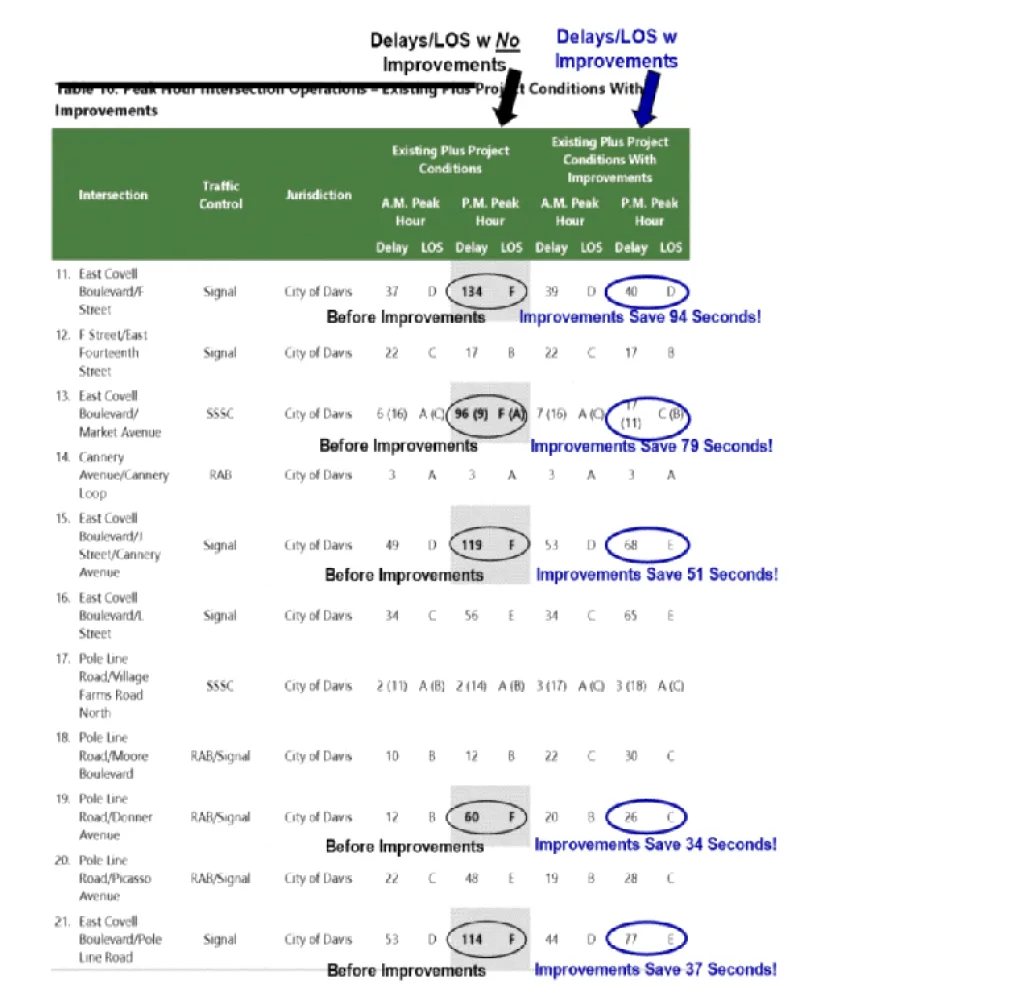
When viewed in this correct factual light, the adverse impacts of inccreased traffic are very manageable.
Following is a partial list of the extensive bike path and biking safety-related street mitigation improvements along with on- and off-site roadway improvements required by the Project to minimize vehicular traffic and biking impacts. These include:
a) Biking and Pedestrian-Related Improvements –
• Development of over 7 miles of multi-use trails, public bike lanes and walking paths throughout the Project,
• Construction of new Class I shared-use paths along the entire Pole Line Road (west side) and East Covell Boulevard (north side) of the site frontages,
• Construction of new high-visibility Class I shared-use path connections/road crossing at all entrances to the Project including 3 on Covell Blvd and 3 on Poleline Rd,
• High visibility crossing improvements on Covell Blvd at Birch Lane and Stripe Class III bike route on Birch Lane from Covell Blvd to Pole Line Road,
• Develop over 7 miles of multi-use trails, public bike lanes and walking paths throughout the Project.
b) Street Traffic-Related Improvements
• Roundabout and street crossing improvements at Moore Blvd,
• Traffic Signals and street crossing improvements at Donner and Picasso on Poleline,
• Traffic Efficiency Improvements at the signalized Covell Blvd/Poleline Rd Intersection,
• Fair share funding toward cumulative traffic impacts including expansion of roadway facilities and construction of traffic control and safety improvements along the Covell Corridor.
Follow the Vanguard on Social Media – X, Instagram and Facebook. Subscribe the Vanguard News letters. To make a tax-deductible donation, please visit davisvanguard.org/donate or give directly through ActBlue. Your support will ensure that the vital work of the Vanguard continues.

The plans for the project are the Developer’s concept, what develops from there depends on the Builder. A prime example is Bretton Woods Development that was completely changed from the original concept by the Builder. Developer to Builder is a critical step in the process and that can prove to be a huge change in the concept expectations.
I witnessed an early confrontation between Alan vs. those who were concerned about a probable vernal pool onsite, and I personally observed Alan responding in a manner that caused me to believe he was biased regarding that issue and the proposal as a whole. Anyone who saw that would arrive at the same conclusion.
One of the individuals who brought up the vernal pool was not what I’d characterize as a “slow growther”. He was a young UCD graduate, interested in that topic. His own behavior was not confrontational during that meeting, but he was seemingly surprised by Alan’s tone, etc.
Alan flat-out denied that a vernal pool existed at the site at all, when it was clear that it “wasn’t” clear to any unbiased observer.
The young man never attended another local Sierra Club meeting.
Since that time, I’ve noticed that Alan takes it “personally” when someone questions some aspect of his claims. (For example, in regard to the projected price of the housing.) You can also see some of this personal reaction in the article above.
Frankly, he “knows too much” about the developer talking points for me to conclude that he’s unbiased, as well.
Ron – I think your postings would have a greater impact if you confined your criticisms to the factual aspects of the Project itself or what I said in my writings instead of dwelling on whether or not you think I was a “meanie” at some point in the past.
It doesn’t have to do with being “mean” – it has to do with bias right from the start.
It continues in this article, and it continues anytime anyone puts forth a different conclusion.
Just a couple of days ago, I provided an example myself of the likely cost of any single-family unit built at the site, and you took immediate issue with it.
Even though I have an actual example.
https://www.centurycommunities.com/find-your-new-home/california/northern-california-metro/davis/harvest-glen/?utm_source=google_local&utm_medium=organic&utm_campaign=harvest-glen_gmb_ccs&utm_content=california
This type of thing (disputing the probable prices) is in conflict with your sudden interest in expanding “family housing”.
You’d be better off acknowledging the reality of what any single-family, detached housing is going to cost.
And other types of housing don’t generally appeal to families (2 adults, 2 kids, 2 cars).
Looking at Alan’s three criteria, I don’t see how these differ from Covell Village which also had 1864 homes on the same site in 2005. https://ceqanet.lci.ca.gov/2004062089/4#. That project was the first to come before the public under Measure J and it was rejected then. Alan wrote the “No” ballot argument on behalf of the Sierra Club then. It has the same developer, it has the same characteristics and features, and similar environmental impacts. I don’t see what’s changed.
In contrast, Alternative 4 in the VF EIR would have increased density 50%, making much more of the housing affordable while greatly reducing traffic and greenhouse gas emissions so that it could better comply with Davis’ Climate Action and Adaptation Plan (CAAP) that Alan had a hand in crafting while he was on the Natural Resources Commission. (We served together.)
Alan was a prime author of the proposed set of environmental-protection attributes submitted on the Davis Innovation Sustainability Center (DISC) in 2020 and in 2022. Here’s Alan’s comments from 2022: https://davisite.org/2021/10/26/comments-for-the-natural-resources-commission-review-of-disc-2022/ I resubmitted that list in my comments on the EIR and others echoed many of those requests. They were generally rejected by the developer in refusing to make reasonable changes in the proposal. I am failing to see the consistency between Alan’s views on DISC and on VF.
It is interesting to read the Davis Wiki entry on Covell Village and see the echoes in the opposition to VF. It looks like there’s been no real progress made in two decades: https://localwiki.org/davis/Covell_Village
Richard – Re: your post above about not seeing the differences between Covell Village from 20 years ago and the current Village Farms Davis proposed project – “It has the same developer, it has the same characteristics and features, and similar environmental impacts. I don’t see what’s changed.”
Well, actually quite a bit actually has changed from an environmental/sustainability perspective, as follows.
1) Village Farms Davis is engineered to withstand a 200-year flood event instead of just a 100-year flood event protecton proposed for Covell Village so the neighborhood will be much more flood resilient.
2) 47.1 acres of alkali playa wetlands habitat will now permanently preserved with a permanent conservation easement and an endowment to provide upkeep in the future. Covell Village proposed to build on that same land.
3) The level of contamination from the Old Davis Landfill has substantially diminished over time. All of the volatile organic chemical contaminants identified in the groundwater under the Old Davis Landfill and the Project when Covell Village was proposed have now completely dissipated and are now gone.
4) The Village Farms Davis project will rely entirely on City-supplied municipal water for all residential and irrigation use. The proposed deep well for residents’ use at Covell Village has been completely eliminated.
5) Channel A has been rerouted in Village Farms compared to Covell Village, It will now have a larger holding capacity and will be clay-lined to eliminate any threat of groundwater intrusion into the Channel.
6) The soil borrow site from the agricultural area to the north of the project is larger and can accept larger runoff flow from the H St. pump station thus reducing flood risks in central Davis (which is partly in a 100 year flood zone).
7) There are substantially smaller average lot sizes in Village farms compared to Covell village. Village Farms will have over 1,000 lots less than 5,000 sq feet.
8) The Village Farms project proposes a 16 acre donation of land a $6 million to the Davis Housing Trust Fund to construct 360 units of low income apartment housing instead of 185 single-family for sale homes reserved for seniors.
9) The amount of commercial space in Village Farms is hugely reduced from what was proposed for Covell Village which then proposed total commercial space over 200,000 sq ft.
10) All bike paths are upgraded to Class 1 and substantial additional mandatory street modifications and improvements are now required by the Project.
11) Many, many more bus stops and routes are now located adjacent to the project providing greatly increased public transit access compared to 20 years ago at Covell Village.
12) The Village Farms site will be all-electric with solar and EV ready wiring on each residence. Natural gas will be completely eliminated compared to Covell Village.
And these are just the ones that pop into my head off the bat. But it sure sounds like a lot has changed to me.
Reducing the commercial space is one of the big mistakes. We need more mixed used zoning, not less, to encourage walking and biking and to reduce driving. Lot sizes of 5,000 sf are still quite large and still unaffordable. The engineered flood protection is going to require moving 100,000 dump truck loads and most likely will destroy the agricultural productivity of the land to the north where the the soil is being “borrowed.” Building all electric is basically required for all new housing anyway under the Reach Code. Similarly all housing will now be on the City’s water system pulling from the Sacramento River. Putting the large park on the south side creates a significant barrier to transit and cycling no matter what how many stops are added or paths are upgraded. The biggest question is whether the Affordable housing will even be built because those units won’t qualify for funding from the state’s Strategic Growth Fund given the lack of focus on being transit oriented.
Lots of little changes, but nothing adding up to substantial. Little of this adds up to the NRC guidelines that we authored together for DISC.
Re: The engineered flood protection is going to require moving 100,000 dump truck loads and most likely will destroy the agricultural productivity of the land to the north where the the soil is being “borrowed.”
Not accordingly to House Consultants who performed the ag analysis on the project. They claimed because of the uniformity of the soil strata going down to 20 ft or more that it should be as productive as before the borrow. Also, Greg House and his brothers are also long-time organic farmers in Yolo County and their ag consulting is a side gig – so they know their farming! I do too having been born and raised working the fields and later managing the small family farm for my folks in Merced County for decades. I’ve seen lots of row crops and even orchards put in former soil borrow sites and they do just fine but only if the soil strata they are grown in is consistent down in the root zones – which is apparently the case in Village Farms.
_______________________________
Re: “Putting the large park on the south side creates a significant barrier to transit and cycling no matter what how many stops are added or paths are upgraded”
You have got to be kidding me! – If a 15 acre park is such a huge impediment to biking or walking to a bus stop or to work, then those folks were not likely to be walking or biking or using public transit anyways. Plus when the proposed low income housing was earlier put right on Covell instead of the proposed park, lots of folks howled that it was discriminatory (and racist) to put the poor people right on the noisiest part of the project with the highest likelihood of traffic emission exposure…Sort of damned if you do, damned if you don’t, eh?.
_______________________________
Re: “The biggest question is whether the affordable housing will even be built because those units won’t qualify for funding from the state’s Strategic Growth Fund given the lack of focus on being transit oriented.”
The low income housing program was demanded by the City because Staff claimed it has the highest liklihood of the housing being built. It basically uses the same model by which the most recent low income housing projects got built in Woodland and West Sac. Do you actually have a better financial model to work from? If so, where was it succesfully utilized and why wasn’t this model brought to the attention of the City when the matter was being considered by the Social Services Commission? Also I cannot find the transit-oriented requirements you referenced in the Startegic Growth Fund. Can you provide a url to link me to them?
_______________________________
Re: “I am failing to see the consistency between Alan’s views on DISC and on VF. It is interesting to read the Davis Wiki entry on Covell Village and see the echoes in the opposition to VF”.
The 12 measureable differences between the Village Farms and Covell Village that I posted above are all substantial and material differences and directly address the most serious concerns expressed during Measure X 20 years ago.
“You have got to be kidding me! – If a 15 acre park is such a huge impediment to biking or walking to a bus stop or to work, then those folks were not likely to be walking or biking or using public transit anyways.”
Probably the most-accurate thing you’ve said. (That is, they wouldn’t be walking, biking, or using public transit regardless). Unless, for example, their Sacramento-based employers subsidize public transit. (In which case, they’d be using cars primarily for non-work activities.)
How many parking spaces (garages, streets, or dedicated parking) are planned for the development in its entirety?
Almost every single “family” has at least two cars. Almost every single household with two or more adults has two or more cars.
The only exception to that (might) be UCD students.
“I don’t see what’s changed.”
Clearly what’s changed is AP.
“Clearly what’s changed is AP”
Well, yes, there’s that too.
In response to Alan Pryor’s endorsement of Village Farms and Measure V. I received the 8-page multicolored pro-Village Farms Flyer in the mail on Saturday, along with most city residents. Very slick production values with scenes of bucolic parks, open spaces and smiles on the faces of child models happily running amongst the trees. The flyer is not informational; it is an advertisement paid for by deep pocketed developers trying to sell a product. It’s easy to see how, with blinders on, Alan Pryor might see VF as a no-brainer. I however take exception to some of the unaddressed deficiencies in the proposed project with a potential billion dollar plus valuation. (This is a back of the envelope figure from multiplying 1800 housing units times the current median home price in Davis. When my calculator spit out a number in 10 to the 9th scientific notation, I realized the enormity of the project’s potential worth).
I would argue the merits of the project must also be weighed against the deficits that Mr. Pryor dismisses.
1. The project is near employment centers. Yes, if you work at Nugget Market, CVS, Super Cuts or the now dilapidated Carls Jr restaurant. UC Davis is the major employer, and Village Farms is on the far side of the city and distant from accessing I-80 or 113 conduits that lead to major auto entrances to campus.
2. Appropriate mix of subsidized housing sounds wonderful, but where will the not yet guaranteed subsidies come from. The developer’s generous 6-million-dollar grant is but a small percentage of what is needed for 100 to 360 housing units. While similar processes in West Sacramento have been successful, the price structure in Davis is a completely different nut to crack.
3. Environmental safeguards are a huge reason to vote NO on V to allow time for more 3rd party studies. Mr. Pryor characterizes claims that Village Farms has substantial environmental dangers as being “derogatory”, which in itself is rather derogatory. These claims sound more “cautionary” in my opinion. As a Davis resident with an average knowledge of science, I sat unconvinced during the City Council meeting in which the final EIR was officially certified. This meeting, of course, opened the door to moving forward with the premature request for a June ballot slot for Village Farms. More traffic lights, roundabouts and speed bumps do not, in my opinion, mitigate the travel times, driver frustration and increased air pollution the addition of 1800 households worth of automobiles will bring. One effect of the moving of tons of earth during the decade long construction phase will produce unavoidable diesel and dust pollution. The North Wind Drift will carry particulate matter and toxics directly over Covell Blvd and into the Davisville Senior Apartments at Kennedy Place. Seniors are among the groups considered to be “Sensitive Receptors” and therefore highly susceptible to poor and dangerous air quality.
4. As for a developer with a long track record, the Nishi project opposed by Mr. Pryor involved the same Whitcombe group proposing Village Farms.
It could legitimately be argued that the delay created by a No no V vote would allow for more study of the proposed size and scope of Village Farms. Fewer units, south of drainage channel A and the old dump site would be a win for the residents of Davis even though it would cut down on the potential profits of the currently proposed and largest ever residential development in the history of Davis. Mr. Pryor lays out his argument for his support as an argument for a “peripheral” project and in the next breath tries to legitimize it as being “infill”. It can’t be both my friends, but requiring annexation on the edge of town makes Village Farms peripheral to the City. I would strongly urge every voter to read the entire ballot language before making their decision. This would include the arguments and rebuttals for and against.
“More traffic lights, roundabouts and speed bumps do not, in my opinion, mitigate the travel times, driver frustration and increased air pollution the addition of 1800 households worth of automobiles will bring.”
I always laugh to myself when they label additional traffic flow impediments as “improvements”.
I try to retain that level of amusement whenever I’m faced with a new “improvement”. Several of these “improvements” have been installed along Road 102 (the Costco Highway), including one in Davis itself and two or three others resulting from the Spring Lake housing development.
By the time they get through “improving” that road, it will take a half-hour to travel between Davis and Woodland.
Re: “By the time they get through “improving” that road, it will take a half-hour to travel between Davis and Woodland.”
I agree. It’s all those damn Spring Lake residents flooding into Davis every day to work at UCD or bring their transfer student kids to school! If only someone would build some decent housing in Davis so those folks could live closer to the Davis schools and the kids could ride their bikes to school and the parents could take the bus to work. If only…
I’m on board with you, regarding DJUSD’s poaching of Woodland students.
But there aren’t going to be mass numbers of Davis (or UCD workers) willing to sell their current homes, for the privilege of losing a bunch of money in the transaction and buying a more-expensive shoebox with much less square footage, yards, and parking spaces.
The same reason that younger families seek out Spring Lake in the first place. And that’s not going to change. ($$$)
The people making these arguments are completely out of touch with reality. Perhaps they’re too far-removed from the time that they purchased their own Davis house for pocket change.
Again, it’s approximately $550K – $600K to purchase the smallest-size new “family” house in Woodland itself! These are places with literally no yard, no street parking – other than a limited number of assigned spaces, on lots that appear to be significantly smaller than the 5,000 square foot size that you cited for Village Farms.
https://www.lennar.com/new-homes/california/sacramento/woodland/ruby-cottages
As a side note/point of clarification, I don’t believe that the very first image in the video above shows the new development, itself. I believe it shows a “nearby” one (which is already established/completed), and would cost more than “Ruby Cottages”.
(And this goes to why I hate the entire sales profession – dishonesty.)
But the video then transitions into showing the actual Ruby Cottages development itself (tiny front yard, no backyard – since their garages/driveways abut the “shared” driveway/street.)
And again, this is in “oh-so-desirable” Woodland! Get your checkbooks out.
Truth be told, the finishes (e.g., fixtures) at that development are rather low-quality, as well.
In Reply to John Cooper’s post above
Wow. There’s a lot to unpack here. Ok, let’s get started
Re: Driving to UCD – “Village Farms is on the far side of the city and distant from accessing I-80 or 113 conduits that lead to major auto entrances to campus.”
I do not expect VFD residents will drive to “access” the major I-80 and113 conduits that lead to the major auto entrances to campus. That would be, well, stupid. The advantage of VFD’s location is that residents of VFD, instead of driving to work, can easily ride a bike or take a bus to campus – just like the 70% of UCD employees who live in Davis already do…That’s the whole point!
__________________________________
Re: Low Income Housing – “While similar processes in West Sacramento have been successful, the price structure in Davis is a completely different nut to crack.”
I don’t believe the construction costs in Davis are any different than in Woodland or West Sac. So how is it a different nut to crack?
__________________________________
Re: Environmental Costs – “More traffic lights, roundabouts and speed bumps do not, in my opinion, mitigate the travel times, driver frustration and increased air pollution the addition of 1800 households worth of automobiles will bring.”
This does not make any sense. Are you saying that if the 1,800 homes were instead built in Woodland or West Sac or Dixon or Vacaville that those folks driving to Davis to work will somehow result in less “travel times, driver frustration and increased air pollution” than if they lived in VFD? If so, I’d love to see your math on that one.
__________________________________
Re: Dust from dirt moving – ” One effect of the moving of tons of earth during the decade long construction phase will produce unavoidable diesel and dust pollution”
Read the mitigation measures in the DEIR. The short haul from the borrow site to the deposit side will be lightly sprayed with water any time any dust is generated to minimize drift. This is a far better than the clouds of dust generated multiple times a year when the ag fields are disced or harvested for which absolutely no mitigation is required at all.
__________________________________
Re: Peripheral vs Infill Development – “Mr. Pryor lays out his argument for his support as an argument for a “peripheral” project and in the next breath tries to legitimize it as being “infill”. It can’t be both my friends, but requiring annexation on the edge of town makes Village Farms peripheral to the City”
Uh – Yes it can be both peripheral and infill at the same time! It is outside the City limits so it is considered “peripheral” to the City limits and requires a vote by the electorate to annex it into the City. But it will be surrounded on 3 sides by existing residential development, so it is considered “Infill”. I don’t see the conflict here at all
__________________________________
Re: Educate yourself before voting – “I would strongly urge every voter to read the entire ballot language before making their decision. This would include the arguments and rebuttals for and against.”
As would I. I would also urge voters to read the numerous articles I have written in the Vanguard, such as the article above, that refutes all of the false claims made by project opponents.
Ron says nearly every household has two cars. That is true today in most suburban developments, but that pattern is partly a product of how neighborhoods are designed. When housing is closer to transit, jobs, and services—and when parking is limited—car ownership rates drop. This is well documented in transit-oriented developments and university-adjacent housing areas. Around University of California, Davis, for example, student-heavy neighborhoods often have significantly fewer cars per household than typical suburban tracts.
Ron suggests people will not move to smaller homes with less parking or yard space. In reality, the market already shows strong demand for exactly that kind of housing—particularly among younger buyers, downsizing retirees, and households priced out of large-lot homes. Builders would not continue producing small-lot homes if buyers were not purchasing them.
What is true, however, is that existing homeowners rarely move just to obtain smaller housing. High transaction costs, property tax rules, and mortgage rates discourage people from selling. That does not mean there is no demand but what it does mean is that the buyers are often new entrants to the market rather than existing Davis homeowners trading down.
My original comment (I probably edited it before posting) noted that UCD students likely have fewer cars per “adult” than other cohorts (such as parents/non-students).
But Davis is not an employment center, and UCD isn’t hiring. And most households do not consist of two adults working at the same location in the first place.
Sacramento is an employment center.
By the time someone wants to have a family, they’re looking for space and affordability. And for better or worse, they’ll find it in Woodland.
Of course, units at Village Farms would “sell”. But it wouldn’t be families who buy them. (Probably housing UCD students to a significant degree, one way or another.)
“and UCD isn’t hiring.”
UC Davis is always hiring, and has 260 job listings right now.
https://hr.ucdavis.edu/jobs
O.K. – does that mean that 260 former workers are leaving the area (or have already done so)?
Perhaps a better descriptor is that UCD is not expanding the number of jobs. Not sure if they’re resumed hiring replacements in regard to Trump’s earlier actions.
Yes, there’s always turnover regarding employment – just as there is with housing. Should we review the Zillow listings, again?
In any case, whatever happened to the plan to house more UCD workers on campus, as they’ve done for decades behind the small mall (Davis Commons?) downtown?
Couldn’t edit my comment, due to some technical delay (apparently at the Vanguard). But couldn’t help but notice that your link refers to UCD’s presence in Sacramento, as well.
Was that an oversight?
For that matter, the link itself does not provide any such count. So I dug a little further, and limited the search result to UC DAVIS (130 job openings, not 260.)
And now that I think about it a little more (always a dangerous thing), did any of the UC workers in Sacramento live in Davis, “taking up” housing in Davis? And if so, have they at least moved out of Davis since they’re no longer working in Sacramento?
The suppositions about who will occupy the housing denies the reality that families make decisions based on many factors instead of the preconceptions of the know it all’s who comment here.
Most of this goes against current thinking – and I find it odd that you keep promoting housing in Woodland rather than Davis.
I do not promote housing in Woodland – quite the opposite.
But you seem to think I have some kind of influence, there. (Other than saving the park from the school district, which required a great deal of effort.) Actually, saved it three times, since the city also wanted to put housing in a portion of it at one time. (Similar to what occurred in Mace Ranch park – a failed commercial site that’s now covered in ugly housing. Perhaps partly because I was no longer around to try to protect it, though I’m not sure if I would have succeeded there. I could see it coming from a mile away so to speak, at both locations.)
I don’t think you have any influence, but you are now constantly promoting Woodland as having better housing opportunities and more.
I’m just noting the reality regarding the price difference.
Actually, the same reason that Davis has so many transplants from the Bay Area.
Davis’ housing is “cheap” in comparison. And the jobs in the Sacramento area generally don’t pay that much less.
This overall situation is true throughout the country. That is, unless you’re “at the top” in regard to income, you’re better off living in an area where the average salary is more inline with housing and other costs (including taxes).
This is also the reason for the California exodus, of course.
This type of “adjustment” that people make has always been true. It’s also the same reason that Daly City was developed (for people who couldn’t afford Nob Hill). And this was well-before the growth nuts came up with terms like “NIMBY”.
It’s actually the free market at work. There is no way for Nob Hill to be as cheap as Daly City.
Though as far as having “no influence” at all, the people on the council know who I am. But it’s not “me” that’s important – it’s the issue(s).
I just pick battles that I might have a chance to win (such as the issue with the park). The secret to my (limited) but substantial success? I seek help from others who would have similar concerns.
Obviously, a council is going to ignore an individual if it goes against what they’d prefer – even if he or she is “right”.
If I don’t lead myself regarding a particular issue that I care about, I will then “follow” the leader. (And I will “let them” lead without interference from me. Someone has to make decisions regarding strategy/effort, at some point.)
For me the decision comes down to 2 things:
1. Another car-centric design.
2. Not enough affordable housing to get us even close to our RHNA allocations, and most of what’s included isn’t guaranteed ever to get built.
Thanks, but no thanks.
McCann: “Reducing the commercial space is one of the big mistakes. We need more mixed used zoning, not less, to encourage walking and biking and to reduce driving.”
Dude you are so living in the past. Vacant commercial space is abundant as big box stores and the internet has decimated the need for the kind of commercial space you describe above. In fact, as I have pointed out before, there is still undeveloped commercial space next door at the Cannery. But hey don’t let reality get in the way of your fevered dreams.
And there is a shopping center right across the street from the Village Farms site.
Yeap – a shopping center that they’d nevertheless drive to.
Wow dude how do you get to the Co-op?
“Ron says nearly every household has two cars. That is true today in most suburban developments, but that pattern is partly a product of how neighborhoods are designed.”
Old thinking. Many of my neighbors are now getting to campus on e-bikes as will many of the residents who will move into this development. One neighbor told me her e-car battery went dead from disuse and had to be charged because she doesn’t drive much anymore because she commutes to UCD on her e-bike
I’m apparently surrounded by “old thinkers” (despite being in a neighborhood where the residents are much younger than me, on average). And they have kids (most of whom end up getting their own cars before they move out – assuming that they ever do these days).
As far as “e-bikes” are concerned, I think we saw the result of one of those the other day. I’ve personally witnessed some pretty impressive “wheelies” on Pole Line, as well as some kid going around 45 mph on Fifth Street in Davis.
Strange, how the collision was initially described as being between “two bicyclists” (and there’s been no release of information regarding what type of “e-bike” the kid was riding).
Shameful. Exploiting the death of a community member for a cheap political shot when we don’t even yet know what the investigation will reveal. Your lack of decency disgusts me.
As noted, it’s not just that one incident. Also, we already do know that the older woman who was killed was definitely not the one riding a heavier, faster, electrically-assisted machine.
Some of these vehicles are essentially electric motorcycles, which are dangerous and are not being sufficiently regulated (by parents or the authorities). And yet, you seem to be stating that residents at Village Farms would rely upon them as if that’s a good thing. (I’m not convinced that they’d use those as primary transportation in the first place, but they’re certainly no panacea and are a hazard to existing bicyclists and pedestrians.)
Ron O, I agree. We have several kids riding those electric bikes (mini motorcycles) in our neighborhood without wearing helmets. They go fast and are dangerous. A lot of children are going to get injured, or worse, on e-bike-motorcycles not to mention who else they may hurt.
I know someone in the medical field who says they’re seeing a lot of e-bike, e-scooter and e-skateboard injuries coming into their emergency rooms.
I agree with you Keith there is a lot of dangerous behavior on e-bikes and we need better enforcement. But if you go back and look at Ron O’s comment it wasn’t about the dangers of e-bikes it was about denying and disparaging the new transportation realities e-bikes create in order to argue against Measure V because he will use anything he can think of to oppose the project. Exploiting the tragic collision and death of a community member in this way is what I find both insensitive and objectionable.
The Malthusian Troll likes to be provocative but in this case he goes too low and pissed me off.
Ron G: You’d probably have to first look at your original comment where you imply that those things are a good solution. That’s what I was responding to, so here it is again:
“Old thinking. Many of my neighbors are now getting to campus on e-bikes as will many of the residents who will move into this development.”
As I noted, my own neighbors (most of whom are decidedly younger than I am, and have kids) are apparently “old thinkers” in your view.
But you’d also have to look at my response more carefully, as I doubt that residents living on new sprawl will abandon their usage of cars in the first place. Pretty sure that they’d even “drive” to Nugget – right across the street.
I’ve asked this before (with no response from Alan P or anyone else): What is the total number of parking spaces planned for Village Farms (including garages, driveways, street parking, or other designated parking areas)? If you know the answer to that, then you’ll know how many vehicles one might expect. (From residents, visitors, contractors, delivery people, etc.)
I’m sorry that you’re “pissed off” at my observations so easily. But as I recall, you’re one of the biggest proponents of vehicular parking (e.g., free parking downtown) in the first place.
Ron Glick said … “ Many of my neighbors are now getting to campus on e-bikes”
I don’t know what neighborhood you live in Ron, but proximity to the destination, and age of the person commuting greatly affect the choice of transportation mode. For example, e-bikes are rarely seen in El Macero or the neighborhoods around Pioneer Elementary School. They are much more prevalent in Davis’ close to Downtown neighborhoods, and mostly with student riders.
Given the fact that all the apartments are described as deed and income restricted, they won’t be available to UCD students, so any e-bikers will be adults. The market penetration of e-bikes by demographic cohort would be interesting to know. For example, does your have an e-bike? If yes, how often do you use it?
E-bikes are more ubiquitous than you think. My belief is based on anecdotal evidence and observation but I do know several middle aged or young senior e-bike riders that are driving less and enjoying their commute more. I know two who work at UCD and one that works at DJUSD. My expectation is that the use of e-bikes for travel within Davis and UCD will continue to grow because e-bikes are more energy efficient than cars, cheaper to operate and easier to park close to a person’s destination.
Doubling down on disgusting.
One topic that I am unclear about and no one has addressed (I don’t think) is whether is Davis likely to be subject to state mandates soon if we don’t create more housing? My problem with most of the discussion of housing in Davis is that it is presented as though the alternative is perfect housing. The reality is that people working in Davis are now driving from West Sacramento, Dixon, Woodland, and other locations in the county and beyond. This may not seem a tragedy for those who already live here (and see their property values go up with the constricted supply), but when you talk about environmental and other impacts, please frame them in the context of plausible alternatives.
“is Davis likely to be subject to state mandates soon if we don’t create more housing?”
Davis is already subject to state mandates on housing via the RHNA process. The question is whether or not the state will attempt to overrule Measure J and bypass the local approval process. My non-lawyerly sense is that they won’t be able to do that until a peripheral landowner first annexes his land to the city, as the city could argue that it lacks jurisdiction to approve housing on land that’s in the county. (The current process, as I understand it, is that once a Measure J vote succeeds the owner petitions LAFCo for annexation, the annexation is effected, and then the development agreement between the city and the owner is implemented.) Alternatively, the state could compel the county to approve the peripheral development, but that would run counter to the state’s own preference for development to occur within cities. So it seems to me that a state override of Measure J, while possible, has to overcome some legal hurdles first.
That is a really important question Mike. There is a near term answer to it … through 2030 … and a longer term answer to it … beyond 2030.
Up through 2030 the City has in place a State-certified Housing Element that meets the State’s RHNA (Regional Housing Needs Assessment) mandate for housing. And the number of units from the Village Farms development is not part of that certified Housing Element. So until at least 2030 Davis should be immune to any State intrusion.
After 2030 involves some speculation because the State RHNA allocation numbers are unknown at this time. But two things are crystal clear. (1) the Village farms proposal will not have a sufficient number of affordable units to satisfy the Affordable portion of the RHNA allocation, and (2) the City has time to look at rezoning corridors of existing Davis (the Anderson Road corridor, the 5th Street East corridor, and Downtown to name just three areas) for dense enough housing to cover the overall RHNA allocation. So, the fear of the State coming in is premature … as long as Nero doesn’t fiddle while Davis burns.
With the above said, let’s look at those people who are “working in Davis (who) are now driving from West Sacramento, Dixon, Woodland, and other locations in the county and beyond.” The jobs profile of Davis is a city with a preponderance of moderate-paying to low-paying service jobs. Lots of restaurant jobs and coffee shop jobs and hotel maintenance jobs and hospital support jobs and school teacher jobs. Those jobs simply do not pay enough to provide the financial means/resources needed to purchase a home in Davis.
Why is that? Because the developers who have built new homes in Davis have prioritized profits over social justice. That is how capitalism works. St they have built large homes with large prices. The only way we are going to improve the supply of houses that those people “working in Davis (who) are now driving from West Sacramento, Dixon, Woodland, and other locations in the county and beyond” can afford is to build smaller houses, situated on smaller lots, selling for smaller price tags.
If you read through the Baseline Features of the Village Farms proposal, you will find no ability to hold the developer (or the City government) accountable for actually building affordable housing. Look at the real estate sales listings for both Bretton Woods and The Cannery. The prices they are selling for … $800,000 and up at Bretton Woods and over $1 million at The Cannery will not do anything to cause even one person to move to a new home in Davis who currently is “working in Davis (who) is now driving from West Sacramento, Dixon, Woodland, and other locations in the county and beyond”
Mr. Pryor. You are Treasure and Chair of the local Yolano Sierra Club Group but I do not find that readily stated in your resent promotional articles for Measure V on the Davisite or Vanguard web sites. I attended and commented a recent virtual meeting of the Yolano Group in which participants overwhelming requested the Group not endorse Village Farms. Could you kindly indicate if you’re representing a Yolano Group endorsement or giving your singular support for Measure V/Village Farms. Thanks.
My endorsement is my individual opinion and that is why I have never indicated any affiliation whatsoever with the Sierra Club in any of my articles. The Sierra Club Yolano Group Management Committee recently took a formal vote of “No Position” on Village Farms Davis and Measure V.
Thanks for the clarification Alan.
Thank you all for the robust dialogue (sincerely). I find myself in the (unusual) position of being aligned with Alan on this one for the reasons he has described. 1) This is infill; 2) Closer to ‘affordable’ housing than previous projects; 3) Protection of the Ag land North of the Project. Still it seems like there is a missed opportunity to create something of a Pedestrian friendly ‘North Town Center’ along Covell/Across from Nugget. While the Park is needed/should be part of the project, it seems crazy to put it across the street from the Nugget parking lot. I’m interested in Alan & Rich McCann’s view if this ‘realignment’ might still be addressed (if the project is approved) in the Final Build Plan, or is the current alignment a ‘done deal’?
Hey Mark, good to hear from you. I saw this old woman with a Humboldt State sweatshirt on today and I said to her “Humboldt class of 78. Did I know you 50 years ago?”
Turns out it was her kid who went there.
Anyway, the trouble with planning by plebiscite is that it makes everyone want to weigh in on every design issue and detail. At this point its yea or nay time.
Looks like Alan has taken another firehose approach to his advocacy, but to be kinder to readers, I will address some of the most notable points.
Alan is clearly a very dedicated advocate of the Village Farms developers’ project, despite the many environmental impacts the project has. A fundamental environmental and good-planning principle is that you do not build on massive floodplains like the enormous FEMA Hazard Zone A, which Village Farms lies predominantly within.
Another responsible environmental and good-planning principle is to not support projects with toxics issues. Village Farms has carcinogenic PFAS “forever chemicals” leaking to it from the adjacent unlined Old Davis Landfill and Sewage Treatment Plant. These chemicals can cause serious public health impacts through vapor intrusion.
Another responsible environmental and good-planning principle is to not endanger vernal pools. It is notable that Alan avoids using the term vernal pools because “Alkaline Playa” is not recognized by most people. But then again, Alan repeatedly tried to disprove that they were vernal pools. Even the City Biologist made clear that these were vernal pools on the Village Farms site.
It was tragic and disturbing that these vernal pools were disced in 2023 just before the Village Farms EIR began. This discing happened shortly after Alan got the list of the rare vernal pool plants from a botany student who had been studying these vernal pools and gave a presentation at a local environmental group meeting. It is also notable that, similarly, the Burrowing Owl habitat got disced just before the Covell Village project EIR began, on land owned by the same developer as Village Farms now. How coincidental.
It is also notable that the developer fully intended to pave over the vernal pools, but fortunately, this time, unlike with Covell Village, the consultants did not make the same error of sampling at the wrong times. That error had conveniently resulted in an endangered invertebrate species being entirely missed in the Covell Village EIR.
Fortunately, the endangered Vernal Pool Tadpole Shrimp was found this time during the Village Farms EIR assessment, and Alan’s efforts to claim that these were not vernal pools failed. This endangered species discovery was very much thanks to vigilant local environmentalists, including some UCD botany students who kept the pressure up to protect the vernal pools, despite Alan’s efforts to discredit some of them.
So, as it turned out, the developer had to modify the Village Farms original Proposed Project, which would have destroyed the vernal pools, to the new version which avoids paving over the vernal pools, but unfortunately does not protect them due to the Channel A re-routing which will seriously disrupt the hydrology supporting the vernal pools, and the fact that there is no conservation easement in place yet. That is supposed to come “later”.
And regarding traffic, who is going to believe that adding 15,000 more cars to Covell Blvd and Pole Line Road traffic jams is going to be remedied by changing some traffic-signal timing? And the same report he cites lists other streets that will still have Level of Service F, just not on that cherry-picked page. Further, wouldn’t you think that the City would have already tried this magical solution of changing traffic-signal timing with the traffic backups we have now on Covell and Pole Line Rd? Maybe they have tried it, but if so, it has not worked, apparently, since we have backed-up traffic on those streets all the time.
Also, Alan strongly refuted the traffic studies regarding DISC I and DISC II and Nishi, but he says these Village Farms traffic studies, done by the same company, are reliable. How convenient.
And I noticed that Alan conveniently does not talk about the “affordable housing plan.” The developer is not responsible for building the affordable housing except that he “may” build 100 units in the last phase of the plan, 10+ years down the road. And this is only if the City has first built 100 affordable units by the last phase, Phase 3. Only then “may” the City ask the developer to build 100 apartments, wherein the City has to return the unexpended portion of the $6 million donation, plus interest, and give the dedicated land back to the developer needed to build those 100 units. Is this supposed to be a good affordable housing plan? It does not sound like it to me, or to others who have raised concerns.
Meanwhile, the developer still has not even defined where the 16 acres are to be located. Not to mention that Village Farms’ requirement is 18.6 acres, but the developer is only dedicating 16 acres. It is a 498-acre project, but the developer cannot find 18.6 acres to dedicate for the affordable units. I mean, seriously?
Further, even a City Council member repeatedly raised the concern that the developer could walk away from building the 100 units since the vast majority of the project will already have been built. So it is possible that no affordable units get built at Village Farms. This issue, and other deficiencies of the Village Farms “affordable housing plan,” have been raised in several recent articles in the Davisite by Roberta Millstein and David Thompson, who is a long-time affordable housing advocate and developer.
https://davisite.org/2026/03/05/what-are-the-guaranteed-parts-of-the-village-farms-project/
https://davisite.org/2026/02/03/suggested-changes-to-ordinances-for-the-village-farms-project/
https://davisite.org/2026/03/10/letter-why-we-need-to-talk-about-the-word-may/
Then, regarding track record, John Whitcombe’s Nishi project was approved over 7 years ago, and he has not delivered that housing project nor the promised grade-separated crossing. And yet we are supposed to believe he would deliver two grade-separated crossings and a 1,800-unit housing project? And then there are all the other issues, including the enormous floodplain, carcinogenic toxics in the groundwater, soil toxics like the high levels of neurotoxic toxaphene and lead at Heritage Oak Park, where kids would play, as well as unsafe access issues, massive traffic, and unaffordable housing that would come with it. Village Farms is an environmental train wreck.
This all boils down to who and what you are going to believe, and I think Davis residents are becoming aware of the spin and many false claims being made by Village Farms.