
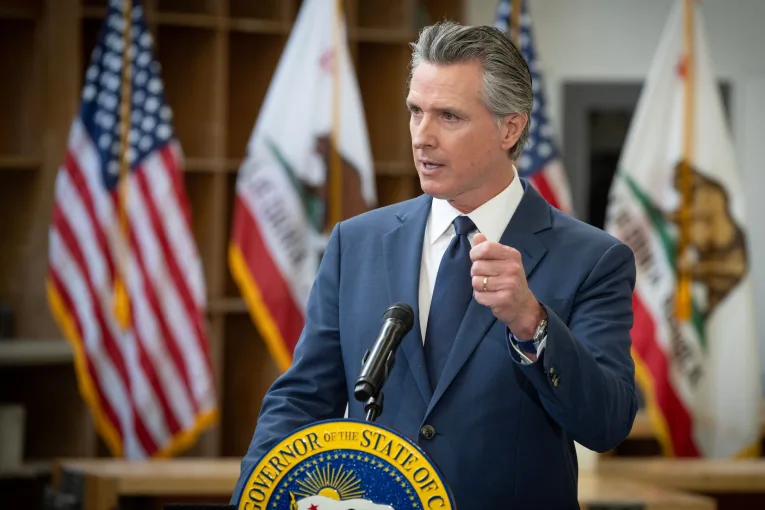
SACRAMENTO, Calif. — Gov. Gavin Newsom on Wednesday unveiled a revised 2026-27 California budget proposal that he said eliminates the state’s structural deficit through 2028 while preserving major investments in healthcare, education, housing and homelessness programs, even as county leaders warned the proposal leaves local governments unable to sustain critical safety net services.
The revised budget proposes $1.8 billion in General Fund spending reductions while maintaining what the administration describes as fiscal stability during a period of economic uncertainty and federal policy shifts.
According to the Governor’s Office, the proposal delivers “$0 deficit this budget year,” “$0 deficit next budget year,” and “$0 structural deficit through July 2028.”
In a statement released with the revised budget, Newsom said, “California is proof that fiscal discipline and progressive values go hand in hand. We’re balancing the budget, eliminating the deficit, cutting spending, and building reserves — all while protecting healthcare, education, and essential services for Californians.”
The administration said the proposal avoids major new ongoing General Fund spending commitments and instead focuses on “fiscal restraint, long-term sustainability, and protecting the state against future economic volatility.”
According to the Governor’s Office, the revised budget would place $9.7 billion into the state’s Surplus Holding Account while maintaining nearly $30 billion in combined reserves.
The administration framed the revised budget as a direct response to what it characterized as federal attacks on California’s healthcare and social programs under President Donald Trump.
With the May Revision, the governor’s office states that the proposal is “a fiscally disciplined, balanced plan that cuts the long-term deficit by more than half and tightens Sacramento’s belt — while supporting our most vulnerable Californians amid Donald Trump’s cruel assault on the state.”
The revised budget includes a proposed $300 million investment to offset the loss of enhanced Affordable Care Act subsidies after the Trump administration allowed them to expire.
According to the administration, the proposal would “keep $0 monthly health plans available for lower-income Californians” and provide “new state assistance for Californians earning up to 200% of the federal poverty level.”
The budget also proposes a 50 percent tax cut for new small businesses through reduced LLC fees, a record $5 billion education block grant, and what the administration called “the largest investment in special education in the 175-year history of the state.”
Under the proposal, California would invest $500 million to expand literacy and math support in high-need schools and establish a new $100 million disaster rebuilding fund to help survivors of the 2025 Los Angeles wildfires rebuild homes.
Housing and homelessness policy emerged as a central focus of the May Revision, with the administration touting reforms designed to lower affordable housing construction costs and accelerate housing production statewide.
The administration stated California has implemented “a comprehensive set of housing and homelessness reforms that have accelerated housing production, reduced development timelines and costs, and strengthened accountability.”
The state is seeking to create a more streamlined “one-stop shop” affordable housing finance system through the newly-established California Housing and Homelessness Agency under the Governor’s Reorganization Plan.
The administration is also proposing statutory changes aimed at reducing locally imposed development fees on affordable housing projects that receive state funding. According to the May Revision, the proposal “encourages local governments to provide development fee waivers by recognizing those waivers as a form of local contribution in state affordable housing programs.”
The proposal would also prohibit local governments acting as “a lead- or co-applicant” from imposing development impact fees on projects receiving state funding.
The administration argued the policy would “help direct state investments toward building affordable housing rather than offsetting locally imposed costs.”
The reforms are expected to “reduce affordable housing development costs by tens of thousands of dollars per unit and generate hundreds of millions in annual savings that can be reinvested into building more housing.”
The revised budget also includes proposals tied to homelessness funding and accountability.
According to the administration, California has already distributed a sixth round of Homeless Housing, Assistance and Prevention, or HHAP, funding totaling $1 billion.
An additional seventh round of HHAP funding totaling $500 million would be contingent on new accountability and performance requirements.
The proposal would require local governments seeking funding to maintain compliant housing elements, align with state encampment guidance, adopt pro-housing policies and leverage local resources to expand homelessness investments.
The administration argued that “aligning these policies with state investments is critical to preventing homelessness, supporting exits from homelessness, and increasing placements in permanent housing.”
Newsom’s office also pointed to new statewide homelessness data, asserting that “California’s unsheltered homelessness rate declined 9.5%.”
But county leaders sharply criticized the revised budget, arguing it leaves local governments responsible for absorbing the impacts of federal cuts without sufficient state support.
In a statement responding to the May Revision, the California State Association of Counties said, “Struggling Californians are on their own.”
The organization argued the revised budget “would fund just five percent of the County Family’s modest request to reduce harm to children and families — and less than half a percent of what’s needed next year.”
The counties association described the proposal as “a failure of scale, urgency, and responsibility.”
CSAC CEO Graham Knaus said, “The May Revision abandons struggling families the same way the President and Congress did by passing H.R. 1.”
Knaus added, “It doubles down on the federal cuts, leaving more families without healthcare or food, weakening our economy, and ultimately walking away from the communities that need support the most. This does not reflect California values.”
CSAC warned that the revised budget provides no funding for what it called “the state’s unfunded mandate on counties to provide indigent care in their communities” and does not provide sufficient support for public hospitals at risk of closure.
According to the organization, the administration’s proposal includes “just $104 million of $1.9 billion in Fiscal Year 2026-27 and less than $17 million of $4.5 billion the following year.”
County leaders also criticized the administration’s proposed cost shift in the In-Home Supportive Services program. CSAC said the May Revision “retains a $233.6 million shift in IHSS costs from the state to counties.”
The organization argued the shift “would undermine the existing fiscal structure for IHSS and directly strain all county safety net services.”
On homelessness, county officials objected to the continued reduction in HHAP funding levels compared to prior years. According to CSAC, the revised budget “does not restore the 50 percent cut from last year’s budget and only includes $500 million 2026–27 — down from $1 billion in previous rounds.”
The organization warned, “Counties cannot tackle homelessness alone. Without reliable, ongoing state investment, the progress made across California is at risk.”
Knaus said local governments are being asked to provide services without adequate funding support from the state.
“At the end of the day the state should not be expecting us to deliver services up to the roof when they’re only willing to fund what’s on the floor,” Knaus said. “That’s unacceptable. It doesn’t work, and it guarantees failure.”
CSAC further warned that counties may be forced to divert funding from “public safety, fire response, homelessness and elections” to stabilize core health and human service systems.
The organization concluded by urging lawmakers “to meet the urgency this moment demands and stand with counties to protect the essential services millions of Californians rely on every single day.”
The Legislature is expected to negotiate final budget details with the Governor’s Office over the coming weeks before the constitutional deadline to pass a state budget in June.
Follow the Vanguard on Social Media – X, Instagram and Facebook. Subscribe the Vanguard News letters. To make a tax-deductible donation, please visit davisvanguard.org/donate or give directly through ActBlue. Your support will ensure that the vital work of the Vanguard continues.
