
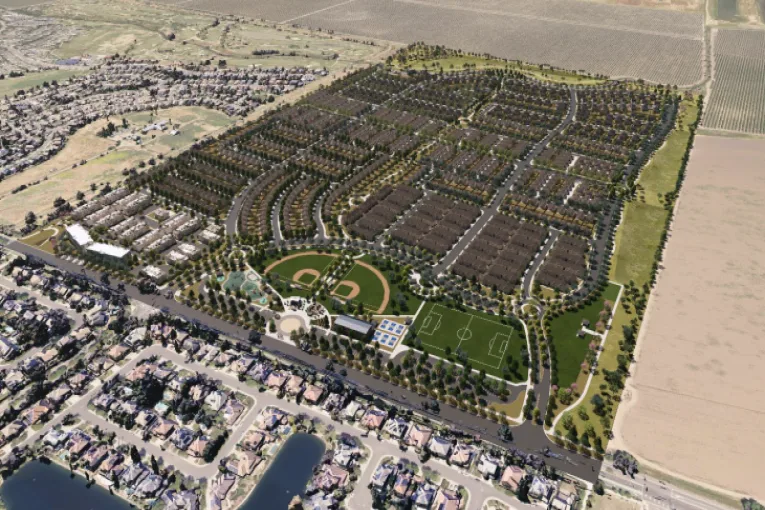
DAVIS, Calif. — After lengthy public testimony marked by unusually broad support, the Davis City Council voted unanimously to approve the Willow Grove housing proposal and place it on the November 2026 ballot, positioning the project as one of the most significant and widely supported development efforts in recent city history.
Public comment reflected a rare level of consensus, with speakers highlighting the project’s housing mix, affordability commitments, and responsiveness to community concerns. Judy Ennis, a longtime community member, underscored the moment, telling councilmembers, “this has been almost 100% support,” adding, “I don’t know if we’ve ever seen this level of public support for a project. It’s rare if it has ever happened.”
The Willow Grove project, a large-scale housing development proposed on the city’s periphery, must ultimately be approved by voters under Davis’ Measure J/R/D growth-control ordinance. The council’s vote does not finalize the project but advances it to the electorate, where its fate will be decided later this year.
Speakers repeatedly framed the project as a response to Davis’ long-standing housing challenges, particularly the difficulty faced by younger residents and families attempting to remain in the city. Joe Dinunzio, a member of the Davis Joint Unified School District Board of Education, spoke in favor of the proposal, tying it to generational continuity in the community.
“I want new young families to have the same opportunities that we had,” Dinunzio said. “And I think the Willow Grove Project is a fantastic addition to our community.”
He added that the development “will provide the kind of amenities and experiences and community that young families need and will become an important part of the fabric that Davis is.”
Other speakers emphasized the project’s affordability provisions, which include both rental and ownership opportunities as well as financial contributions to housing assistance programs. David Sandino voiced support for the project’s affordable housing plan, arguing it addresses structural inequities in access to housing.
“We enjoy a capitalist system in this country which provides many benefits, but it’s not always equitable for low and middle income citizens, especially when it comes to housing,” Sandino said.
He described the plan as “a step in the direction to reduce some of these inequities,” noting that it includes “housing both for rental and for sale housing, and we need both for this city.”
Sandino also highlighted the project’s financial contributions, stating that “it also makes a contribution, as you heard, a $1.8 million to the Housing Trust Fund,” which he said would help prospective buyers lacking down payment resources.
Concerns about fiscal impacts were raised in earlier discussions, but Sandino argued those fears were overstated. “I don’t see it that way because there’s funding available in the plan itself,” he said, adding that existing city staff could manage the program.
For some residents, the project’s significance lies in its attempt to address what is often referred to as the “missing middle” — households that earn too much for traditional affordable housing but cannot afford market-rate homes in Davis. Landon Friend, a relatively new resident, described the challenges facing such families.
“In the last two years, we’ve watched what it takes for young families to make Davis work,” Friend said. “Needless to say, it’s difficult.”
He continued, “What impresses me about the Willow Grove Project is that it’s built for families like that, built for families like me.”
While most public comments were supportive, some speakers urged caution and mitigation measures. Marjorie Longo, representing a neighborhood association, asked the council to adopt specific conditions to reduce environmental and neighborhood impacts.
“Please accept the donated land adding 1.1 acres to the wildhorse agricultural buffer,” Longo said, emphasizing the importance of wildlife protection corridors.
She also urged the council to “please keep the requirement for 40% single story homes along the western edge to reduce visual and ecological impacts,” and warned against further densification of the project.
Longo raised a broader policy concern as well, cautioning that approving a project outside the city’s traditional growth boundaries could set a precedent. She asked the council to “acknowledge that there’s a valid concern of a precedent being set… that’s outside the Davis sphere of influence.”
Despite these concerns, councilmembers largely focused on the project’s extensive negotiation process and its alignment with city priorities. Councilmember Josh Chapman emphasized the unusual level of cooperation from the development team.
“This is not common,” Chapman said, noting that the project went “above and beyond what the city has asked of applicants and development teams.”
He pointed to key features including affordability commitments and financial contributions, stating that delivering such elements “without city subsidies is massive for a city to be able to do that.”
Vice Mayor Gloria Partida echoed that assessment, highlighting the role of community engagement in shaping the project.
“It’s clear that listening to a community makes a difference,” Partida said. “There was a lot of listening that happened before it even came before the city.”
She added that the result was a project that is “strong and reflective of the needs of the community,” and that “this comes very, very close” to achieving the right balance.
Councilmember Bapu Vaitla focused on specific policy gains embedded in the proposal, particularly around affordability and equity. He described the project as helping to establish “procedures and expectations” for future developments, especially regarding affordable housing commitments.
“The equity piece on girls sports is huge,” Vaitla said, referencing planned recreational facilities designed to address disparities in access.
He also praised the inclusion of housing for individuals with intellectual and developmental disabilities, calling the expansion of those units a significant achievement.
Councilmember Linda Deos emphasized accountability, noting that past debates in Davis have often centered on whether developers follow through on commitments.
“Over the many years, it’s always been, well, how do we hold developers accountable?” Deos said. “Well, we’ve made giant strides in making that happen with the last project and this project.”
Mayor Donna Neville described the proposal as a rare opportunity to achieve meaningful progress, saying the council does not often enter meetings “thinking, ‘Wow, we are really getting something really important and positive done.’”
She highlighted specific features, including housing for individuals with intellectual disabilities, calling it “just fantastic” and expressing hope that similar provisions would be included in future developments.
In addition to public testimony and council deliberation, technical aspects of the project were addressed during the meeting. Staff confirmed that environmental impacts related to drainage and flood risk had been mitigated through design features.
“The project addresses the flows within the channel and the project’s additional flows,” a staff member explained, noting that on-site detention basins would ensure the development does not exacerbate flooding.
Following discussion, the council first voted to certify the project’s Environmental Impact Report, a required step under California law. The motion passed unanimously, with no opposition or abstentions.
The council then approved the remaining project entitlements and formally voted to place Willow Grove on the November ballot. The final vote was also unanimous.
“The project is hereby approved and it’s going to make its way to the November 2026 ballot,” Neville said following the vote.
The decision marks a critical milestone but not a final outcome. Under Davis’ voter-controlled growth system, residents will ultimately determine whether the project proceeds.
Still, the tone of the meeting suggested a shift in the city’s often contentious housing debates. As Ennis noted in her remarks, the breadth of support may represent a turning point.
“Perhaps this is a milestone,” she said.
Follow the Vanguard on Social Media – X, Instagram and Facebook. Subscribe the Vanguard News letters. To make a tax-deductible donation, please visit davisvanguard.org/donate or give directly through ActBlue. Your support will ensure that the vital work of the Vanguard continues.

It will be interesting to see whether the Baseline Features of this project are as disdainful of accountability as the Baseline Features of Village Farms are.
If they are, then it may be good to have all the Council members tested for an accountability allergy.