
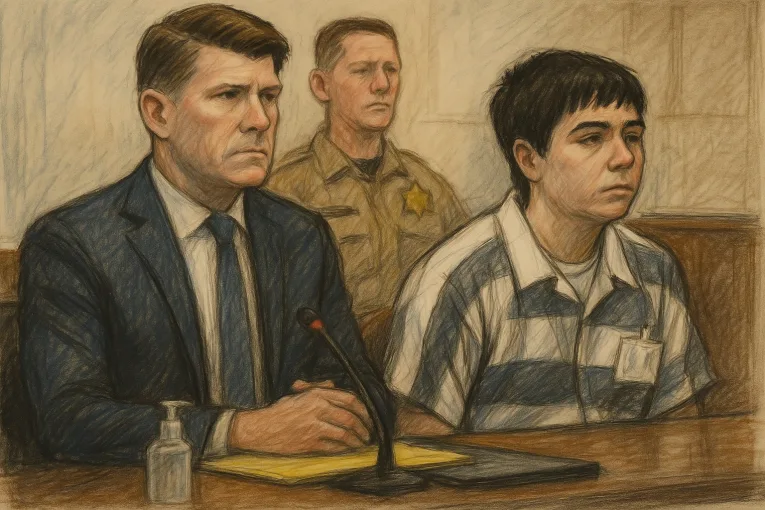
WOODLAND, Calif. – During a pretrial hearing held Thursday, May 7, 2026, in Yolo County Superior Court, the court ruled on multiple motions in the retrial of a former UC Davis student accused of murdering two people and attempting to murder a third in a series of stabbing attacks in Davis. The hearing focused heavily on expert psychiatric testimony, jury selection procedures, media access, and whether the accused’s creative writings can be admitted under new California evidence law.
The accused faces two counts of murder and one count of attempted murder for a series of stabbing incidents involving UC Davis students. In a prior trial, the jury was unable to reach a unanimous verdict on second-degree murder and acquitted on first-degree murder charges, resulting in a mistrial and leading to the current retrial. The accused has pleaded not guilty by reason of insanity.
A major portion of the hearing addressed courtroom media access, including livestreaming and the presence of a physical television camera. The defense argued that cameras could influence witness testimony and create fairness concerns, while the prosecution maintained that livestream access supports transparency and helps counter misinformation about the case.
The court ruled that livestreaming would continue with limited restrictions but did not immediately resolve the dispute over a physical “pool camera,” instead setting a later hearing to allow media organizations to argue their position. The judge emphasized balancing public access rights with the integrity of trial proceedings.
Jury selection procedures were also discussed at length. The court declined to impose a strict time limit on attorney questioning during voir dire but encouraged attorneys to focus on open-ended questions that reveal juror attitudes rather than testing knowledge of legal doctrines or hypothetical scenarios. The judge stressed efficiency and professionalism, warning against repetitive or speculative questioning.
Multiple motions in limine focused on expert witnesses in the case, particularly psychiatric experts expected to testify about the accused’s mental state and insanity defense. The court granted a request allowing each side to designate investigators and permitted expert witnesses to observe live testimony, especially from other experts and the accused, while limiting access to non-testimonial portions of proceedings such as extended legal arguments.
The court also addressed objections to expert language using the phrase “reasonable degree of medical certainty,” which the defense argued is vague and potentially misleading in a criminal trial. The judge agreed and ruled the phrase would be excluded, noting that it is commonly used in civil litigation but can confuse jurors given the higher burden of proof in criminal cases.
Another key issue involved whether prosecution experts could rely on and repeat hearsay statements from other evaluators without those evaluators testifying in court. The defense argued this would violate California’s hearsay rules under People v. Sanchez, while the prosecution argued it was necessary for efficiency and consistency in expert testimony. The court indicated that experts could rely on underlying records but would not be allowed to improperly present case-specific hearsay without proper foundation.
The hearing also addressed whether a prosecution expert could testify despite not having personally evaluated the accused. The defense sought to prevent any implication that the defense had blocked access to an evaluation, while the prosecution argued the expert’s opinion was still valid based on records and other expert interviews. The court ruled the expert may testify that no evaluation occurred but ordered that jurors be instructed not to speculate about the reason for the absence of an interview.
A significant evidentiary dispute centered on the admissibility of the accused’s writings, including songs and poems, under newly enacted California Evidence Code Section 352.2, which governs the use of creative expression in criminal trials. The defense argued that hundreds of writings spanning several years lack temporal proximity or factual similarity to the charged crimes and risk unfair prejudice if misinterpreted as propensity evidence.
The court acknowledged the new statute and noted that it requires a detailed, writing-specific analysis balancing probative value against prejudicial impact. The judge denied the prosecution’s request to admit the writings at this stage without prejudice, instructing the parties to file a more specific motion identifying particular works for review before opening statements. A future hearing was set to resolve the issue.
The court also ruled on several procedural matters, including prohibiting speaking objections in front of the jury and reaffirming that objections must be concise and limited to legal grounds. In addition, the judge denied a request for a jury view of the crime scene, finding that photographs, video, satellite imagery, and other visual evidence were sufficient and that an in-person visit would not add meaningful evidentiary value.
The judge noted that the trial remains in pretrial proceedings, with additional hearings scheduled before opening statements. The court indicated that remaining evidentiary disputes—particularly regarding expert testimony and creative expression evidence—will be resolved in upcoming sessions as jury selection proceeds. The trial will reconvene Wednesday, May 13, 2026, at 1:30 p.m. in Department 14.
Follow the Vanguard on Social Media – X, Instagram and Facebook. Subscribe the Vanguard News letters. To make a tax-deductible donation, please visit davisvanguard.org/donate or give directly through ActBlue. Your support will ensure that the vital work of the Vanguard continues.
