
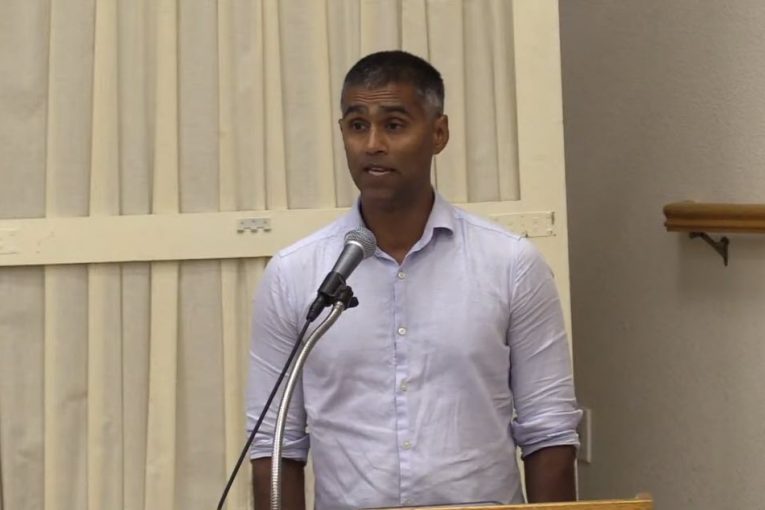
By Bapu Vaitla, Davis City Councilmember
I was not an easy vote for Village Farms, and I think it’s useful for Davis voters to know why.
At the Jan. 14 City Council workshop, I voted no on Village Farms’ affordable housing proposal. I was worried that the developers weren’t offering sufficient resources to actually get affordable units built. I’ve seen many well-intentioned “affordable housing plans” fall apart. The developers and I had fierce arguments, both privately and publicly. But, to their credit, the Village Farms team was willing to keep negotiating.
In the end, the developer made a commitment to affordable housing that’s unprecedented for Davis. Village Farms is giving its affordable housing partners 16 acres of land improved with streets, sidewalks, and utilities, as well as $6 million toward construction. Those resources will go toward building 280 affordable units for low-income households, as well as 80 moderate-income for-sale homes.
But here’s the real win. If for any reason the affordable housing partners are unable to construct those units—for example, because of inflationary pressures or inability to find matching grants—the responsibility for building at least 100 units falls to the Village Farms development team. In fact, Village Farms won’t be able to obtain their final set of building permits—permits for large-lot homes that are a major chunk of their expected profit—until construction of those affordable homes is underway.
Best of all, this commitment can’t be changed: it will be contained within the ballot measure we vote on in June. That’s a different level of accountability than anything we’ve had before. At a time when getting any housing built is challenging, this is a good deal for Davis.
In addition, our community and City Council pushed Village Farms for much more. We pushed for over 1,000 smaller lots and starter homes instead of an enclave of McMansions. We pushed for conserving nearly 50 acres of biologically valuable habitat on the project site. We pushed for climate-resilient features, including transfer of Village Farms’ electricity infrastructure to a public utility (should we get one established in time) and a commitment to buy carbon offsets locally when available. Village Farms agreed to all this—and went further. They dedicated over half of the development’s acreage to parks, greenbelts, habitat, playfields and urban agriculture. They designed an all-electric neighborhood with a great electric vehicle charging infrastructure. Village Farms is a good fit for our community.
And this vote matters beyond the project itself. The people who teach our children, care for our sick, cook our food and keep our city running can’t afford to live in Davis. People who grew up here and want to start their own families here can’t afford to stay. We bus in students from other towns to keep our schools from closing because the students’ families can’t afford to live here. Eleven thousand UC Davis employees commute into town, in part because Davis lacks housing. We can do better. If we want our economy and our schools to thrive, we will do better.
For those of us who feel that climate change is the world’s most pressing challenge, supporting compact, transit-linked, net-zero housing is the most powerful step we can take to leave a better future for the generations to come. Measure J/R/D was born from a legitimate impulse to stop sprawl, which is a real harm to both people and the environment. But pushing families out of Davis means more commuters, more emissions and more traffic. There is a reasonable middle way: supporting well-designed developments like Village Farms.
Critics of Village Farms will say we moved too fast, gave away too much or accepted too few affordable housing units. I spent months wrestling with these questions. The project that will appear on our June ballot is substantively better than what was first proposed—because this community fought for it to be. It includes enforceable affordable housing commitments. It includes smaller lots and attainable homeownership for first-time buyers and working families. It includes conserved farmland, unique habitat and a climate-resilient neighborhood design.
Village Farms is not perfect. Few housing developments are. But it is more than good enough, and we owe the people who have been waiting to live here—people who love Davis, work here and contribute every day to our community—a chance to be neighbors.
Join me in voting yes on Village Farms.
Disclaimer: Opinions are those of the writer and do not reflect those of The Vanguard or its Editorial Staff. The Vanguard does not endorse political candidates and is committed to publishing all public opinions and maintaining an open forum subject to guidelines related to decency and tone, not content.
Follow the Vanguard on Social Media – X, Instagram and Facebook. Subscribe the Vanguard News letters. To make a tax-deductible donation, please visit davisvanguard.org/donate or give directly through ActBlue. Your support will ensure that the vital work of the Vanguard continues.

But here’s the real win. If for any reason the affordable housing partners are unable to construct those units—for example, because of inflationary pressures or inability to find matching grants—the responsibility for building at least 100 units falls to the Village Farms development team. In fact, Village Farms won’t be able to obtain their final set of building permits—permits for large-lot homes that are a major chunk of their expected profit—until construction of those affordable homes is underway.
There is an unfortunate problem with what Bapu has said here, especially the bolded part. Specifically, in one of my early discussions with the development team after one of their public presentations at Lamppost Pizza I asked them what was the story about the 310 large, low-density lots in North Village. I suggested to them that those could alternatively be 620 small lots on which small-a affordable homes with $500,000 price tags could built rather than the 310 million dollar plus homes they had described in the presentation.
Their explanation to me of the purpose of this 310 lots was very illuminating. Their plan was … and still is to the best of my knowledge … to sell those lots to small local builders at the very beginning of the project in order to generate the cash needed to pay for building the roads and sewers and capital infrastructure backbone. As they said at the time, “We need that immediate cash for the project to proceed.”
That explanation makes total sense in terms of project management and finance, but it also puts a serious wrinkle in the Affordable safety net Bapu has described … specifically that the developer will no longer own those North Village lots and it will be the small local builders who will not be able to pull building permits for the lots they have bought.
Some how that doesn’t seem fair to the small local builders, and it sounds like a nightmare for the City to enforce.
It is also important to note that the Bretton Woods Affordable project is over seven years down the road with no progress having been made on procuring funding. Perhaps Bapu can tell us how that life lesson informed the City as it negotiated the terms with Village Farms?
“Their plan was … and still is to the best of my knowledge … to sell those lots to small local builders at the very beginning of the project…”
Matt – Perhaps you should update “the best of your knowledge”. No small builder is going to pay cash for a lot if he cannot build on it for an indeterminate number of years. If this is the cornerstone foundation of your argument against the affordable housing plan, the argument crumbles.
“It is also important to note that the Bretton Woods Affordable project is over seven years down the road with no progress having been made on procuring funding. Perhaps Bapu can tell us how that life lesson informed the City as it negotiated the terms with Village Farms?”
Matt – To your point as to why the Bretton Wood affordable housing plan has not brought in a builder and how it informed the City’snegotiating position, this was explicitly discussed by Sheri Metzger during the VF hearings on their affordable housing plan. You should go back and listen to the tape. She said the Bretton Woods plan had too little land for the number of apartments proposed AND there was no cash contribution for the City to juice the deal for the non-profit developer. So the City upped the required land donation at Village Farms from 9 to 16 acres and the City demanded an additional $6 million contribution. She said the combination of those two increased contributions gave the afforadable housing component of Village Farms the highest likelihood of success. So, in fact, the land donation and cash contribution were not the developer’s offer to the City, this was the City’s demand to get them to approve the afforadable housing plan and the Village Farms developer acquiesced.
Alan Pryor said … Matt – Perhaps you should update “the best of your knowledge”. No small builder is going to pay cash for a lot if he cannot build on it for an indeterminate number of years. If this is the cornerstone foundation of your argument against the affordable housing plan, the argument crumbles.
Alan it isn’t my argument. It was words directly from the mouths of members of the development team. Their explanation of that plan was simple, they needed the dollars and cents proceeds of those lot sales to fund the construction of the capital infrastructure (roads, sewers, walkways, bike paths, etc.). If that isn’t the plan for raising the dollars needed, what is the plan?
I understand Bapu feeling the need to support the project after negotiating concessions, but this is yet another example of just how damaging the little details of our measure J process is.
“Anchoring” is one of the most effective negotiation tactics: Be in control of the STARTING POINT in a negotiation so that any concessions you make still leave you in territory you are still willing to accept. This strategy is widely deployed in business and governmental negotiations: It is always an advantage to be the person drafting the agreement and setting the stage for later negotiation.
In this case, the developer started with a massive expensive single family development that called for the bulldozing of a vernal pool. They were talked into not destroying a sensitive ecosystem… do they get “points” for that?
The fact that Bapu was able to negotiate for improvements to this plan makes him feel obliged to support the project, which I understand. That is in fact how good faith negotiations are supposed to work.
But what would this project look like if we designed it from first principles based on the actual NEEDS of our city? And not based on “what makes the developer the most money”?
Well, for one there wouldnt be ANY McMansions or even “small-lot” single family homes. There is no actual benefit to us as a city for building ANY structures like that. Instead we would be building housing for our displaced workforce, for teachers, for university staff. etc. All of the people who make too much to qualify for the means-tested affordable, and too little to still afford anything in the as-negotiated village farms.
But THAT is not the conversation the city ever had. The developer anchored with typical urban sprawl and the city was able to make some improvements on it. So now its a “better” sprawling proposal still based on 1950’s land use concepts? I dont think that qualifies as a win for us.
The upshot of this negotiation however is this: A precedent has been set for developer to be willing to build the capital-A affordable housing themselves as a condition for building more profitable single family homes.
THAT is a tradeoff that is novel and useful. Previously developers only had to do a “land dedication” and then other affordable housing developers would find ways to scare up the money to actually build it – often many many years later.
This new standard ,where single family construction is used to directly subsidize the build-out of means-tested affordable, is a great precedent to set for other negotiations down the road.
But when we do THOSE negotiations, lets not let the developers draft the proposal. Lets start with best practices, lets start with OUR own civic needs, including considerations of sustainability and affordability for our most economically shut-out economic segment, and lets let the developers argue and justify just how much single family housing they need to give them the margin necessary to produce the housing that WE actually need.
“I dont think that qualifies as a win for us.”
Tim, who is this us you claim to be speaking for? Were you elected to something?
Unfortunately the project aims to circumvent the General Plan Update we are working on TODAY–there was a workshop in Round #2 on April 30. Why rush into a project over which we have little control when we can defer it for a year or two and give very specific direction on what is desired and acceptable? That’s what an elected official should be trying to gain–control of our community’s future over the desires of profit-motivated individuals. If for no other reason, we should oppose Village Farms (and Willowgrove) so that we really set the destiny of Davis, not just a small group.