
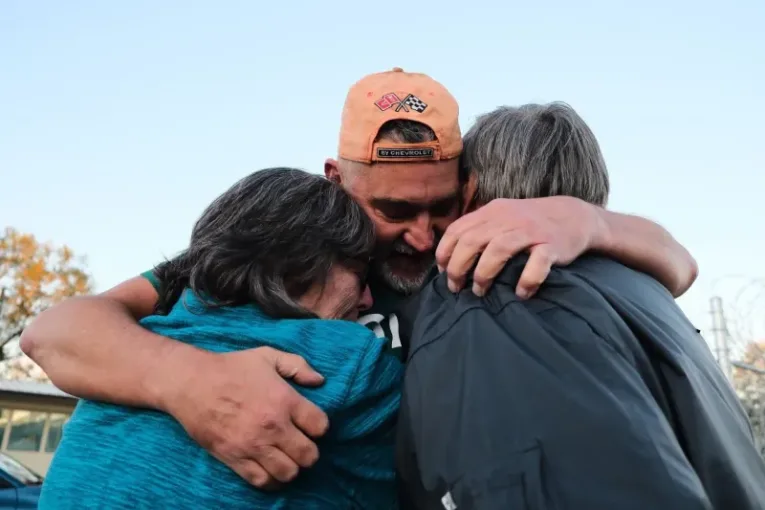
Former Louisiana death row prisoner Jimmie “Chris” Duncan is officially a free man after the Louisiana Supreme Court unanimously upheld a lower court’s decision overturning his 1998 murder conviction, delivering a sweeping rebuke of the forensic evidence that sent him to death row nearly three decades ago.
In a unanimous opinion issued Monday, the seven-member court concluded that the evidence presented during Duncan’s post-conviction proceedings demolished the scientific foundation of the prosecution’s case. Justice Cade R. Cole wrote that, “The post-conviction evidence undermined the core factual premises on which the state depended.”
The ruling marks the culmination of years of litigation and follows an extensive investigation by ProPublica and Verite News that examined the forensic practices used to convict Duncan. It also effectively ends the last remaining death sentence based substantially on the work of controversial Mississippi forensic dentist Michael West and pathologist Steven Hayne, whose testimony has contributed to numerous wrongful convictions over several decades.
Journalist Richard A. Webster, who spent roughly a year and a half investigating the case for ProPublica and Verite News, said the court’s ruling was remarkable not only because Duncan prevailed, but because of how decisively the justices rejected the prosecution’s evidence.
“The ruling came down Monday and so they had the oral arguments in April and I attended that,” Webster said in an interview with the Vanguard. “Based on the questions from the justices, they were extremely skeptical of the case being put forth by the district attorney. And you could tell by their questions that they were leaning very heavily towards Jimmy Duncan and it was a unanimous ruling.”
Webster said one portion of the ruling stood out above all others.
“The Chief Justice, I don’t know if you read the ruling, but the Chief Justice likened the district attorney’s case against Jimmy Duncan to the Salem witch trials, which is about as sort of damning description or a comparison that you can really come up with,” Webster said.
Chief Justice John Weimer, writing separately in a concurring opinion, compared the forensic evidence presented against Duncan to the notorious “trial by water” used during 17th-century witch hunts.
“We now look back at those practices as asinine and absurd, since those who fell victim to those practices often did not survive, regardless of whether they were found guilty or innocent,” Weimer wrote. “The bite mark evidence and the sexual abuse evidence used in the trial against the accused has proven to be similarly specious.”
He added that Duncan’s prosecution “demonstrates we cannot be too careful in determining whether the death penalty should be implemented in cases such as this case because of the finality of the sentence and the impossibility of rectification.”
“Such an irreversible and tragic consequence is inimical and deleterious to our system of justice if carried out based on evidence that is devoid of legitimacy,” Weimer wrote.
Webster said the significance of the concurrence cannot be overstated.
“The other thing that stood out in the concurrence written by the Chief Justice was him sort of taking aim at the death penalty where he said, these things cannot be taken lightly,” Webster said. “And based on this flimsy evidence, we had put someone on death row, which I thought was pretty remarkable.”
He noted that the decision came from a court not generally viewed as hostile to capital punishment.
“For it to be unanimous, it just really shows the just incredible weakness of their case and just sort of mind-blowing that it stood for so long and they’re still so adamant that he did it and he deserves to be put to death,” Webster said.
Duncan was arrested in December 1993 after the drowning death of Haley Oliveaux, the 23-month-old daughter of his then-girlfriend. According to court records, Duncan told investigators he had left Haley alone briefly in the bathtub while washing dishes downstairs before discovering her submerged in the water.
Police initially arrested Duncan for negligent homicide.
The case changed dramatically after Hayne and West examined Haley’s body and concluded she had been sexually assaulted, intentionally drowned and bore bite marks matching Duncan’s teeth.
Those conclusions became the cornerstone of the prosecution’s capital murder case.
According to Webster’s reporting, the bite-mark evidence has since been thoroughly discredited by modern forensic science, and West and Hayne’s work has come under sustained criticism from forensic scientists, civil rights attorneys and courts around the country.
Over the nearly three decades since Duncan’s conviction, nine prisoners convicted in part through testimony from West and Hayne have been exonerated. Three had been sentenced to death.
“Duncan was the last person awaiting an execution based on the pair’s work,” Webster reported.
“As we had said repeatedly in our reporting that Jimmy Duncan was the last person put on death row based on evidence by these two forensic specialists from Mississippi, Steven Hayne and Michael West,” Webster said. “There were nine other people that they helped convict who were later exonerated and he was the last one left.”
He added, “There’s no one left on death row that was put there based on their work, which is sort of remarkable that he was the last one.”
Central to Duncan’s exoneration was previously unseen video footage documenting West’s examination of Haley’s body.
Justice Cole’s opinion focused heavily on that recording, which jurors never saw during Duncan’s trial.
Cole wrote that defense experts concluded it was “scientifically indefensible” to identify the marks as Duncan’s bite marks and found that “the angles shown in the West Video were physically impossible for a human bite.”
West has maintained that he was simply performing what he called a “direct comparison” technique by pressing a mold of Duncan’s teeth against the child’s body.
For Webster, that video became the defining piece of evidence.
“I mean, it’s the video that was taken of West’s examination of the little girl’s body,” Webster said. “He has that mold of Duncan’s teeth and he’s dragging it across the baby’s body and grinding it into her skin.”
“Duncan’s team says this appeared that he was creating bite marks, which was the only physical evidence tying Duncan to an alleged violent crime,” Webster continued. “Without that, it would’ve 100% been negligent homicide.”
Webster said the Louisiana Supreme Court itself highlighted the significance of the recording.
“In the Supreme Court’s ruling, they brought up that video and they brought up how some of the bite marks on the girl’s body would’ve been impossible to make,” he said. “The video was everything.”
Duncan remained on death row at the Louisiana State Penitentiary at Angola for roughly three decades while post-conviction attorneys uncovered mounting evidence undermining the prosecution’s case, including expert testimony concluding Haley’s death was consistent with accidental drowning and a jailhouse informant who recanted testimony claiming Duncan confessed.
“I am flooded with relief,” Chris Fabricant, director of strategic litigation at the Innocence Project, said following Monday’s ruling. “It would have been a moral outrage for the conviction to be reinstated.”
Fabricant later added, “If there is any sense of fairness and justice left, this should be the end of this case.”
Follow the Vanguard on Social Media – X, Instagram and Facebook. Subscribe the Vanguard News letters. To make a tax-deductible donation, please visit davisvanguard.org/donate or give directly through ActBlue. Your support will ensure that the vital work of the Vanguard continues.
