
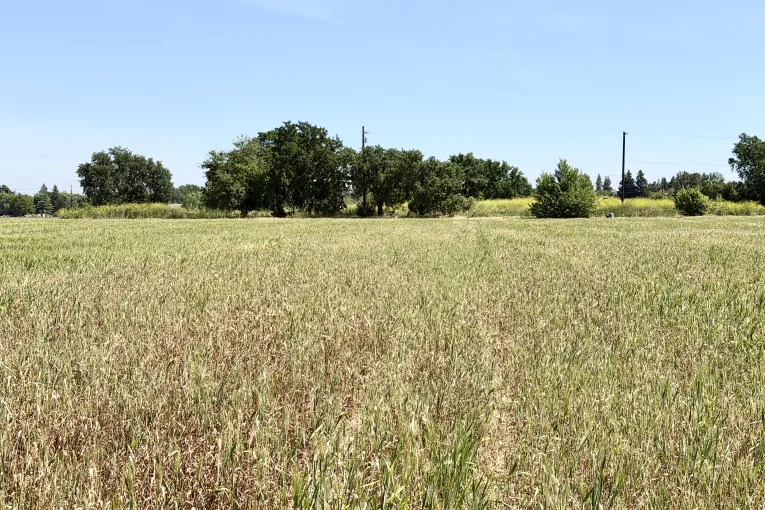
Although many mourn the narrow defeat of Measure V with its 1,800 new housing units, this vote presents an opportunity for a much better project in the future.
Village Farms was a mediocre development proposal. The 1980s-style site plan called for 1,440 single-family detached homes, with 360 low-income apartments segregated to the southwest corner of the site. It contained none of the “missing middle” housing forms that cities often seek to provide housing choice and urban density—townhouses, duplexes, triplexes, cottage courts, and small apartment buildings. The site plan arranged streets in a poorly connected twentieth-century “degenerate grid” pattern. In contrast to today’s transit-oriented development philosophy, it placed a large park in the most transit-accessible location next to Covell Boulevard and its shopping center.
Ironically, the 2005 Covell Village plan for the same site, which also lost at the ballot box, was a much better design. That plan had a more unified and connected street pattern, a better gradient of densities increasing toward transit, a better mix of unit sizes throughout the subdivision, and—crucially—a vision of redesigning Covell as a pedestrian-friendly boulevard.
The Village Farms site will and should develop. How could a better project design come about in the future?
The problems start with the American tradition of developer-driven projects in which cities try to negotiate for more parks, affordable housing, and better design but have relatively little leverage compared to developers. In other parts of the world, especially Northern Europe, cities often proactively acquire land, establish a plan, and lease sites back to developers. That process can result in projects better meeting public needs, and can also recapture increases in land value due to public investment (in transit, roads, parks, schools, etc.) for local government rather than private landowners.
John Whitcombe bought the main 386-acre Village Farms parcel for a mere $3.2 million at a 1990s bankruptcy auction. If the City of Davis had been on the ball, it could have acquired the land itself. Even now the City should explore ways to acquire the site if, as seems likely, the Whitcombes are tired of mounting ballot campaigns. However, 50 years of right-wing efforts such as 1978’s Proposition 13 have so constrained public-sector revenues that a well-funded Affordable Housing Trust Fund doesn’t exist with which to do this. Still, maybe other ways can be found.
Assuming the land stays in private hands, the city should create twenty-first century standards for such projects. These would include transit-oriented project design, urban densities, well-connected street patterns, a mix of housing forms including “missing middle” types, greenway and path networks, and substantial amounts of affordable housing due to “accessibility by design” (small units and shared housing types) as well as permanently subsidized rents and prices.
Traffic is a legitimate concern of local residents. The old model of putting housing-only developments in one part of the city and business parks elsewhere (for example through the failed 2022 DISC proposal at the east end of town) is a recipe for increased driving. The alternative? Co-locate jobs and housing. A more phased development plan for Village Farms including workplaces as well as housing, plus a strong package of incentives (parking charges, transit subsidies) to reduce driving, could gain greater public support. Developers might partner with the University to designate some housing for university staff, who could then bike or take transit to campus. Redesigning Covell and L Street as pedestrian-friendly boulevards accommodating slow-and-steady traffic would also help make this a less car-oriented district and address local residents very-real congestion concerns.
Making the project a zero-net-energy microgrid and expanding greenways would add other twenty-first-century elements. A better Village Farms might actually include a “village” with a central plaza off Covell, European-style tall-and-thin apartment buildings around courtyards, a thorough mix of housing types, connected street patterns, and a higher percentage of affordable units. The result could be a really exciting sustainable neighborhood of the future.
Now is the time for the City, in its new General Plan or Specific Plans for each new addition to the city, to establish a cutting-edge framework for this and other new neighborhoods. Disappointing as the Measure V vote is to many, it is an opportunity for Davis to ensure that something far better comes about.
Stephen Wheeler is emeritus professor of urban planning and design at U.C. Davis and author of Planning for Sustainability in the Time of Populism, Inequality, and Climate Crisis (Routledge 2026).
Follow the Vanguard on Social Media – X, Instagram and Facebook. Subscribe the Vanguard News letters. To make a tax-deductible donation, please visit davisvanguard.org/donate or give directly through ActBlue. Your support will ensure that the vital work of the Vanguard continues.

Great idea. Go buy an option on the property. Develop a plan. Finance an election. Spend millions of dollars and risk walking away with nothing after spending those millions of dollars. Good luck with that.
Ron G
So only the wealthy who can afford to buy this land are allowed to make decisions about the future of our community? In other words we should just live in an Ayn Rand plutocracy? Using your logic we shouldn’t even bother having a democracy because only the rich are qualified to make decisions about what’s best for us.
On the other hand, you completely ignore the fact that the wealthy got where they did thanks to the community support and the socialization of corporate risk that they received. We all pay taxes to pay for the legal system that protects their property rights and we pay for educating their workforce. The real truth is that the rest of us bear the costs of poor decisions by the wealthy and we have the right to intervene to make those decisions better.
Richard said “So only the wealthy who can afford to buy this land are allowed to make decisions about the future of our community?”
I didn’t say buy the land I said buy an option. How else do you think your wet dream perfection is going to happen? The author of this piece, like you and your friends, has big ideas about what should happen but you never put up any money. Talk is cheap.
Like you, Richard has the power of Measure J. Had the developers thrown a few crumbs his way (and those who have similar goals), it seems likely that Village Farms would have passed.
There was a pretty determined little group on here at least, who were opposed to Village Farms (but aren’t slow-growthers). I would suspect that they represented perhaps the margin of difference in regard to Village Farms, at least.
I believe (but don’t know for sure) that there were others who are normally slow-growthers, but didn’t like Village Farms for some of the same reasons that Richard didn’t like it.
Pretty sure it will resurface in some form, within a few years. In the meantime, I guess those who would have purchased homes there will be circling the property day/night for the next few years (and possibly squatting on the property), instead of looking at all of the pre-existing housing for sale in Davis (which wouldn’t have as much Mello Roos, located in a more-convenient location with mature landscaping, yards, garages, streets that are actually wide-enough to handle two-way traffic PLUS bicycles, etc.).
“However, 50 years of right-wing efforts such as 1978’s Proposition 13 have so constrained public-sector revenues”
The homeowners of Davis may want to thank those right wingers because without Prop 13 the average base Davis property tax bill would be $22,891 and that doesn’t include added on local parcel taxes.
“Before the passage of the proposition, local governments could set their own property tax rates, and the statewide average was $2.67 per $100 (or 2.67%) of a home’s assessed value. By comparison, the current statewide effective tax rate (including voter-approved bonds) is generally about 0.71% to 1.55%.If those historical rates were applied to today’s housing market, a typical homeowner in a high-cost area would see massive jumps in annual taxes. For example:The Math: If your home’s current market value is $500,000, a 2.67% tax rate equals an annual property tax of $13,350.Under the 1% cap established by Prop 13, that same tax bill would be $5,000 (plus localized voter-approved bonds).”
https://lao.ca.gov/reports/2016/3497/common-claims-prop13-091916.pdf
What’s the tax bill for someone buying a $900K house today?
$9000 plus added on local parcel taxes of @ $1500.
Probably around $12000 with parcel taxes. But this doesn’t cover costs. Break even is 2-3 % of assessed value.
“Break even is 2-3 % of assessed value.”
Break even for what – the school districts?
Someone researched this on Next Door the other day – apparently, more than half of property taxes are spent on school districts. (Not including parcel taxes, CFDs, etc.)
No, break even for the City. Something Matt Williams is always complaining about.
But your tax bill would not be as much without prop 13 because your property value would be less. Remember that after Prop 13 passed property values shot up dramatically. People could afford to pay more in equity because they paid less in property taxes.
Properties are reassessed upon purchase, and that’s when buyers decide whether or not they can afford it.
And when Mello Roos / CFDs and parcel taxes are added into the mix (especially for new developments), this has a dampening effect on the price of the new houses. This is also a reason that pre-existing housing is generally a much better deal, since those fees/taxes are usually significantly less or non-existent.
Mello Roos and CFDs are a rather dishonest way for developers to avoid pricing their housing at true market value (by de-emphasizing those fees). Those type of costs (which are essentially impact fees resulting from the new development) should logically be included in the price of the house in the first place.
But on the “bright side”, keeping those fees out of the price of the house itself means that buyers won’t then be paying property tax ON those fees (as they would have if they had been included in the price of the house).
In other words, it helps buyers avoid being “taxed on the tax” they pay. (Though I wouldn’t be surprised if the state eventually figures out a way to do so, regardless.)
Keith O
You’re ignoring the fact that the state raised income and sales taxes to offset the loss of property taxes, so our overall tax bill remains about the same as a proportion of our incomes.
“What’s the tax bill for someone buying a $900K house today?”
About $12,780.00, according to Google.
The irony is the biggest free riders are the homeowners with the longest ownership and the smallest original tax base.
The biggest “free riders” are school districts. Basically, paying for someone else’s kids via taxing mechanisms (property taxes, parcel taxes, and CFDs) that have no relationship whatsoever to the cost of kids. And in Davis’ case, the cost of educating kids from Woodland, as well, since the district refuses to actually right-size itself (despite using that as a campaign tactic on behalf of Village Farms and Willowgrove).
All of which are HOUSING costs – the same costs that the school district complains about (that they themselves cause). No irony there, I guess?
Not to mention the massive income tax breaks that parents receive.
They’ve got all of this backwards.
You win Ron O. The Davis schools are going to right size to fit your world view. The district was doing fine until Measure J passed in 2000 with construction staying slightly ahead of demand as the community grew. After Measure J brought in the No Growth Era enrollment peaked and its been all downhill since then. The community did all it could to resist the decline in enrollment since we stopped building family housing after Wildhorse but it seems time has run out.
You and your acolytes blocked Ramos’ and Whitcombe’s projects at the ballot box. U.C. faculty housing south of Russell was blocked by the neighbors lawsuit. You add it all up and it could have been a lot of kids in our schools. So you have won twice Ron O. Your triumph against housing and children and human growth in general has prevailed and now you will succeed at downsizing our schools too. Congratulations.
I’m only involved in campaigns as a minor figure, and I think UCD SHOULD provide housing for their employees (as they’ve already done regarding the development behind Davis Commons).
I understand that you can blame folks like Dan Carson regarding the concerns regarding connecting to Russell. (I barely knew anything about that, at the time, but I don’t believe that this concern necessarily “stopped” the development proposal either. I recall that the issue was access – not the proposal on campus itself. And that there are other ways to access the campus.)
Most of my efforts are focused right here on the Vanguard. My motive is to counteract biases and sometimes entirely incorrect information that’s put forth. (But most of the time, the articles and comments simply “omit” relevant information – such as the fact that housing “mandates” are failing statewide and that the major population areas along the coast aren’t expanding outward in order to address those “mandates”.)
But it’s not “my” reality that school districts across California are having to deal with. Some made a mistake in assuming that young people would continue having lots of kids. It’s an unsustainable assumption in the first place.
But not all districts are declining. Look at Mountain House. They built 8000 homes and the schools are thriving.
You have it backwards on West Village. The neighbors settled for no access but the opposition was to the housing itself.
“But not all districts are declining. Look at Mountain House. They built 8000 homes and the schools are thriving.”
That’s RG’s go to, Mountain House.
There’s that one anyway…
Well, building 8,000 houses for the purpose of staving-off declining enrollment doesn’t sound very sustainable.
Enrollment will ALWAYS decline over time, compared to when housing is first built. And that’s because people don’t move out when their kids age-out of the system.
It’s happening in Woodland, as well. The older sections of town have fewer kids than they used to. Nothing to do with housing prices there. In fact, WJUSD is expected to experience slightly declining enrollment overall, DESPITE the ongoing housing construction there.
Since enrollment is declining overall (even in places like Texas), school districts essentially have the following choices:
1) Poach students from other districts (where their families will continue to live).
2) Poach students from other districts (by supporting development proposals in the hope that they will move to their district).
3) Adjust the size of their district to match the declining needs of a given locale.
We already know which of these options that school districts prefer (#1 & #2), but they are inevitably forced into option #3 (after throwing a tantrum at a level that their own younger students would envy).
There will be a point at which enrollment is relatively stable (but at a lower level) in cities that aren’t continuously building.
I’ll take your word for it, regarding what the neighborhood in West Davis was opposed to. I barely remember it.
RonG, where are the residents of those 8,000 residences coming from?
How do those other communities feel about their residents leaving the school district and moving to Mountain House?
What is the housing price profile of those 8,000 residences?
What has the student yield per residence been by housing type?
Mountain House is a great example that debunks the dominant paradigm of Davis.
They commute to Silicon Valley.
People buy homes and have kids in them or move there to raise a family from less affordable area’s. Homes range from $700,000- $1,500,000 with median home price around $950,000
Homes prices are comparable to Davis.
I don’t know the yield but the schools are thriving.
“Yes, Mountain House is considered a wealthy and highly affluent area. It features a median household income exceeding $171,000 and median property values hovering around $946,000. This planned community, located in San Joaquin County, attracts many high-earning professionals commuting to the nearby San Francisco Bay Area.”
https://www.point2homes.com/US/Neighborhood/CA/Mountain-House-Demographics.html
Ron G
I was part of the citizens’ group that negotiated the deal with UCD. It was ENTIRELY about access. We agreed with having move housing but proposed that it be built on a north south alignment along 113, and another access point to the med school. It would have served UCD much better. Instead the planners caved to the pressure from a small group of faculty with pet projects along that area (including the tractor museum). Please get your facts straight.
Regarding the location of the parks in these type of proposals, having the park site hidden inside of the developments is the most-unattractive, least-usable way to situate them (from the perspective of those who will be voting on these developments).
Who wants to be parking at Nugget (or driving along Covell) only to see high-rise apartments/condos replacing farm fields? What benefit is that for those who already have a home of some type?
There isn’t going to be a major “public transit hub” at any of these developments. And anyone who wants to take a bus can walk through a park to get to the bus stop. (I used to walk almost a mile or so to take the bus to Sacramento to/from Davis, through neighborhoods rather than a nice park.)
Also, every one of these residents is going to have at least one car per household – and more likely two or more. That’s how people live in the valley. Davis is not a self-contained town – people travel. And the farther that these developments are situated from the center of town and UCD, the more likely that they’re going to drive EVERYWHERE. (That’s how it would be at Willowgrove in particular.)
I drove past the Willowgrove site yesterday, just to see how far it is from the Village Farms site. It’s farther than I first realized – it’s not walking distance to ANY part of town, or any service other than the school across the street (and the access point to I-80).
The other reason I drove past that site is because I wanted to see the development being built at the former horse farm (Palomino Place).
Many of us agree the Village Farms project was unacceptable for so many reasons, including the toxics, flooding potential, unsafe access, massive traffic, serious habitat destruction including the threatened vernal pools and its endangered species and rare native plants, and of course the unaffordable market-rate housing and the inadequate affordable housing “plan” which would likely have resulted with no affordable units.
While this article agrees that we need a better plan, it is important to recognize that the No on Measure V campaign made very clear that if this project was to come back, it needed to come back building only below Channel A, which would distance the housing from the toxics and the bulk of the floodplain, and had to preserve Channel A habitat but also needed a conservation easement to be put in place for vernal pools with funding for management and protection of these vernal pools with their endangered species and rare native plants. But it is also critical that the number of housing units would be 900-1,000 units, not more. All of these features would make this a “environmentally superior” alternative similar to the reduced footprint alternative which was included in the Covell Village EIR.
While I agree that the proposed park location and design for the project did not work for a number or reasons, I am disappointed that the article says nothing about the preservation of the vernal pools and the Channel A habitat. Those are important elements of urban planning as well.
The last thing we want is a rerun of another badly planned project at this site which would generate opposition again, particularly because what needs to be taken into account is that the site is seriously handicapped with an enormous floodplain and toxics issues plus massive traffic and access issues as well. So, this is important input for our General Plan update. The reason Whitcombe was able to purchase the site for only $3.2 million in bankruptcy was because the previous developers abandoned it because of the plethora of problems this Village Farms site has had a history of.
The other important issue is that our current General Plan is a citizen-based document which was created by 15 committees which took years of weekly meetings and community input to draft. It cost over a million dollars and it has been used as a model General Plan by other cities. Our General Plan has progressive policies that Davis citizens support, So while it needs updating, it needs to not be gutted, because the fundamentals of the document still apply to Davis.
Eileen
To make a new Village Farms market rate affordable by design we need to have densities at least comparable to Willowgrove which is 12 units per acre versus 8 for the VF proposal. On a 200 acre site south of Channel A, that would be 2400 homes. We can easily fit 1800 homes into the smaller footprint. These homes should be affordable to those who work in Davis and but can’t live here.
In this opinion piece I mentioned the elements of the Village Farms proposal that seem most crucial to improve in the long run, expecially density, unit mix, affordability, street connectivity, transit orientation, jobs-housing balance, and strategies to reduce motor vehicle impacts including redesign of Covell. Some of the issues raised by Measure V opponents (e.g. floodplain, toxics, habitat) seem like the sort of opportunistic issues typically raised by NIMBY opponents of any project. I’m not saying these issues don’t matter, but that they probably aren’t as important in the long run and/or can be relatively easily dealt with through modest design changes. Many other Davis neighborhoods have probably had similar impacts in the past that received little attention when those developments were approved.
DCPG has written two articles with more specifics on alternative plans that fit Stephen’s vision:
https://davisvanguard.org/2025/10/davis-village-farms-rethink/
https://davisvanguard.org/2026/05/transit-oriented-growth-davis/
Richard said “I was part of the citizens’ group that negotiated the deal with UCD. It was ENTIRELY about access.”
So Village Farms is the second housing project your perfection demands helped defeat. Good for you Richard. You helped close both Patwin and Birch Lane.
So are you on board with Measure W., Willow Grove?