
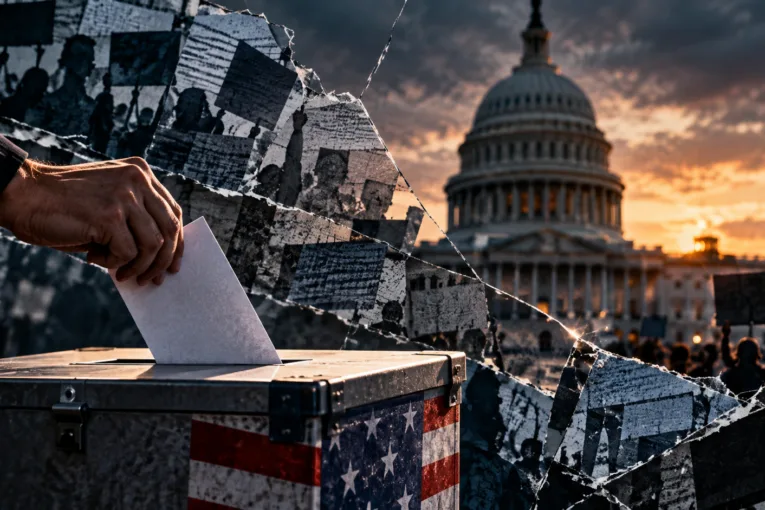
WASHINGTON, D.C. — With the 2026 midterm elections approaching, new polling shows Americans remain deeply divided over the integrity of their elections, while allegations of election fraud, artificial intelligence-generated campaign material and expanding state powers to designate domestic terrorist organizations raise questions about the relationship between political misinformation, public trust and government authority.
A Gallup survey released Oct. 7 found that just 49% of Americans expressed confidence in the honesty of U.S. elections, compared with 51% who did not, reflecting a longstanding divide over election integrity.
But the more unusual finding was not the overall level of distrust, Gallup found that Americans who disapprove of the country’s leadership are now more confident in election honesty than those who approve, reversing a pattern that has prevailed internationally for years.
According to Gallup, 52% of Americans who disapprove of national leadership expressed confidence in election honesty, compared with 41% of those who approve.
Gallup reported that no other country surveyed during the past 15 years had shown a statistically significant reversal of this kind, making the United States an international outlier in how confidence in elections relates to approval of national leadership.
The partisan divide was similarly striking. Sixty-three percent of Democrats expressed confidence in election honesty, compared with 37% of Republicans and 35% of independents.
The findings represent a change from 2024, when 78% of Democrats and 23% of Republicans expressed confidence in election honesty. In 2025, those figures were 50% and 46%, respectively.
Despite those shifts, overall public confidence has remained relatively stable, measuring 51% in 2024, 47% in 2025 and 49% in 2026.
Gallup’s findings do not establish that more Americans are embracing election conspiracy theories. Rather, they demonstrate that perceptions of election integrity remain sharply divided and that those divisions have changed with the political environment.
The survey arrives as allegations about election legitimacy are entering political campaigns before ballots have been counted, while increasingly sophisticated artificial intelligence tools are making it easier to create convincing but fabricated political material.
In New York, Republican gubernatorial candidate Bruce Blakeman has suggested Democrats could steal the upcoming election while circulating AI-generated campaign videos depicting the state and political opponents in unfavorable circumstances.
According to Associated Press reporting, Blakeman has adopted elements of President Donald Trump’s political approach, including questioning election integrity and using AI-generated imagery in campaign advertising.
The campaign illustrates how allegations about election legitimacy can become part of conventional electoral messaging rather than remaining confined to fringe websites or anonymous online communities.
Artificial intelligence introduces another dimension to the problem by allowing campaigns, political activists and other actors to produce realistic images, videos and documents depicting events that never occurred.
An August investigation by the Brennan Center for Justice found that major artificial intelligence systems generally challenged established election conspiracy theories when asked about them directly but remained vulnerable to requests involving the creation of deceptive election-related imagery.
Researchers tested several popular AI systems, including ChatGPT, Gemini, Grok, Meta AI, Runway and Flux, and found that all six image-generation systems tested could produce material potentially useful for spreading false claims about elections.
The researchers also examined whether chatbots could identify AI-generated images and found substantial limitations, including instances in which systems failed to recognize images produced by their own technology.
In an Oct. 5 follow-up, the Brennan Center reported that most tested chatbots continued to struggle with identifying synthetic images even after California’s AI Transparency Act took effect.
The law requires certain transparency measures intended to help identify AI-generated material, but researchers found that the availability of digital indicators did not consistently translate into accurate identification by chatbots.
The findings raise concerns about the ability of voters to distinguish authentic documentation of election activity from fabricated material, particularly when misleading images are distributed through social media or incorporated into political campaigns.
They also illustrate a limitation of relying on artificial intelligence to verify information when the same technology can generate convincing false evidence.
The movement of contested political narratives into public institutions extends beyond election campaigns.
In Florida, state officials have advanced a new domestic-terrorism designation framework that gives the government authority to identify organizations as terrorist groups and impose restrictions on their relationships with public agencies, schools and other state-funded institutions.
Under Florida Statute 943.03102, the state’s chief of domestic security may designate organizations as domestic terrorist organizations when specified statutory conditions are met, subject to approval by the governor and Cabinet.
The law requires findings that a domestic organization is engaging in terrorist activity and presents an ongoing threat to state or national security.
Once a designation is formally published, state agencies, local governments and public school districts face restrictions on funding, contracting with or accepting certain financial support from designated organizations.
The statute also establishes a process through which designated organizations or their members may challenge the designation in court.
State officials have presented the framework as a public-safety measure intended to address terrorism threats. Critics have raised concerns about civil liberties, freedom of association and the possibility that politically disputed designations could affect lawful organizations and their members.
Florida’s designation framework has direct legal consequences because it establishes governmental authority to restrict certain relationships with organizations formally identified under the law.
The broader context includes the continuing influence of election-denial movements that developed following the 2020 presidential election, when Trump and his allies challenged the outcome despite the absence of evidence establishing widespread fraud sufficient to alter the result.
Some of those narratives have persisted through conservative media, political activism and campaigns, while new technologies have expanded the means by which allegations can be illustrated and circulated.
Gallup’s findings suggest that public confidence in election honesty cannot be understood simply as a reflection of whether voters support the party controlling the White House.
Historically, Gallup found that Americans who approved of national leadership were substantially more confident in election honesty than those who disapproved, a relationship that generally holds across political systems internationally.
The reversal in the United States raises questions about how Americans evaluate electoral institutions and whether their confidence depends on political identity, perceptions of government conduct or other factors.
The survey does not establish why individual respondents distrust elections, nor does it measure whether they would reject certified results or act on unsupported allegations.
But taken alongside the documented use of synthetic campaign material and the expansion of government authority over designated organizations, the findings provide a broader picture of a political environment in which disputes over truth, legitimacy and institutional power are increasingly coming front and center.
With the midterms approaching, the question is not only whether Americans believe their elections are honest, but how political claims are generated, amplified and translated into actions by candidates and government officials.
To comment please go to one of these social media platforms:
Facebook: https://www.facebook.com/DavisVanguard
LinkedIn: https://www.linkedin.com/company/peoples-vanguard-of-davis-inc/
Instagram: https://www.instagram.com/davisvanguard/
X: https://x.com/davisvanguard
Bluesky: https://bsky.app/profile/vanguardnewsgroup.bsky.social
Subscribe to the Vanguard News letters. To make a tax-deductible donation, please visit davisvanguard.org/donate or give directly through ActBlue. Your support will ensure that the vital work of the Vanguard continues.
