
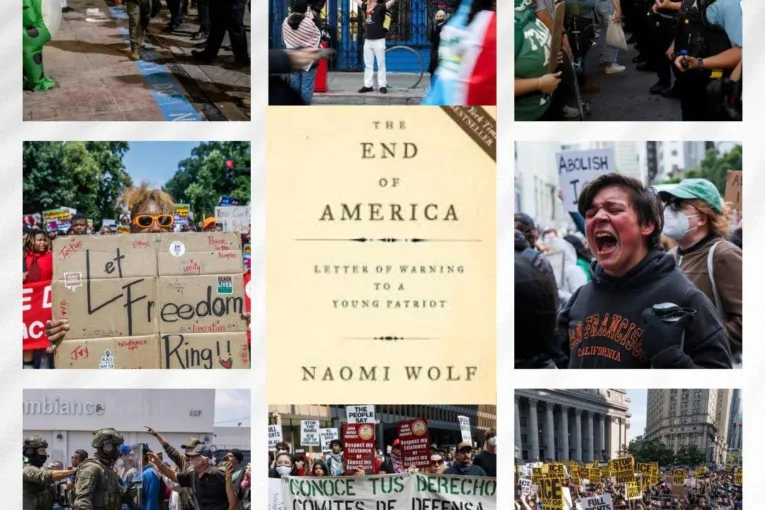
I warned about the threat. Now we must examine the machinery: who commands it, who pays for it, and whose freedom becomes negotiable when a blueprint becomes government policy.
Today is Monday, November 2nd, 2026. The general election is scheduled for tomorrow November 3rd, and the question before us is not only who wins power, but whether that power remains answerable to the people.
I warned you in August 2024. Not because I could predict every executive order or every court decision, but because the people preparing this transformation were telling us what they intended to do. Heritage Foundation President Kevin Roberts spoke of a “second American Revolution” that would remain bloodless “if the left allows it to be.” I called that a veiled threat. Roberts later said he meant a peaceful revolution at the ballot box. I do not have to pretend his explanation never existed to insist that peace should never be offered to political opponents as a conditional promise.
In October 2025, I returned to the warning in Soldiers in the Streets: Project 2025, Posse Comitatus and the Fight for America’s Cities. This time my focus was the boundary between federal authority and military policing. I called what I saw “domination disguised as democracy.” My concern was not only what officials were doing. It was what the rest of us might be persuaded to accept as normal.
With tomorrow’s vote approaching, I refuse to give you either of two comforting falsehoods: that nothing fundamental has changed, or that every institution has already surrendered. Presidential control has expanded through personnel rules, agency decisions and judicial doctrine. Protections have narrowed. Other attempted changes have been stopped. The economy is still growing, even as hiring weakens. We must be able to tell all of those truths at once.
The question I ask is simple: when government gathers more power into fewer hands, whose life becomes less secure? Follow that question from the federal workplace to the immigration courtroom, from the hospital to the ballot box. That is where a political program becomes a human reality.
I said pay attention. Now follow the machinery.
When I examined Project 2025 in 2024, I looked beyond Donald Trump’s distancing statements. I examined the people preparing the program and the positions they had occupied. I also directed readers to an Associated Press investigation of a Heritage-funded effort to identify career employees considered obstacles to a future conservative administration. The AP documented a $100,000 Heritage grant for that effort. This was preparation, not a rumor about what somebody might do someday.
By the time I wrote about soldiers in our cities, my concern had sharpened: repeat the language of emergency often enough, and exceptional power can begin to look ordinary. But I also included the legal context. Judge Charles Breyer’s Posse Comitatus ruling was under appeal and stayed. The fight was not over simply because one judge had ruled.
Let me be precise about the machinery. Project 2025 is a blueprint, not a statute. Its recommendations do not become law by appearing between covers. Officials must turn them into appointments, orders, regulations, legislation and enforcement decisions. Courts can permit those actions, limit them or stop them. The public blueprint advocates stronger presidential control and military assistance at the border; that is not the same as an express repeal of Posse Comitatus or a blanket instruction to turn every protesting city into a military operation.
I will not confuse a warning about a national abortion ban with proof that one has been enacted. Nor will I tell every low- or middle-income family that its taxes rose without examining the evidence. Precision is not retreat. If we intend to hold powerful people accountable, our facts must withstand their denials.
From a personnel plan to presidential power
Before January 20, 2025, the civil service was not insulated from elected leadership. Presidents appointed agency heads; managers could discipline workers. But the earlier Schedule F initiative had been revoked, and 2024 personnel regulations protected appeal rights when career employees were involuntarily reclassified. Project 2025 urged bringing Schedule F back. The administration did so under the name Schedule Policy/Career; a February 2026 OPM rule removed specified protections, and a June executive order placed listed positions into the new category. This is a concrete recommendation-to-action sequence, not an atmospheric resemblance.
The administration’s stated argument deserves accurate representation: an elected president must be able to make government carry out lawful policy. Its January order expressly says employees need not personally or politically support the president; its June order says selection is to rest on merit, not political affiliation. The countervailing concern is institutional: reducing removal protections can make professional disagreement harder to distinguish, in practice, from punishable resistance. The number of employees affected and the system’s ultimate legal reach remain separate questions.
A more fundamental change came at the Supreme Court. Project 2025 urged a formal challenge to Humphrey’s Executor, the precedent supporting specified independent-agency removal protections. On June 29, 2026, the Court’s divided decision in Trump v. Slaughter invalidated the Federal Trade Commission’s for-cause protection. That materially changed the pre-2025 legal baseline. It did not make every civil servant an at-will employee, and the opinion reserved other institutional questions. But it enlarged presidential control in precisely an area the blueprint had identified.
Now return to the military boundary I warned about. On October 23, 2026, the Ninth Circuit affirmed preliminary relief against the initial federalization of California’s Guard. The court found that the government had not established the statutory predicates for the June 2025 action. The record acknowledged serious violence as well as largely peaceful protest. I do not need to deny the violence to question the government’s authority. Neither did the court.
Three questions must remain separate: who commands the Guard, whether federalization was authorized, and what missions troops may lawfully perform. Federalization is not a self-executing exemption from restrictions on military law enforcement. The Insurrection Act is a different potential source of authority, with separate conditions. The California order under review invoked Section 12406; this was not a judgment approving or rejecting every possible Insurrection Act deployment.
Nor did the October ruling finally affirm Breyer’s separate Posse Comitatus injunction. The companion order identifies that injunction’s separate appeal as administratively stayed and held in abeyance. It also says California’s Guard was already no longer federalized or deployed in Los Angeles because an injunction against the extension had taken effect. The constitutional picture is one of attempted expansion, delayed remedies and meaningful resistance—not a legal firewall wholly erased, nor one that worked immediately.
The politics of division: Islamophobia, misogyny and the demand for accountability
A president does not have to repeal a constitutional guarantee to attack the people who depend on it. He can tell the country that a Muslim candidate is a terrorist in waiting. His administration can brand a woman killed by a federal officer a “domestic terrorist” before an independent accounting is complete. When those claims arrive with the authority of the presidency, they are not merely background noise. I argue that they encourage the public to fear certain people—and excuse their treatment.
Abdul El-Sayed: turning a candidate’s faith into a warning label
At his October 25, 2026 rally in Port Huron, Michigan, Trump called Democratic Senate candidate Abdul El-Sayed a “jihadist” and said he would “have to go through a metal detector before he’s allowed to go into the Senate.” Invoking September 11 and Flight 93, he urged Michigan to fight to stop “a jihadist from walking into the Capitol.” AP reporting carried by NPR, along with BBC reporting, documented the remarks. A political opponent was being placed in the imaginative company of the men who attacked this country.
El-Sayed was born in the United States, served as a Detroit public-health official and is Muslim. The AP account carried by NPR reported no evidence of his affiliation with the Muslim Brotherhood; El-Sayed has denied such ties and expressly disavowed the organization. His statements, policy positions and political associations are legitimate subjects of scrutiny. His faith is not evidence of terrorism. The White House nevertheless defended Trump’s attacks: spokesman Davis Ingle told the BBC the president would continue calling out “complete and total extremists like El-Sayed without apology.”
I call this Islamophobia because the rhetoric turns Muslim identity into a presumption of danger and conditional belonging. The criticism crossed party lines: Bishara Bahbah, a founder of Arab Americans for Trump, called the remarks “out of line” and “racist.” The point is not that El-Sayed should be exempt from hard questions. It is that no American should have to defeat a religious accusation before being permitted an ordinary political argument.
The constitutional principle is explicit. Article VI says that “no religious Test shall ever be required as a Qualification to any Office or public Trust under the United States.” Campaign insults are not, by themselves, a legally imposed qualification for office; I am not reporting a court finding that these remarks violated Article VI. I am identifying the contradiction between the Constitution’s rejection of religious exclusion and a president’s attempt to make a candidate’s religion a reason to regard him as an intruder. The First Amendment’s protection of religious exercise belongs in that same frame.
Misogyny is not a harmless sideshow
At that same Michigan rally, the AP account carried by NPR reported, Trump commented on Nicki Minaj’s posterior and signaled for her to stand for the crowd. Minaj was appearing in support of the Republican ticket. The incident matters precisely because contempt and objectification do not require a woman to be an opponent. I regard this public reduction of a woman to her body as misogynistic conduct, not as a substitute for judging her political choices.
There is an uglier example in the record of Renee Good’s death. ABC News reported that the cellphone video captures someone saying “F—— bitch” after shots are fired, as her vehicle moves away and crashes. The report does not conclusively identify the speaker, and I will not assign the words to a named officer without that proof. Nor does the slur, on its own, establish why Good was shot. It does establish that a degrading, explicitly sexist epithet is part of the recorded aftermath. That language deserves to be examined, not edited out of the public’s understanding.
Renee Good and Alex Pretti: constitutional rights have human names
Renee Good was 37, a poet and a mother of three. An ICE officer shot and killed her in her car in Minneapolis on January 7, 2026. Reuters reported that she and her partner, Becca, whom she called her wife, had joined protests against the federal immigration operation. DHS defended the shooting as justified; senior administration officials initially branded Good a “domestic terrorist.” Her family’s October lawsuits allege excessive force and civil-rights violations. The White House called those suits baseless. The allegations require adjudication, but an administration’s accusation against a dead woman is not itself an independent investigation of her killing.
Alex Pretti was also 37, an intensive-care nurse who worked for Veterans Affairs. Federal officers shot and killed him on January 24, 2026 during the Minneapolis enforcement surge. Officials initially claimed he was trying to attack agents with a handgun. Reuters’ verified video account showed him holding a cellphone as officers wrestled him down; an officer removed a gun from his body shortly before the first shots. Reuters’ October reporting also described him trying to help a protester who had been pushed to the ground. These are consequential contradictions to the initial official account—not a reason to invent details beyond the recordings.
The Justice Department announced a civil-rights investigation into Pretti’s killing on January 30. That development must be acknowledged. But the demand for an investigation and the demand for accountability are not satisfied by the same announcement. On October 27, Pretti’s father, Michael, said: “Our experience with the Department of Justice has left us wondering how Alex will ever get justice.” Reuters reported that DOJ defended its handling and said communications with families do not typically occur during an investigation.
The evidence dispute remained active as the election approached. Minnesota’s March complaint alleges that federal officers blocked state investigators from Pretti’s shooting scene even after they obtained a judicial warrant. That is the state’s allegation, not a finding I can declare proved. Federal authorities began providing materials in July; October reporting then documented state officials’ complaints that sharing had stopped and important materials were still missing. DOJ argued that it had discretion to withhold information and that formal legal proceedings had not begun when Minnesota requested it. PBS reported on October 23 that no criminal charges had been filed in either fatal shooting.
The constitutional argument must be as exact as the moral one
The First Amendment protects speech, peaceful assembly and petition. The Fourth Amendment governs claims of excessive force during a seizure through the objective-reasonableness standard described in Graham v. Connor. That standard considers the circumstances confronting officers, including an immediate threat; neither an officer’s asserted good intentions nor an observer’s outrage decides the legal question. Whether a violation occurred, whether a particular claim can proceed, and whether criminal liability can be proved are distinct questions.
My argument is not that hateful language, the Michigan campaign and the Minneapolis shootings are legally identical events—or that a Project 2025 page ordered either killing. It is that they expose connected dangers: making a religious minority suspect, degrading women, treating dissent as menace, and contested restrictions on outside scrutiny after government force kills. In my judgment, that combination attacks the constitutional culture that makes formal guarantees usable. It asks the public to grant officials more trust precisely when the evidence demands more examination.
We do not have to pretend every allegation has been proved to demand that evidence be preserved, families treated with dignity and official accounts tested. El-Sayed’s faith does not diminish his standing as an American. Good’s and Pretti’s deaths do not diminish the government’s duty to answer questions. The Constitution is not a loyalty program. Its protections are not a reward for being agreeable to the president. Its restraints matter most when those exercising power would rather we stop asking.
A growing economy is not the same as shared security
A serious comparison cannot begin with a fictional golden age. The pre-2025 United States already contained sharp racial inequalities and an abortion-rights landscape transformed by Dobbs. Its economic baseline also matters: hiring was stronger than today’s latest reading, but prices were still rising. The figures below compare information available before inauguration with the latest releases available by November 1—not a single, harmonized revision vintage.
| Indicator | Last pre-inauguration information | Latest by November 1, 2026 |
|---|---|---|
| Monthly payroll growth | +256,000, December 2024 | +29,000, September 2026 |
| Overall unemployment | 4.1%, December 2024 | 4.2%, September 2026 |
| Black unemployment | 6.1%, December 2024 | 7.0%, September 2026 |
| Annual headline / core CPI inflation | 2.9% / 3.2%, December 2024 | 3.7% / 2.6%, September 2026 |
| Real GDP growth, quarterly annualized | 3.1%, Q3 2024, third estimate | 3.4%, Q3 2026, advance estimate |
| Official poverty | 11.1%, calendar 2023 | 10.2%, calendar 2025—not November 2026 |
Sources: BLS baseline jobs; September 2026 jobs; baseline CPI; September 2026 CPI; baseline GDP; 2026 GDP; 2023 poverty; 2025 poverty. Payroll changes are not employment levels; GDP rates are not annual growth; subgroup unemployment estimates are subject to sampling variability.
The pattern is uneven, not uniformly catastrophic. The latest hiring figure is weak; aggregate unemployment is only slightly above the baseline. Headline inflation is higher, core inflation lower. Output continues to expand. An honest account must retain the improved official poverty reading too, while explaining that it measures 2025 and cannot settle what later eligibility restrictions did to families in autumn 2026.
The sharper policy evidence is distributional. CBO’s analysis of the July 2025 reconciliation law projects average annual household-resource losses of roughly $1,200 for the bottom income decile and gains of roughly $13,600 for the top decile over 2026–2034, in 2025 dollars relative to CBO’s January 2025 baseline. These are modeled changes relative to a baseline—not observed cash taken from or deposited into household accounts. The calculation combines taxes, benefits, state responses and allocated spending; CBO warns those channels are not directly comparable. Still, the direction is clear: an average gain can conceal a loss at the bottom.
When I warned about the economic threat in 2024, I was asking readers to examine who would bear the cost. We now have to look beyond tax rates alone. What matters is the combined value of what families pay, what they receive and what they can actually access. A tax benefit does not tell the whole story if a household also loses assistance it depends on.
Timing also changes the story. The law’s general Medicaid work-requirement start is January 1, 2027, with earlier state implementation possible. Its major provider-tax phase-down begins later still. Those provisions cannot honestly be described as nationwide losses already experienced by November 1. But narrower federally funded immigrant Medicaid eligibility took effect October 1, 2026. SNAP’s expanded work/time-limit framework and the shift of administrative costs toward states are also enacted changes; CBO’s projected participation losses over the decade are not a count of people already removed.
Project 2025 specifically recommended Medicaid and SNAP work requirements. The law therefore reflects identifiable policy overlap. It does not follow that the blueprint caused slower hiring, higher headline inflation or every household’s hardship. This is a before-and-after comparison, not an experiment isolating one program from interest rates, international conditions, demographics or state policy.
Whose rights became harder to exercise?
Immigration: a wider arrest campaign, not simply a longer removal tally
Immigration enforcement did not begin in 2025. The meaningful comparison is who became a target, what process remained, and how much discretion government asserted. Project 2025 recommended rescinding “sensitive zones” memoranda, expanding expedited removal and increasing detention capacity. Its specified 100,000-bed target is a proposal—not an observed detention population.
Reuters’ September 2026 analysis found nearly 51,000 ICE arrests in August, while deportations remained around 1,200 per day. People with criminal convictions accounted for less than a quarter of July arrests, compared with nearly 60 percent in December 2024. Neither statistic establishes that everyone else had lawful status or lacked pending charges. What it does establish is that the arrest campaign extended far beyond people with convictions—and that arrests and removals are not interchangeable measures.
The distinction is visible in a family Reuters documented. Dolores Mendoza and Roberto Avalos, grandparents raising their late daughter’s American children, were detained at an airport while their residency petitions were pending. Reuters reported that neither had a criminal record and that both had work authorization. Their lawyer challenged the detention. Their story shows how enforcement decisions reach into the lives of U.S.-citizen children.
On October 23, the Fifth Circuit, sitting en banc, rejected three long-resident immigrants’ asserted entitlement to individual bond hearings under the disputed detention framework. The opinion preserved possible habeas challenges on other grounds. It is a consequential circuit ruling, not a national declaration that immigrants have no constitutional rights. In the opposite direction, the Supreme Court’s June 2026 Trump v. Barbara judgment rejected the original attempt to restrict birthright citizenship. The machinery expanded; some boundaries held.
Women’s rights: the baseline was already post-Roe
There was no general federal constitutional right to abortion immediately before Trump’s second inauguration; Dobbs had already changed that landscape. The subsequent federal shift must be measured against that damaged baseline, not against an imagined restoration of Roe. One precise match with Project 2025 is the withdrawal of Biden-era pregnancy-emergency guidance under EMTALA. CMS announced the rescission in June 2025 while saying it would continue enforcing the underlying emergency-care law. Guidance withdrawal is a change in federal policy, not repeal of EMTALA.
The latest legal record resists sweeping shorthand. On October 30, 2026, a Ninth Circuit panel stayed an Idaho health-preserving abortion injunction pending appeal. But its text identifies a separate St. Luke’s EMTALA injunction that remained binding. And the FDA’s abortion-pill safety review remained a review: an October report described potential future changes, not completed withdrawal of mifepristone’s approval or a nationwide end to mail dispensing. Project 2025 sought more extensive restrictions than the verified record establishes as accomplished here.
The social consequence is not captured by counting statutes alone. When eligibility, geography and competing court orders determine access, the ability to find information, travel or secure counsel becomes part of the practical value of a right. A right that requires money, travel or legal help is not equally accessible to everyone who holds it.
LGBTQ rights: restriction is not the same as total erasure
Project 2025’s opening pages proposed stripping federal instruments of terminology including sexual orientation and gender identity. The administration’s ensuing actions have particularly targeted transgender recognition and care. The 2026 Medicaid/CHIP final payment rule, effective October 13, restricts federal payment for specified gender-transition treatments for Medicaid beneficiaries under 18 and separate-CHIP beneficiaries under 19, with a limited exception for tapering certain hormone treatment. Its scope matters: it is not a universal ban on adult treatment, and it does not prohibit state-only or private funding. Litigation and other injunctions complicate enforcement.
Not every attempted restriction succeeded. On October 21, the Supreme Court refused emergency relief that would have allowed the administration to enforce its challenged transgender-prisoner policy during litigation. That was not a final merits judgment, but it left an important protection in place at that stage. The record is therefore one of narrowing access and recognition, especially for transgender people—not the legal disappearance of every LGBTQ person’s rights. Nor should developments specific to transgender care be casually presented as identical experiences for lesbian, gay and bisexual Americans.
Black Americans: economic exposure and weaker routes to remedy
For African Americans, the comparison joins economic conditions to enforcement capacity. September’s Black unemployment rate was 7.0 percent, against 3.6 percent for White workers; the last pre-inauguration Black rate was 6.1 percent. Monthly subgroup estimates fluctuate, and this comparison does not establish that Project 2025 caused the change. It does show why aggregate unemployment is an inadequate description of Black economic security.
At the same time, several agencies eliminated disparate-impact regulations, following a 2025 presidential directive. These rules provided specified administrative avenues for challenging practices with discriminatory effects without treating every case as requiring the same direct evidence of discriminatory intent. Project 2025 explicitly advocated eliminating disparate impact and rescinding the federal-contractor affirmative-action order. Yet agency regulations, Title VII statutory claims and all civil-rights law are not interchangeable: the executive did not simply erase every discrimination remedy.
The Supreme Court separately narrowed the Section 2 vote-dilution framework in April’s Louisiana v. Callais, requiring a strong inference of intentional racial discrimination under its new construction. Section 2 was not formally repealed. The significance is the changed route to remedy. A court’s independent decision should not be mislabeled an executive implementation order merely because it moves in a compatible ideological direction.
Other underserved communities: different vulnerabilities, overlapping burdens
Immigration status is not ethnicity. Nonetheless, the October Medicaid restrictions affect specified low-income immigrant groups, including refugees and asylees without green cards, with exceptions and procedural protections. Undocumented immigrants already lacked ordinary full federally funded Medicaid coverage; the new policy narrows eligibility for additional groups. Some states may substitute state-only coverage. The eligibility change should not be confused with a verified national count of people already disenrolled.
For disabled Americans, NPR reported an October enforcement retreat and a September judgment removing HHS integration regulations after the federal government reversed position. The report also stresses what survived: ADA protections and the Olmstead line of cases were not undone. That account is drawn from NPR’s reporting.
For Indigenous nations, sovereignty must not be reduced to a demographic category. In an Oklahoma-specific dispute, the Tenth Circuit upheld EPA’s removal of a state–tribal engagement condition attached to defined environmental authority. That is a concrete loss of a procedural safeguard, not proof that tribal sovereignty or every environmental protection disappeared nationwide. This ruling is not, by itself, proof of a direct Project 2025 instruction.
These communities are not interchangeable, and their members are not only victims. The common structural question is whether a person with less money, weaker institutional access or a contested legal status must carry more of the burden of obtaining a benefit, securing care or enforcing a right.
Environmental retreat is a transfer of risk
Before 2025, federal policy included the greenhouse-gas endangerment finding and stronger 2024 Mercury and Air Toxics Standards amendments. In February 2026, EPA finalized rescission of the endangerment finding and highway-vehicle greenhouse-gas standards, with an April effective date. EPA framed its action in terms of statutory authority and regulatory relief. Those are the agency’s contested legal and policy positions—not judicial findings that the climate danger disappeared. The action did not repeal the Clean Air Act or every conventional-pollutant vehicle standard.
The precision matters for Project 2025 attribution too. The blueprint called for updating the endangerment finding; it did not use the same operative language as the eventual rescission. EPA also repealed the 2024 MATS strengthening, while the 2012 framework remained. The result is a documented reduction in federal regulatory ambition, not the abolition of mercury regulation or a measurement of additional deaths.
Environmental justice links this policy story to the civil-rights story. The blueprint sought removal of a stand-alone environmental-justice office while relocating its function. Separately, the administration’s termination of the Environmental and Climate Justice Block Grant Program led to litigation: a district court ordered program administration restored, and the Fourth Circuit stayed that order in August 2026. A litigation victory on paper therefore cannot be assumed to mean money reached communities. The cited chronology does not establish subsequent disbursement.
Calling this a transfer of risk is an analytical judgment: when government weakens future compliance obligations or withdraws a channel of community support, the relevant question becomes who must absorb the consequences if protection proves insufficient. It is not a substitute for measuring exposure. Policy retreat is documented. The additional pollution, illness or climate damage attributable to it must be measured, not invented.
Black lives, hanging deaths and the federal answer we are owed
Before I close, there is another constitutional question this country must confront: what happens when Black families ask the government to explain how their children died—and cannot obtain an answer they can examine and trust? Across the South and beyond it, reports of Black people found hanging have reopened a wound that America has never fully healed. The legacy of lynching makes these discoveries terrifying. It also makes disciplined investigation indispensable. Fear deserves to be heard. Evidence must decide what happened.
Capital B reported on September 24 that at least ten Black people had been found hanging from trees over the preceding year. Some deaths were ruled suicides; families questioned several investigations. Separately, a congressional letter dated September 8 and announced September 10 cited at least ten reported hangings in 2026. These are differently framed counts, not interchangeable statistics—and neither establishes a measured increase in proven racially motivated killings. Calling every death a lynching before the evidence is established would fail the very families whose demand is for the truth.
Young people are among those whose deaths demand careful scrutiny. The NAACP Legal Defense Fund’s August 24 appeal to United Nations experts identifies 16-year-old Juliana Umba Nzita in North Carolina and 27-year-old To’Nea Nicole Miller in Florida, whose deaths were ruled suicides but whose cases raised questions for relatives or advocates. LDF also discusses suspicious deaths that were not hangings. Those distinctions must survive the headlines. Its appeal is an urgent request for independent scrutiny, not an international finding that murder occurred.
Consider Demartravion “Trey” Reed, the 21-year-old Delta State University student found dead on September 15, 2025. The official autopsy ruled his death a suicide. The Mississippi Free Press later reported family accounts of messages from his phone threatening suicide, alongside the family’s continuing questions and frustration over an independent autopsy whose final results they said had not been shared. We cannot omit evidence that complicates a racial-murder allegation. Nor can we treat a grieving family’s demand for records as something beneath an answer.
Consider, too, Tasia Fortune, 29, found hanging in Jackson, Mississippi, on August 3, 2026. Her death was ruled a homicide, and men were charged with murder. But police described a staged hanging after a killing they linked to a drug dispute; the reporting does not establish a racial motive. Homicide, a staged hanging and a legally established hate crime are not synonyms. Her life deserves justice on the evidence, not conscription into a story whose conclusions have already been written.
“Prepared to investigate” cannot be the end of the public conversation
The FBI was not wholly silent about Reed. On September 17, 2025, spokesperson Marshay Lawson told the Clarion Ledger that FBI Jackson was aware of his death, in regular contact with local authorities and “prepared to investigate” if information suggesting a potential federal violation emerged. Representative Bennie Thompson had called for a full federal investigation. That statement is part of the record. It does not establish that no federal work followed; neither is it a published, completed independent review.
A year later, Representative Ayanna Pressley and colleagues demanded something more concrete from DOJ and the FBI: thorough federal investigations, independent autopsies with family permission, audits of local investigations, review of evidence, reports to Congress and systematic data collection. Their letter declared, “Inaction by the federal government is tantamount to complicity.” That is the lawmakers’ accusation, not a finding I can declare proved. LDF separately condemned what it called the “apparent indifference” of federal as well as state and local authorities.
I have not verified a comprehensive public DOJ or FBI response to that congressional demand by the November 1 reporting cutoff. That is a limit of this reporting—not proof that every agent did nothing or that confidential work does not exist. My criticism is of an inadequate public accounting: families and communities should be able to learn what was reviewed, what jurisdiction was assessed and what conclusions can responsibly be disclosed. Confidentiality may limit particular disclosures. It should not become a permanent substitute for accountability.
The Emmett Till Antilynching Act, enacted in 2022, provides federal penalties for specified hate-crime conspiracies with grave consequences. It does not turn every hanging into a federal hate crime. The Fourteenth Amendment’s command of equal protection binds the states; a family’s disagreement with a suicide ruling does not, by itself, establish a constitutional violation. But possible discriminatory failures to investigate are serious enough to demand scrutiny—not dismissal. The point of an investigation is to establish the facts, not to require a family to prove the entire case before officials will explain their work.
I will not manufacture a lynching statistic to make this administration look worse. I will demand that it show its work. If a death was suicide, explain the evidence with humanity and respect for privacy. If it was homicide, pursue those responsible. If racial intimidation or discriminatory official conduct is supported by evidence, use the applicable federal law. An anti-lynching statute cannot be allowed to become a ceremonial promise. Black families are owed neither rumor nor reassurance without substance. They are owed truth—and institutions willing to pursue it.
On the eve of the vote: a test, not a verdict
I consider this election a test of whether the people can still make concentrated power answer to them. I do not need to assign it a place in a century-long ranking to explain those stakes. November 3 is ahead of us. I cannot report its turnout, result or legitimacy in advance, and neither can anyone else. What I can do is examine the conditions under which Americans are being asked to vote.
The administration’s March 2026 election order directed citizenship-list development and new postal-ballot procedures, invoking integrity and verification. Courts then produced different outcomes. In September, the Supreme Court left an injunction against the final postal rule in place; separately, in litigation over modifications initiated under a March 2025 order, it allowed the modified SAVE verification program to proceed pending appeal. Permission to operate that system is not permission automatically to remove every unmatched voter, and the stay is not a final merits judgment. These are specific decisions about specific powers, not a single judicial endorsement or repudiation of the administration’s election agenda.
What, then, distinguishes America before the governing program took shape from America on this election-eve morning? Not the invention of inequality, immigration detention or executive ambition. Those were already present. The documented change is a set of mechanisms: fewer procedural protections in selected career posts; greater presidential removal power at the FTC; narrower administrative civil-rights routes; a broader immigration arrest campaign; unresolved demands for accountability after the Minneapolis killings; divisive attacks on religious belonging; reduced federal support for specified care; and environmental rollbacks. Alongside them stand adverse rulings, surviving protections and an economy whose aggregate expansion cannot settle the question of who is secure.
In 2024, I asked readers to look at the plan. In 2025, I asked them to look at the streets. Today I ask you to look at the connection: appointments, regulations, appropriations, enforcement choices and court judgments. That is how an ideology acquires the force of government. It is also where people can contest it. Nothing about surrender is inevitable.
A right can survive in the statute book while becoming harder to use. A constitutional limit can survive in principle while arriving late in someone’s life.
That is the question beneath the campaign language: whether authority remains answerable to people who must live with its exercise. A civil-service appeal, a bond hearing, an emergency-care protection, a pollution limit and an unimpeded ballot are different instruments. Their common purpose is to keep power from becoming the only fact that matters.
I again urge readers to pick up Naomi Wolf’s The End of America: Letter of Warning to a Young Patriot (Chelsea Green, 2007), the book featured at the center of the opening collage. Wolf asks readers to recognize patterns through which an open society can lose its freedoms. Read it critically, compare its arguments with the public record, and do not treat any historical analogy as proof that our future is predetermined. My recommendation is not an invitation to surrender to fear. It is an invitation to recognize warning signs while there is still room to act.
I warned because silence was not an option. I write now because neither is resignation. This country goes into November 3 neither untouched nor beyond repair. Read the record. Know what has changed. Defend the people whose rights are easiest to bargain away. And do not mistake a democracy that still has a ballot for a democracy that no longer needs defending.

Malik Washington is an investigative journalist, U.S. Army veteran, and CEO of Destination Freedom Media Group, which he co-founded with Gale Washington. Destination Freedom Media Group, an independent nonprofit newsroom dedicated to accountability reporting at the intersection of civil rights, public integrity, disability justice, structural accountability within American institutions, and community survival.
He previously served as Editor-in-Chief of the San Francisco Bay View National Black Newspaper (2020–2021) and has been a published journalist for over 14 years.
With journalist Maura Corkery, he is co-author of The Unquiet Resignation, an investigative series on the San Francisco Unified School District produced in partnership with The Davis Vanguard.
His “Price of Being Poor” series — also produced in partnership with The Davis Vanguard — is the most sustained recent accounting of privatized public housing in San Francisco documenting the conditions at Alice Griffith Apartments that culminated in San Francisco’s first-of-its-kind code-enforcement settlement of August 26, 2026.
His work focuses on government power, criminal justice, environmental justice, and the human consequences of policy decisions too often insulated from public scrutiny. Washington’s reporting amplifies the voices of impacted communities while insisting on documentary evidence, transparency, and the unvarnished truth—especially when institutions demand silence.
His work appears on platforms such as Muck Rack, examining the intersection of justice, governance, and community.
You can reach him via email: mwashington2059@gmail.com or call him at (719) 715-9592.
Suggestions or leads on stories are always welcome.
Please follow us on:
Facebook: https://www.facebook.com/destfreedom13
Instagram: https://www.instagram.com/destinationfreedom13/
X: https://x.com/dest_freedom
To comment please go to one of these social media platforms:
Facebook: https://www.facebook.com/DavisVanguard
LinkedIn: https://www.linkedin.com/company/peoples-vanguard-of-davis-inc/
Instagram: https://www.instagram.com/davisvanguard/
X: https://x.com/davisvanguard
Bluesky: https://bsky.app/profile/vanguardnewsgroup.bsky.social
Subscribe to the Vanguard News letters. To make a tax-deductible donation, please visit davisvanguard.org/donate or give directly through ActBlue. Your support will ensure that the vital work of the Vanguard continues.
