
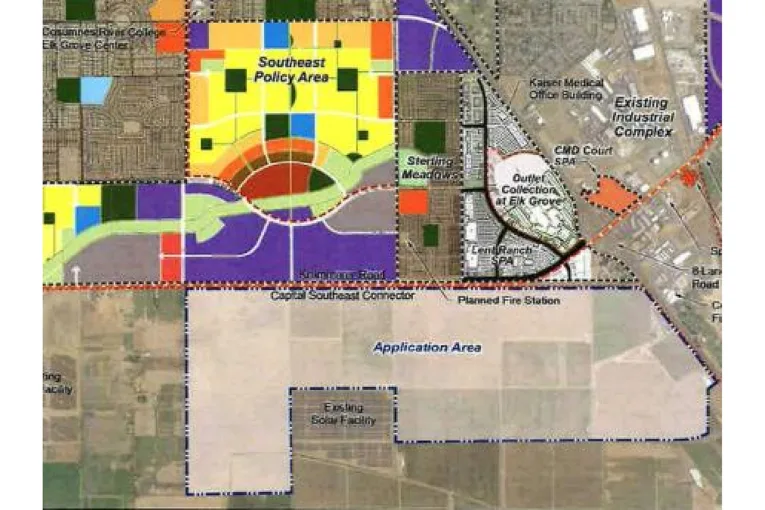
ELK GROVE, Calif. — As California continues to press local governments to accommodate more housing through state-mandated planning requirements, the city of Elk Grove is reviewing two major developments that could bring more than 5,000 homes to agricultural land outside its existing city limits.
The two proposals, Reserve at Elk Grove and Elk Grove Crossing, encompass approximately 1,169 acres south of Kammerer Road and would require annexation before development could proceed.
According to an Oct. 30 report by the Sacramento Business Journal, the developments are moving through the city’s planning and environmental review processes, with a key water-supply determination scheduled for consideration by Sacramento County supervisors on Nov. 3.
The proposals come as California continues implementing housing laws designed to increase residential construction, require cities to identify sufficient land for future development and limit local barriers to projects that comply with state requirements.
Under the state’s Regional Housing Needs Allocation process, cities must plan for housing across multiple income categories, while their housing elements are subject to review by the California Department of Housing and Community Development.
Those requirements have become a central feature of California housing policy, with the state exercising greater oversight of local planning decisions and imposing consequences when jurisdictions fail to maintain compliant housing elements.
In Elk Grove, the two projects would extend development south of Kammerer Road, an area already included within the city’s sphere of influence but not formally annexed into the municipality.
City spokeswoman Kristyn Nelson confirmed to the Business Journal that both properties are part of pending annexation applications moving through the review process.
Elk Grove Crossing, proposed by Feletto Development Company, would occupy approximately 319 acres between planned extensions of Big Horn Boulevard and Murphy’s Corral Road.
The development includes 602 low-density homes, 400 medium-density homes and 709 higher-density units, for a total of 1,711 residences.
The higher-density housing would be concentrated primarily toward Kammerer Road, while lower-density neighborhoods would occupy the southern portion of the site.
The proposal also includes three neighborhood centers covering approximately 68 acres, along with an elementary school, parks, open space and stormwater detention facilities.
The larger Reserve at Elk Grove project, proposed by Integral Communities, would occupy approximately 850 acres east of Elk Grove Crossing and west of Highway 99.
According to the Business Journal’s description of the plans, the project would include 1,199 low-density homes, 1,174 medium-density homes and 402 residences arranged in six-unit and eight-unit configurations.
An additional 639 higher-density residences would be located within a mixed-use commercial area, bringing the project’s reported residential total to 3,414 units.
The proposal also includes approximately 151 acres of commercial and office development, an elementary school and a 100-acre regional park, along with additional parks and drainage facilities.
Together, the two projects would provide approximately 5,125 homes if approved and constructed as described in the reported plans.
The proposals remain subject to environmental review, local approvals and annexation proceedings.
According to the California Environmental Quality Act filing for Reserve at Elk Grove, the city initiated environmental review of the development earlier this year.
The Elk Grove Crossing environmental filing also identifies a series of required approvals, including land-use planning, infrastructure and environmental authorizations.
Nelson told the Business Journal that a draft environmental impact report for Reserve at Elk Grove was expected within several weeks, while city planning staff continued reviewing the draft specific plan for Elk Grove Crossing.
A separate decision involving water availability is scheduled for Nov. 3, when Sacramento County supervisors are expected to consider a Sacramento County Water Agency assessment addressing whether sufficient water supplies are available for the proposed developments.
If the city approves the specific plans, annexation applications would proceed to the Sacramento Local Agency Formation Commission, the regional agency responsible for reviewing municipal boundary changes.
Elk Grove began pursuing expansion into the area in 2013, when it sought to enlarge its sphere of influence south of Kammerer Road.
Environmental organizations challenged that expansion, and subsequent proceedings resulted in LAFCO approval of a sphere-of-influence expansion sought by private property owners.
The projects are advancing against the backdrop of California’s broader efforts to address its housing shortage through state planning mandates and increased oversight of local governments.
State housing law requires municipalities to adopt housing elements identifying sites and policies capable of accommodating their assigned share of regional housing needs. The California Department of Housing and Community Development reviews those plans for compliance with state law.
The state has also expanded enforcement mechanisms through the Housing Accountability Act, Housing Crisis Act and other legislation intended to reduce local obstacles to residential development.
Those laws do not independently require Elk Grove to approve the two proposed annexations, but they establish the broader regulatory framework governing local housing planning and development decisions.
In nearby Davis, state housing requirements have similarly shaped debates over future growth, particularly as the city considers how to accommodate lower-income housing needs while maintaining voter approval requirements for most peripheral development under Measure J/R/D.
Davis has identified approximately 2,100 housing units in its 2021-2029 regional housing allocation, while Elk Grove’s two pending proposals alone would accommodate more than twice that number of residences.
The two Elk Grove developments would also include a substantial range of housing densities, with more than 1,300 units identified in higher-density categories across the two proposals.
Sacramento County supervisors are scheduled to take up the water-supply assessment Nov. 3, while the city continues reviewing the projects’ environmental documents and specific plans.
To comment please go to one of these social media platforms:
Facebook: https://www.facebook.com/DavisVanguard
LinkedIn: https://www.linkedin.com/company/peoples-vanguard-of-davis-inc/
Instagram: https://www.instagram.com/davisvanguard/
X: https://x.com/davisvanguard
Bluesky: https://bsky.app/profile/vanguardnewsgroup.bsky.social
Subscribe to the Vanguard News letters. To make a tax-deductible donation, please visit davisvanguard.org/donate or give directly through ActBlue. Your support will ensure that the vital work of the Vanguard continues.
