
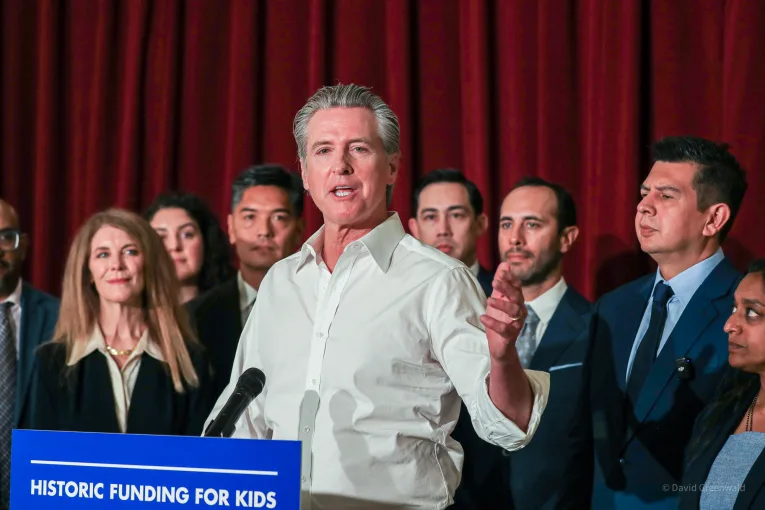
SACRAMENTO, Calif. — Gov. Gavin Newsom has warned California’s four chief federal district judges that the Trump administration could attempt to seize ballots, election records or voting equipment before the November election results are certified, potentially disrupting the counting of votes following Tuesday’s general election.
In an Oct. 31 letter, Newsom raised concerns that federal prosecutors, following a series of unsuccessful court challenges involving California’s election procedures, could turn to criminal investigations and seek search warrants targeting election materials.
The governor’s warning comes amid escalating tensions between California officials and the U.S. Department of Justice over federal demands to identify and segregate ballots cast by individuals the administration believes may be noncitizens.
Newsom addressed the letter to Chief U.S. District Judges Yvonne Gonzalez Rogers of the Northern District, Troy L. Nunley of the Eastern District, Dolly M. Gee of the Central District and Cynthia A. Bashant of the Southern District.
“I write to alert you to the risk to election integrity of judges issuing a search warrant to seize ballots, election records, or certified voting technology while an election is underway and before the results are certified,” Newsom wrote.
He emphasized that he was not responding to any known pending warrant application, acknowledging that he was unaware of any such requests currently before the courts.
Instead, the governor described what he characterized as an emerging threat arising from federal prosecutors’ increasingly aggressive efforts to pursue election officials who decline to comply with Justice Department demands.
Newsom specifically cited Acting Deputy Attorney General Trent McCotter, whom he identified as the department’s second-ranking official, for sending letters warning state and local election officials of potential legal consequences if they failed to comply with federal directives.
He also identified Bilal Essayli, first assistant U.S. attorney for the Central District of California, who Newsom said had threatened criminal prosecution of election officials processing ballots cast by people federal authorities assert may be noncitizens.
The letter pointed to federal grand jury subpoenas issued to Los Angeles County election workers and reports that the Justice Department had directed additional criminal investigations of California election officials.
Those developments followed litigation in which federal courts rejected emergency efforts by the administration to change California’s handling of ballots during an election already underway.
In United States v. California, federal prosecutors sought an order requiring state and local election officials to set aside ballots cast by individuals the federal government identified as likely noncitizens.
On Oct. 28, U.S. District Judge David O. Carter denied the administration’s request for emergency relief, declining to impose the proposed ballot segregation requirements.
Carter also addressed the federal government’s treatment of election officials, advising that it “would be wise that any threats to state and county elected employees cease immediately.”
The Ninth Circuit subsequently rejected further emergency relief sought by the administration, adding to a series of adverse rulings in the election dispute. Governor of California+1
Newsom’s letter suggested those setbacks could prompt federal authorities to pursue a different legal strategy.
“Given the United States Department of Justice’s persistence in advancing this baseless theory of criminal liability, I have grave concerns federal agents will seek search warrants to seize ballots and ballot materials before the election results are certified,” Newsom wrote.
He argued that the administration’s conduct suggested a potential shift from civil litigation to criminal proceedings, where prosecutors could seek judicial authorization to obtain physical election materials.
The distinction is significant because search warrant applications are generally considered through procedures separate from ordinary civil litigation and can be presented to federal magistrate judges without advance notice to the parties whose property would be searched.
Although a warrant requires a judicial finding of probable cause and must satisfy constitutional requirements, the seizure of election materials during active ballot processing could raise additional questions about the necessity, scope and practical consequences of the search.
Newsom argued that California’s existing ballot preservation requirements eliminate any legitimate need to seize equipment or records while election officials are counting votes.
“California’s strict chain of custody, documentation, and retention laws related to ballots and ballot materials ensure any evidence of alleged wrongdoing tied to ballots or ballot materials is preserved and appropriately supervised by a court,” he wrote.
He maintained that removing materials needed to tabulate votes would interfere with the state’s ability to complete the election.
The governor’s assertion that no legitimate law enforcement justification could exist for such seizures represents California’s position, rather than a judicial determination that every potential federal search warrant would be unlawful.
Federal authorities generally have investigative powers to pursue suspected violations of federal election laws, but the exercise of those powers remains subject to constitutional protections and judicial review.
The dispute also comes after California enacted additional legislation intended to protect election materials from unauthorized seizure or interference.
In September, Newsom signed a package of election-related measures that included Assembly Bill 282, which establishes felony penalties for certain seizures of ballots, election records or certified voting technology before election results are certified.
Another measure, Assembly Bill 1664, requires local agencies and election officials to notify the California secretary of state and attorney general when they become aware of warrants, subpoenas or active law enforcement investigations involving election records or voting technology. Governor of California
The application of those state protections to federal officers acting under federal authority could itself raise constitutional questions involving federal supremacy and the respective powers of state and federal governments.
Newsom’s letter focused on the federal judiciary’s responsibility to evaluate any warrant applications before election materials are removed from the custody of local officials.
He enclosed a September 2026 resource prepared by the UC Berkeley Edley Center on Law & Democracy titled Questions for Assessing a Search Warrant for Election Materials.
The document, according to the governor, provides a framework for judges considering requests to seize ballots, election records or voting technology during an active election.
Newsom urged the chief judges to make the resource available to district and magistrate judges who could be asked to consider such applications before California certifies its election results on Dec. 11.
The governor’s intervention places additional attention on the role federal judges could play in determining whether investigative demands involving election materials are justified and whether their execution would interfere with the state’s constitutional responsibility to administer elections.
It also follows a broader confrontation over the federal government’s authority to direct how California election officials process ballots and investigate suspected noncitizen voting.
The Trump administration has argued through its litigation that federal law requires election officials to prevent unlawful votes from being counted, while California officials have maintained that the administration’s proposed remedies threaten to disenfranchise eligible voters based on unreliable determinations of citizenship.
California Attorney General Rob Bonta, responding to the recent federal court rulings, said state law already prohibits noncitizens from voting in federal elections and provides safeguards against unlawful voting.
“No administration can disenfranchise thousands of individuals or disrupt an ongoing election based on highly unreliable claims of noncitizenship,” Bonta said following Carter’s Oct. 28 ruling. Governor of California
The governor’s letter goes beyond the pending civil litigation by raising the possibility that federal agents could attempt to obtain through criminal search warrants materials they have been unable to secure through emergency court orders.
Newsom expressly distinguished his warning from the pending litigation, stating that he was not seeking to influence the outcome of United States v. California.
Nevertheless, he urged federal judges to consider the broader implications of any warrant application involving election materials before the state’s certification deadline.
“The stakes for democracy and the rule of law are too high to consider any such application without additional scrutiny and awareness of the impacts that approval may cause on the ability of California election officials to fulfill their duties to count lawfully cast votes and certify the results reflecting the will of the people,” Newsom wrote.
The letter identifies Dec. 11, 2026, as the deadline for California’s election results to be certified, leaving nearly six weeks after Election Day during which local election officials must complete ballot processing, canvassing and certification procedures.
To comment please go to one of these social media platforms:
Facebook: https://www.facebook.com/DavisVanguard
LinkedIn: https://www.linkedin.com/company/peoples-vanguard-of-davis-inc/
Instagram: https://www.instagram.com/davisvanguard/
X: https://x.com/davisvanguard
Bluesky: https://bsky.app/profile/vanguardnewsgroup.bsky.social
Subscribe to the Vanguard News letters. To make a tax-deductible donation, please visit davisvanguard.org/donate or give directly through ActBlue. Your support will ensure that the vital work of the Vanguard continues.
