
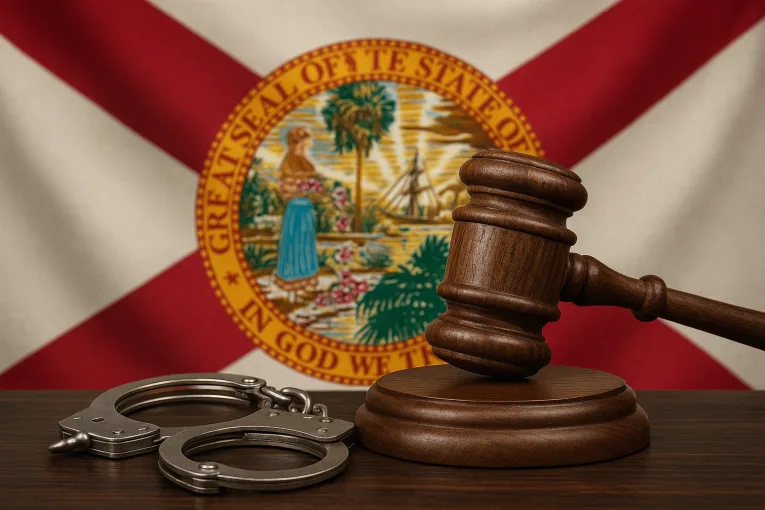
HOLLYWOOD, Fla. — Florida Gov.-elect Byron Donalds said Friday, Nov. 13, that he plans to evaluate execution warrants individually when he takes office in January. He declined to commit to maintaining the pace of death warrants signed under Gov. Ron DeSantis.
According to Florida Phoenix, a reporter asked Donalds at a Hollywood news conference whether he would continue signing death warrants at the current rate.
“For us, we’re just going to evaluate each case as it comes,” Donalds said. “I’m not trying to set a quota, or anything like that. We’re going to evaluate them on an individual basis, because you are talking about following through on a court decision for somebody who’s on death row.”
Donalds added, “And so, we’ll just do that on a case-by-case basis. That’s the way that I’m going to proceed with that topic.”
Florida Phoenix reported that Florida and Pennsylvania are the only states that give their governors sole authority to sign death warrants. DeSantis signed 19 death warrants in 2025 and 22 so far in 2026.
Warrants signed and executions carried out are counted separately. According to the Death Penalty Information Center (DPIC), 37 people had been executed nationwide in 2026 as of Nov. 13, including 19 in Florida.
The three remaining warrants DeSantis signed this year set executions for Nov. 19, Dec. 1 and Dec. 10, Florida Phoenix reported. Florida executed 19 people in 2025, bringing its two-year total to 38, more than any other state in the nation. Before 2025, Florida had never executed more than eight people in a single year.
Donalds’ comments came one day after Floridians for Alternatives to the Death Penalty (FADP) held a news conference in Tallahassee on Thursday, Nov. 12. At the event, three Florida death row exonerees called on the governor-elect to halt executions and review the state’s death penalty laws.
An FADP media advisory announcing the event named the speakers as Joaquín José Martínez, the 19th person exonerated from Florida’s death row; Herman Lindsey, executive director of Witness to Innocence and the 23rd person exonerated; and Seth Penalver, the 24th person exonerated.
According to the advisory, the three men spent a combined 26 years on death row for crimes they did not commit. The advisory stated that 30 men have been released from Florida’s death row due to evidence of innocence since 1976, more than in any other state.
“When I hear about another execution, I think about how close I came to being one of those names,” Lindsey said in the advisory. “I was released, but I worry about who is still there and whether anyone is listening to them.”
Martínez stated: “I was there, and I was innocent. So were 29 other men in Florida. I hope the next governor will think about us when he’s told that a case is certain and there’s no reason to pause executions.”
The exonerees asked Donalds to stop executions, examine Florida laws that they say “make wrongful convictions inevitable” and commit to giving each case careful consideration.
FADP pointed to the scheduled Nov. 19 execution of Thomas Overton, who “has maintained his innocence for 30 years.” According to the advisory, Overton’s execution would break the state’s record of 19 executions set in 2025.
Overton was convicted in 1999 and sentenced to death for the 1991 murders of a Florida Keys couple. The jury’s recommendations for death were not unanimous, with votes of 9-3 and 8-4, according to a Nov. 13 Florida Supreme Court opinion.
In the opinion, the court affirmed a lower court’s denial of Overton’s latest motion for postconviction relief. It also denied his requests for habeas relief and a stay of execution.
The opinion stated that the prosecution’s case at trial relied on DNA evidence and testimony from two witnesses who were formerly incarcerated with Overton.
“There is no such thing under Florida law as an ‘actual innocence’ claim independent of newly discovered evidence,” Justice Adam Tanenbaum wrote for the court.
The court found that Overton “failed to identify new evidence” and instead repackaged earlier challenges to the strength of the evidence presented at trial.
The court also rejected Overton’s claim that Florida’s clemency and death warrant process lacks minimal due process protections, noting that it had rejected the same claim many times before. It further stated that Florida’s capital punishment process is “wholly constitutional.”
Separately, the Rev. Jeff Hood, spiritual adviser to two men scheduled for execution in the next month, urged Donalds on Wednesday, Nov. 11, to commit to a six-month moratorium. The pause would run from Jan. 5, when Donalds takes office, through July 5, Florida Phoenix reported.
“We’re asking for this to be a moment in which the state takes the opportunity to investigate what 40 executions in multiple years has cost,” Hood said during a remote news conference.
Hood said he would like Donalds to create an independent commission during the pause. The commission would determine whether the current process is reliable and fair and whether courts and defense attorneys have enough time to prepare.
Hood explained that his request does not go as far as a permanent halt because “we are trying to meet him where he is.”
According to Florida Phoenix, Donalds told the Miami Herald and the Tampa Bay Times earlier this year that he supports the death penalty.
“This is not California,” he told the newspapers, adding, “Harm a Floridian, and you will face the consequences.”
Florida Phoenix reported that California Gov. Gavin Newsom announced a plan the previous week to commute the death sentences of all 548 people on the state’s death row to life without the possibility of parole. The proposed commutations remain subject to applicable constitutional requirements, including California Supreme Court review for eligible cases.
The calls for a pause come as national support for capital punishment declines. A Gallup poll conducted Oct. 1-19 found that 49% of U.S. adults favor the death penalty for people convicted of murder, while 45% oppose it. Gallup reported that this was the first time support had fallen below a majority since 1971.
The poll began the day after a failed execution attempt involving Tennessee death row prisoner Christa Pike. Gallup reported that Tennessee’s governor subsequently paused executions pending an investigation.
According to Florida Phoenix, 27 states retain the death penalty. Four of them — California, Ohio, Oregon and Pennsylvania — have executive holds on executions.
Although Donalds said he would not set a quota for death warrants, case-by-case review is not a moratorium. He has not said how he will weigh innocence claims or clemency requests once he takes office.
Overton’s execution remains scheduled for Thursday, Nov. 19, more than six weeks before Donalds is sworn in.
To comment please go to one of these social media platforms:
Facebook: https://www.facebook.com/DavisVanguard
LinkedIn: https://www.linkedin.com/company/peoples-vanguard-of-davis-inc/
Instagram: https://www.instagram.com/davisvanguard/
X: https://x.com/davisvanguard
Bluesky: https://bsky.app/profile/vanguardnewsgroup.bsky.social
Subscribe to the Vanguard News letters. To make a tax-deductible donation, please visit davisvanguard.org/donate or give directly through ActBlue. Your support will ensure that the vital work of the Vanguard continues.
