
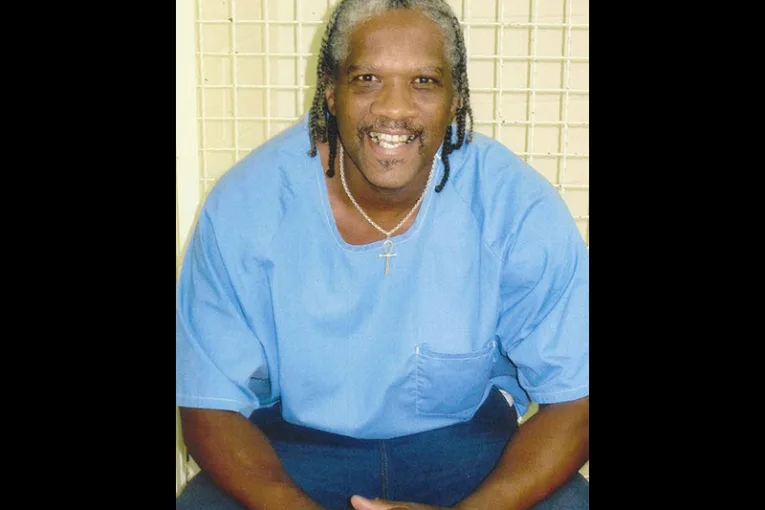
STOCKTON, Calif. — Kevin Cooper, who came within hours of execution in 2004 and has spent more than four decades fighting to overturn his conviction for a 1983 quadruple murder, welcomed Gov. Gavin Newsom’s announcement that he intends to commute every California death sentence but said the decision provides little personal relief because he remains incarcerated and continues to maintain his innocence.
In a telephone interview Friday from the California Health Care Facility in Stockton, Cooper, 68, described the governor’s announcement as a significant development for people facing execution while emphasizing that replacing death sentences with life imprisonment without the possibility of parole does not address wrongful convictions.
“That it was long overdue,” Cooper said when asked about his reaction to the announcement. “I mean, as someone who was almost executed by the state of California in 2004, and I know what it’s like to go through that sick ass death ritual they put you through and be 10 feet away from the death chamber, and I am innocent on top of that.”
Cooper said he was pleased that Newsom had taken action but emphasized that California’s death penalty remains legally authorized and that his own commutation requires an additional constitutional step.
“And while I am glad that he did what he did, the death penalty is still the law of the state,” Cooper said.
Newsom announced Thursday that he intends to commute all California death sentences to life imprisonment without parole, an action that would eliminate the possibility of execution for those affected but would neither overturn their convictions nor provide a pathway to release.
The governor has asked the California Supreme Court for the recommendation required under the state Constitution for 382 condemned individuals with more than one felony conviction, including Cooper. The governor requested a response before the end of his term.
In his Nov. 5 letter to Californians, Newsom described California’s death penalty system as fundamentally flawed, citing wrongful convictions, unequal application and decades of unsuccessful efforts to reform it.
Newsom acknowledged the suffering of victims’ families and the objections of those who believe the death penalty should remain available for the most serious crimes. He said he ultimately concluded that the state should no longer carry out executions.
The governor’s proposal would impose the same sentence of life without parole on every person currently condemned to death, regardless of the circumstances of the conviction.
For Cooper, that uniform approach leaves unresolved the central question he has raised throughout his incarceration: whether he was wrongfully convicted.
Asked whether Newsom’s announcement brought him a sense of relief, Cooper responded immediately.
“No. No, because I’m still in prison and I’m still on death row,” he said.
“I’m fighting to get out of here. I’m not fighting for life without the possibility of parole.”
Cooper said the reaction among formerly condemned prisoners now housed throughout California’s prison system has been mixed.
“Different people have different reactions in here because where I’m at, there are a lot of people from death row here and we all have our mixed emotions on it, but we all are glad that he did what he did,” he said.
He described life without parole as another form of death sentence, even though it removes the prospect of execution.
Cooper’s circumstances are particularly complicated because his conviction has been the subject of decades of litigation, disputed forensic evidence, allegations of police misconduct and an innocence investigation commissioned by Newsom that ultimately rejected his claims.
Cooper was convicted in 1985 of murdering Doug and Peggy Ryen, their 10-year-old daughter Jessica, and 11-year-old Christopher Hughes, who was staying at the family’s Chino Hills home in June 1983. The Ryens’ son, Joshua, survived the attack.
The killings became one of California’s most widely publicized capital cases, and Cooper was sentenced to death.
He has maintained his innocence throughout the proceedings, alleging that investigators ignored evidence pointing toward other suspects and mishandled physical evidence that could have supported his defense.
Prosecutors have maintained that the evidence establishes Cooper’s guilt, and his conviction has survived extensive state and federal judicial review.
In February 2004, Cooper came within hours of execution before a federal court intervened and granted a stay.
During Friday’s interview, Cooper recalled preparing to die that night.
“I had made my peace on February the 9th, 2004 that I was going to die one minute after midnight, but I didn’t,” he said.
He described the psychological effects of preparing for execution and said the experience continues to shape his reaction to the governor’s announcement.
“Whatever happens next happens. I’m prepared for whatever happens because I’ve been there already,” Cooper said.
Although Newsom’s proposed commutations would remove the threat of execution once legally completed, Cooper said he remains focused on securing judicial review of his conviction through California’s Racial Justice Act.
In a February 2026 interview with the Vanguard, Cooper described his continuing efforts to obtain a new trial and his dissatisfaction with the independent investigation Newsom ordered in 2021.
The governor directed the state Board of Parole Hearings to conduct a review of Cooper’s innocence claims, and the law firm Morrison & Foerster was appointed as special counsel.
The resulting 2023 report concluded that the evidence supporting Cooper’s guilt remained extensive and conclusive.
Cooper and his attorneys disputed that finding, arguing that the investigation failed to adequately examine allegations of evidence tampering, destruction of potentially exculpatory material and alternative suspects.
A 2025 Vanguard investigation examined disputes involving DNA evidence, the chain of custody of Cooper’s blood samples and the presence of unidentified DNA on items collected during the original investigation.
One central dispute concerns a bloodstain identified as A-41, recovered from the Ryen home and later linked to Cooper through DNA testing.
The prosecution relied on the DNA findings as evidence connecting Cooper to the murders.
Cooper’s attorneys have challenged the reliability of that evidence, citing the handling of a reference blood sample collected from him shortly after his arrest.
According to the defense, the sample remained without a tamper-evident seal for years, raising questions about whether its contents could have been accessed or contaminated.
The state-commissioned review rejected the defense’s contention that the DNA evidence had been planted or manipulated.
However, forensic analyst Mehul Anjaria, who reviewed portions of the evidence, challenged aspects of the state review and argued that its conclusions about the DNA findings were insufficiently supported.
Additional disputes involve a tan T-shirt found near the crime scene, an orange towel containing unidentified DNA and bloody coveralls that Cooper’s attorneys say were destroyed before they could be tested.
The defense has argued that the unidentified DNA and missing evidence warrant further investigation, while prosecutors and the state’s reviewers have maintained that the available evidence supports the conviction.
The case also involves conflicting accounts of statements made by Joshua Ryen, the surviving child, and questions about whether investigators adequately pursued other possible suspects.
Cooper’s attorneys have argued that the investigation focused prematurely on him and failed to account for evidence suggesting that multiple individuals participated in the killings.
The 2023 review did not find sufficient evidence to support Cooper’s innocence claims, leaving the conviction intact.
Cooper has been sharply critical of that investigation, arguing that it did not provide the comprehensive examination of his case that he had sought.
He is now pursuing a different legal strategy under California’s Racial Justice Act, which permits challenges to convictions and sentences affected by racial discrimination.
During Friday’s interview, Cooper said his attorneys are preparing to seek additional discovery and file a petition requesting an evidentiary hearing.
“My attorneys believe that we have a good case. We can prove the discrimination, the racial discrimination in my case,” he said.
Cooper said the legal team believes it has evidence supporting multiple grounds for relief under the statute, although those claims have not yet been adjudicated.
He said his representation includes private counsel and the University of San Francisco School of Law’s Racial Justice Clinic.
Cooper declined to provide extensive details about the pending legal strategy but said he expects his attorneys to seek records necessary to establish the alleged discrimination.
His legal effort is separate from Newsom’s commutation proposal. Even if the death sentence is replaced with life without parole, Cooper would still need to obtain relief from his conviction through the courts to secure his freedom.
Newsom’s explanatory statement makes clear that the proposed commutations would affect only the sentences imposed and would leave the underlying convictions and restitution orders unchanged.
The governor also emphasized that the action would not make incarcerated people eligible for parole.
Cooper said he understands why others facing execution may view the announcement differently, particularly those who have accepted that they will spend the remainder of their lives in prison.
But he said his own priorities remain centered on overturning his conviction.
“Especially at 68 years old. I mean, my priorities are different than a lot of guys because a lot of guys in here, David, they don’t care. They get out or not, but I do care,” he said.
Cooper also questioned whether Newsom’s action would permanently end executions in California.
Although the state has not carried out an execution since 2006 and Newsom imposed a moratorium in 2019, capital punishment remains authorized under California law.
Cooper warned that a future governor could reverse the moratorium and resume executions if the legal and procedural barriers were resolved.
He also raised concerns that clearing the current backlog of death penalty cases could allow future capital prosecutions to proceed more quickly.
Newsom’s commutation proposal would apply to people currently sentenced to death, not automatically eliminate the death penalty as a sentencing option in future cases.
Cooper said he hopes California and other states ultimately repeal capital punishment altogether.
“It is my hope that not just this state, but this country, and I realize I’m asking a lot when it comes to these ex-slave states, but I am truly hoping that one day this crime against humanity will come to an end and America will live up to what it says it is,” he said.
He acknowledged that such changes might not occur during his lifetime but said he continues to believe they are possible.
“But that’s just a hope. I might be dead before that happens, but I got to hope. As long as there’s hope, there’s life.”
To comment please go to one of these social media platforms:
Facebook: https://www.facebook.com/DavisVanguard
LinkedIn: https://www.linkedin.com/company/peoples-vanguard-of-davis-inc/
Instagram: https://www.instagram.com/davisvanguard/
X: https://x.com/davisvanguard
Bluesky: https://bsky.app/profile/vanguardnewsgroup.bsky.social
Subscribe to the Vanguard News letters. To make a tax-deductible donation, please visit davisvanguard.org/donate or give directly through ActBlue. Your support will ensure that the vital work of the Vanguard continues.
