
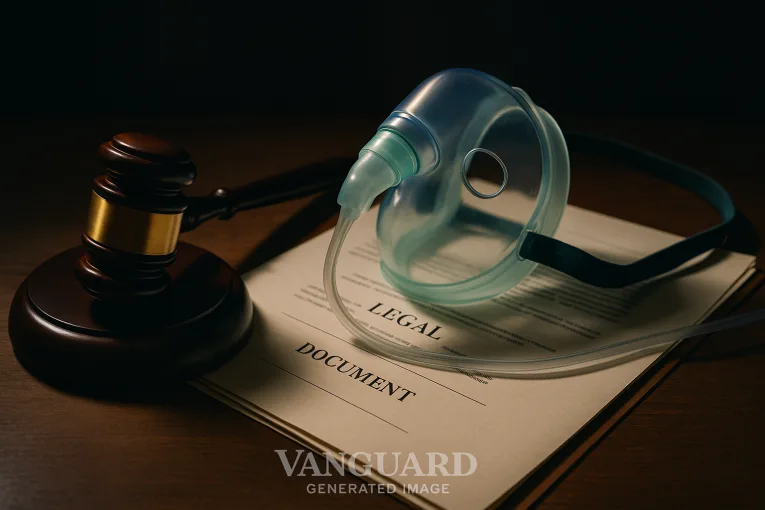
WASHINGTON, D.C. — The use of nitrogen gas executions has come under increasing scrutiny from several Supreme Court justices who have dissented from rulings allowing the method to proceed against people on death row, according to an article on SCOTUSblog.
In January 2025, President Donald Trump used his presidential authority to authorize capital punishment and “restor[e] the death penalty,” according to Kelsey Dallas, the author of the article.
Trump reinstated the death penalty because he believed “[c]apital punishment is an essential tool” for punishment and deterrence against those who “commit the most heinous crimes and acts of lethal violence.”
According to a related article by Dallas, the United States saw its “highest number of executions in approximately a decade” in 2025, with Florida playing a “significant role” in the surge.
A report intended to strengthen “the federal death penalty” was released by the Justice Department in response to the increase in executions and defended the “use of pentobarbital…for lethal injections.”
The report criticized the Biden administration, which determined the injections may cause “unnecessary pain and suffering,” while also suggesting the expansion of methods by which a person could be federally executed.
The report noted “past Supreme Court rulings,” stating the court has never “rejected a method of execution as unconstitutional,” and suggested it would not do so “anytime soon.”
Records show the court rarely considers “issues raised by death row prisoners” and has “not paused an execution in nearly two years.”
Several dissents among the justices have emerged over the years, with some questioning the “constitutionality” of nitrogen hypoxia.
Lethal gas has been used for decades in the United States as a form of capital punishment, though nitrogen gas executions have replaced cyanide gas in modern practice.
The DOJ acknowledged nitrogen gas may cause “conscious suffocation” as the mask “dispens[es] pure nitrogen” and blocks access to oxygen. Despite that concern, the method has been supported by “advocates of medically assisted suicide.”
According to the Death Penalty Information Center, nitrogen hypoxia execution is authorized in Alabama, Arkansas, Louisiana, Mississippi and Oklahoma. However, it is only used if “lethal injection drugs” are unavailable or “if an inmate…chooses it.”
After Anthony Boyd’s nitrogen hypoxia execution in Alabama last October, several organizations voiced concerns about the practice. According to The New York Times, witnesses described seeing “prisoners writhe on the gurney before they are pronounced dead.” The newspaper cited a journalist who observed “Boyd gasp for air more than 225 times” before he was pronounced dead.
The DOJ report acknowledged three rulings supporting its conclusion that “death by nitrogen hypoxia was no more painful than other methods of execution already approved by the Supreme Court.”
Both the U.S. Court of Appeals for the 11th Circuit and the U.S. Court of Appeals for the 5th Circuit concluded that death by nitrogen hypoxia “comports with the Eighth Amendment” because an individual would lose consciousness “in less than a minute” and die “within ten to fifteen minutes” afterward.
The DOJ denied requests to “pause the executions” after finding the prisoners had appealed their cases to the Supreme Court. Multiple public dissents followed in two of the three rulings, and dissenting justices were ultimately overruled.
When Alabama conducted its first nitrogen gas execution, Justices Sonia Sotomayor, Elena Kagan and Ketanji Brown Jackson “dissented in three capital cases involving nitrogen hypoxia,” questioning whether the method “violates the Eighth Amendment.” Similarly, Justice Neil Gorsuch raised concerns about “potential religious freedom.”
Several opinions stemmed from Smith v. Hamm, in which Kenneth Eugene Smith “challenged Alabama’s plan.” Alabama had previously failed in an attempt to execute Smith, and he argued the state’s revised plan “violated the Eighth Amendment.”
Sotomayor, Kagan and Jackson dissented from the denied request to “pause his execution,” arguing he could “choke[] on his own vomit” and emphasizing their commitment to “the Eighth Amendment’s protection against cruel and unusual punishment.”
In Louisiana, Jessie Hoffman invoked the “Eighth Amendment and the Religious Land Use and Institutionalized Persons Act” to challenge his nitrogen gas execution. As a Buddhist, Hoffman argued the method would “interfere with… spiritual practice” because “meditation and unfettered breath at the time of transition from life to death determines the quality of rebirth.”
The three justices stated they “would grant Hoffman’s request for a stay of execution,” while Gorsuch wrote the case should be sent back “to the 5th Circuit” for further consideration.
In Boyd’s case, he “expressed a willingness to be executed by firing squad” rather than by nitrogen gas execution, but the court denied the request.
Sotomayor described the experience as an individual “suffocating to death” from nitrogen gas while their “body keeps telling [them] to breathe.” She added that “seven nitrogen gas executions” had already occurred and argued Boyd should not become the eighth.
Questions surrounding whether executions should be paused because of claims of cruel and unusual punishment may return to the courts next month in the case of Jeffrey Lee. Lee currently has an “ongoing federal lawsuit” challenging the “humaneness of the nitrogen execution method.” He is “scheduled to be executed by nitrogen hypoxia in Alabama” on June 11.
Follow the Vanguard on Social Media – X, Instagram and Facebook. Subscribe the Vanguard News letters. To make a tax-deductible donation, please visit davisvanguard.org/donate or give directly through ActBlue. Your support will ensure that the vital work of the Vanguard continues.
