
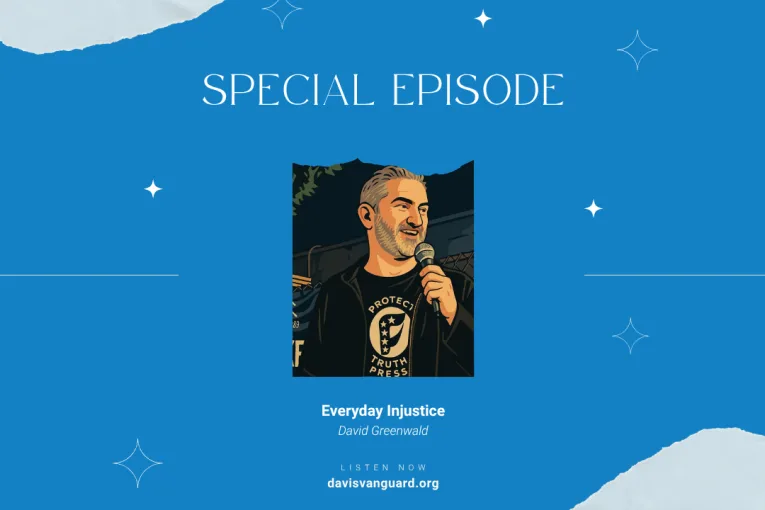
A special edition of the Everyday Injustice podcast brought together host David Greenwald, Ben Free Project founder Ben Frandsen, legal advocate Lydia Morgan, and Santa Clara County District Attorney candidate Daniel Chung for a sweeping discussion on wrongful convictions, prosecutorial misconduct, police accountability, and the future of criminal justice reform in California. The conversation centered on Chung’s campaign to unseat longtime Santa Clara County District Attorney Jeff Rosen, while also examining broader systemic failures within the criminal legal system.
Frandsen, who spent 18 years incarcerated for a wrongful conviction before rebuilding his life through journalism and advocacy, described how his work with the Ben Free Project and the newly formed Miscarriage of Justice Operations (MOJO) emerged from firsthand exposure to what he characterized as deeply flawed prosecutions and ignored evidence. Joined by Morgan, a UCLA legal studies graduate involved in criminal defense work, the pair explained how they are now organizing large teams of law student volunteers to review massive case files involving potential wrongful convictions. They pointed to the case of Paul Garcia, whose legal team alleges evidence manipulation and investigative misconduct during the prosecution.
Chung, a veteran prosecutor who has worked in both New York City and Silicon Valley since 2014, said his decision to challenge Rosen for a second time stems from what he views as a collapse of ethics, transparency and competence within the Santa Clara County District Attorney’s Office. Chung specifically criticized the prosecution of Stanford student protesters, arguing the office pursued “ridiculous” felony charges against young first-time offenders rather than seeking restorative outcomes. He said the office’s handling of the case ultimately resulted in the removal of Rosen’s office from the prosecution after allegations of improper fundraising tied to the pending criminal case surfaced publicly.
Throughout the discussion, Greenwald and Chung connected the Stanford prosecution to a broader statewide pattern in which district attorneys increasingly seek felony charges against protesters and student activists. Greenwald referenced similar cases involving UC Davis and San Francisco protesters, arguing that prosecutors across California have adopted increasingly punitive charging strategies against demonstrators despite many being young people with no prior criminal records. Chung responded that the criminal legal system must better account for modern understandings of brain development and rehabilitation, especially for people under 25, rather than pursuing life-altering felony convictions over nonviolent conduct.
The conversation then shifted toward police accountability and so-called Brady violations, referring to the constitutional obligation established under Brady v. Maryland requiring prosecutors to disclose exculpatory or impeaching evidence. Morgan and Frandsen raised concerns about officers allegedly participating in investigations without proper certification or training, while also describing what they characterized as systemic failures in disclosure practices. Chung responded that Santa Clara County prosecutors themselves are often denied direct access to Brady materials and are only selectively informed by supervisors when officers are scheduled to testify, creating what he called “a recipe for disaster.”
Chung argued that California’s secrecy surrounding police misconduct records contributes to wrongful convictions and shields problematic officers from accountability. He advocated for significantly greater transparency regarding officer misconduct, stating that the public, defense attorneys and prosecutors should all have greater access to credibility findings and disciplinary records involving law enforcement personnel. Greenwald echoed those concerns, arguing that many wrongful conviction cases begin with flawed police investigations that later go unchecked by prosecutors who become too aligned with law enforcement agencies.
The discussion also explored the phenomenon sometimes referred to as “gypsy cops,” in which officers accused of misconduct move between agencies without meaningful accountability. Frandsen and Morgan cited allegations involving officers connected to the Garcia case, arguing that problematic officers were repeatedly rehired by neighboring departments despite prior misconduct concerns. Chung responded that such practices expose cities to enormous liability and undermine public trust in the justice system.
Another major focus of the podcast involved the structure and effectiveness of Conviction Integrity Units, which are intended to review potential wrongful conviction cases. Chung said such units are often dramatically understaffed and lack the resources necessary to conduct meaningful reviews. He expressed support for building partnerships with universities, nonprofits and law students to create larger review teams capable of combing through extensive discovery files and identifying overlooked evidence. Morgan and Frandsen described the immense challenges involved in reviewing tens of thousands of disorganized digital files in wrongful conviction cases, arguing that discovery is sometimes produced in ways that make meaningful review nearly impossible.
Greenwald noted that emerging artificial intelligence technologies may eventually help expose buried evidence and inconsistencies within enormous discovery productions. At the same time, the panel repeatedly emphasized that many systemic injustices stem not only from overt misconduct, but from institutional pressures that prioritize convictions over truth-seeking. Frandsen reflected on his own wrongful conviction experience, arguing that too many actors within the system become more concerned with preserving wins than correcting errors once cases begin to unravel.
The podcast concluded with an unusually personal discussion about Chung’s contentious relationship with Rosen and the Santa Clara County District Attorney’s Office. Chung alleged that investigators working under Rosen attempted to investigate his deceased father’s mental health history after Chung publicly challenged the office, describing the effort as retaliatory and deeply unethical. He also accused Rosen of allowing political and ideological considerations to influence prosecutorial decisions, particularly in cases involving pro-Palestinian protests and activism connected to Israel and Gaza.
Despite the heavy subject matter, the episode repeatedly returned to a central theme emphasized by both Greenwald and Frandsen: the need for a criminal legal system focused less on maximizing punishment and more on uncovering truth, preventing wrongful convictions, and creating opportunities for rehabilitation and accountability outside the traditional punitive framework.
Follow the Vanguard on Social Media – X, Instagram and Facebook. Subscribe the Vanguard News letters. To make a tax-deductible donation, please visit davisvanguard.org/donate or give directly through ActBlue. Your support will ensure that the vital work of the Vanguard continues.
