
DAVIS, Calif. — For years, I have warned that the city’s persistent inability to approve enough housing could eventually invite intervention from the state. Now, those concerns are being echoed by one of the region’s most prominent newspaper voices.
In a sharply worded opinion column published by The Sacramento Bee, Pulitzer Prize-winning editorial writer Tom Philp argued that Davis’ long-standing pattern of rejecting peripheral housing projects has pushed the city to the brink of losing control over its own land-use decisions.
“The city of Davis, with its booming university and its refusal to build the necessary housing, is now the Sacramento region’s capital of not-in-my-backyard politics,” Philp wrote. “This has implications for all of us, and particularly for a city that deserves to lose control of its own urban planning.”
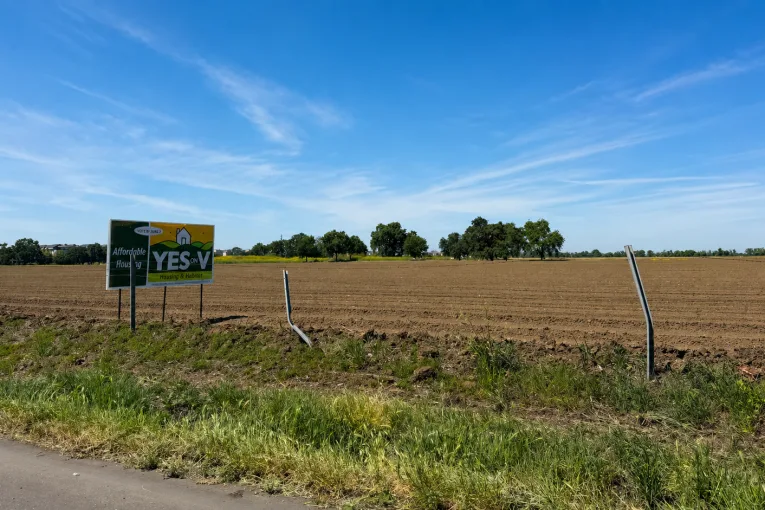
Philp’s column comes in the aftermath of the apparent defeat of Measure V, the June ballot measure that sought voter approval for the proposed Village Farms development on the city’s north side. The project would have allowed construction of approximately 1,800 housing units on roughly 400 acres near Covell Boulevard, including a substantial affordable housing component.
“Attorney General Rob Bonta, who is supposed to police cities that have inadequate housing plans, needs to start paying attention,” Philp wrote.
He added that “City voters are on the verge of rejecting yet another proposed expansion for family housing in the city.”
The apparent failure of Measure V represents the latest chapter in a decades-long struggle over growth in Davis. Since the adoption of Measure J in 2000, later renewed and modified by subsequent measures, voters have retained the power to approve or reject most proposals involving conversion of agricultural land for urban development.
Supporters of the voter-approval process have argued that it protects agricultural land, preserves community character and ensures residents maintain direct control over major growth decisions.
Opponents contend that it has effectively made it impossible for Davis to accommodate population growth associated with the expansion of UC Davis and the broader regional housing crisis.
Philp embraced the latter interpretation.
“Measure V’s rejection keeps intact a pattern by city voters to reject expansions for residents of all age types throughout the 21st century,” he wrote. “This is because ever since 2000, Davis has let city voters have the final say on urban expansion. And Davis voters have used this power with devastating effect to frustrate the city from building enough housing to keep up with the necessary growth of UC Davis as it serves its vital statewide mission.”
He pointed to what he described as an absence of successful family-oriented housing projects over the last quarter century.
“Since 2000, only one senior citizen housing project has been built in Davis,” Philp wrote. “The 150-unit Bretton Woods development was approved in 2018. For housing suitable for faculty, staff or adults who simply want to call Davis home, voters have an unblemished record of saying no.”
Village Farms supporters frequently framed the proposal as an attempt to address exactly those housing needs. The project included plans for a mix of housing types, including smaller homes, apartments and affordable units intended to serve working families, university employees and lower-income residents struggling to remain in Davis.
Opponents raised concerns about traffic, environmental impacts, flooding, toxic contamination and the loss of agricultural land surrounding the city.
Philp acknowledged those concerns, even as he concluded they had produced harmful consequences.
“There is no doubt that the Davis residents who have been resisting development have been doing so for what they believe are well-intentioned reasons,” he wrote. “Growth will bring more cars, and reduce open space.”
He continued: “And there is always concern that the city’s exhaustive planning process would fail to address community fears, such as flooding and toxic contamination that opponents of Village Farms raised, apparently to their great success.”
The column then turned toward California’s increasingly aggressive enforcement of state housing law.
“But cities are supposed to develop plans known as housing elements to demonstrate to the state how they intend to build the necessary housing of all types,” Philp wrote. “If the state finds a housing element to be inadequate, it can intervene so that builders can construct the necessary housing regardless of the local politics.”
Housing elements function as local governments’ blueprints for accommodating their assigned share of regional housing needs. While the state approved Davis’ most recent housing element update in 2024, that approval came after years of scrutiny and earlier findings that the city’s plans contained significant deficiencies.
Philp questioned whether the city’s certified housing element can remain credible if the projects necessary to fulfill it cannot obtain voter approval.
“Gov. Gavin Newsom issued such warnings to 15 cities throughout the state in March,” he wrote. “The city of Davis was not on that list.”
He also noted that “Equally silent about the Democratic stronghold of Davis is Bonta, who, with great fanfare, went after Elk Grove in 2023. The case was settled in 2024.”
The state has increasingly demonstrated a willingness to challenge local governments that fail to comply with housing mandates. Recent years have seen the use of builder’s remedy provisions, litigation and administrative pressure to compel cities to plan for and facilitate housing production.
Philp suggested Davis could become a candidate for similar scrutiny.
“The California Department of Housing and Community Development, after previously warning the city of glaring shortcomings, finally approved an updated housing element for Davis in 2024,” he wrote. “But the immovable obstacle of public votes on housing projects remained, prompting the City Council to ask voters to give up their control of any expansions for affordable housing.”
He added: “Fearing rejection by voters, the council has refused to place this measure on the last two ballots.”
The Davis City Council had previously discussed potential reforms to Measure J, including exemptions for affordable housing projects. However, concerns about voter opposition prevented such proposals from advancing to the ballot.
“And now these same voters have rejected Measure V,” Philp wrote. “The prospect of Davis voters giving up control over housing seems as unlikely as President Donald Trump carrying this liberal city in an election.”
Philp’s strongest criticism was directed not at any particular project, but at what he characterized as a structural breakdown in local governance.
“The record is pretty clear Davis now,” he wrote. “The city’s housing element isn’t worth the paper it is written on.”
He continued: “The City Council, which unanimously supported Village Farms, is not in control of its city. Urban planning in Davis is one of the most time-consuming and fruitless exercises on Planet Earth. And it’s economic suicide for builders to propose the housing that Davis truly needs.”
Village Farms supporters had emphasized that the proposal sought to balance housing production with preservation goals.
“The campaign for Measure V was all about championing a complex of smaller homes and apartments and preserving open space,” Philp wrote.
Yet he warned that repeated rejection of housing proposals may ultimately undermine the very local control Davis voters have long sought to protect.
“Something tells me that most residents in Davis have no idea how they have endangered local control of local land use decisions by saying no to necessary housing, again and again, for 26 years.”
Philp concluded with an unmistakable call for Sacramento to step in.
“For the sake of smart growth in the region, so that people can live closer to their jobs, Davis is ripe for state intervention,” he wrote. “The sooner, the better.”
Whether state officials ultimately agree remains uncertain. But the appearance of such an argument in the pages of The Sacramento Bee signals that concerns once voiced primarily by local housing advocates have entered California’s broader conversation about growth, housing accountability and the future of local control.
Follow the Vanguard on Social Media – X, Instagram and Facebook. Subscribe the Vanguard News letters. To make a tax-deductible donation, please visit davisvanguard.org/donate or give directly through ActBlue. Your support will ensure that the vital work of the Vanguard continues.

Meanwhile here in the immediate reality the biggest losers in the loss of Measure V are the people who would have someday occupied the Affordable housing rejected with the defeat. Everyone who voted no owns the loss of that housing, but, for those homeowners who already have housing, they won’t experience the hardship the loss of that housing means for people of lesser means.
Its a pretty stupid position to be in: Either approve a poorly specced housing development, or lose the ability to object to poorly specced housing developments in the future.
That is the definition of “Lose-Lose”
We need to be focused on “How do we create GOOD housing outcomes”… its doable, it requires a small amount of political courage and work and “not letting the status quo bowl you over”… but communities have solved issues like this before, and its not toing to happen on its own.
I have been warning for some time that the state is not going to stand by and allow Davis to keep blocking projects.
“We need to be focused on “How do we create GOOD housing outcomes”… its doable, it requires a small amount of political courage and work and “not letting the status quo bowl you over”… but communities have solved issues like this before, and its not toing to happen on its own.”
Okay if your rationalizations make you feel better. Actually it would happen if people like yourself would get out of the way.
Some YIMBY author’s opinion in the declining Sacramento YIMBY rag has no meaning whatsoever.
He has no idea what he’s even talking about.
The state cannot force cities to sprawl outward. And if they start doing so (which would require a change in the laws), it would show them to be something other than what they claim to be.
The YIMBY thing is supposed to be about infill in places where their sponsors want to cram in more employees and which aren’t expanding outward (e.g., Silicon Valley).
Of course, they’ve since embraced “California Forever”, so they’ve already exposed what they actually are.
But honestly, did anyone believe what they claimed to be in the first place?
Make no mistake – most of the mainstream rags have ALWAYS had a “YIMBY” point of view.
The state and more specifically the courts can invalidate the law
No, they can’t – for reasons already discussed many, many times on here.
Also, the state and court systems are not the same thing.
Frankly, I’m tired of hearing this b.s. about what “may” happen (even though the law doesn’t support that).
Either put up, or shut up. And if Measure J is as vulnerable as you claim to believe, it would be doomed regardless of individual outcomes.
In the meantime, I hope no one responds to attempts to blackmail voters using fear as a tactic.
Take it to court, rather than to blogs. Test it, and see what happens.
Of course they can
Of the two of us, I’m the one encouraging someone to try it. Go ahead – make sure that Bonta knows about it. Should I notify him, myself? Or would you like for me to wait until you write a thousand more articles about it, first?
If I could currently vote in Davis, I’d also vote against Willowgrove. Even with a thousand more articles to come.
Right on Mr. O, power to the People.
Don’t you mean power to the people with power? The power to say no depriving poorer people access to housing.
Well, here’s one thing I’d agree with the author on:
“The record is pretty clear Davis now,” he wrote. “The city’s housing element isn’t worth the paper it is written on.”
Though obviously, that includes the housing elements for nearly EVERY CITY and COUNTY in the state – INCLUDING Sacramento itself. (Doctor, heal thyself – first.)
Assuming they even turned in a “successful” one in the first place (some still haven’t – and probably won’t do so before the current cycle ends, and the next one begins)!
So apparently, continued sprawl ain’t gettin the job done, either.
https://cities.fairhousingelements.org/
My prediction is that Willowgrove passes and this whole issue goes away.