
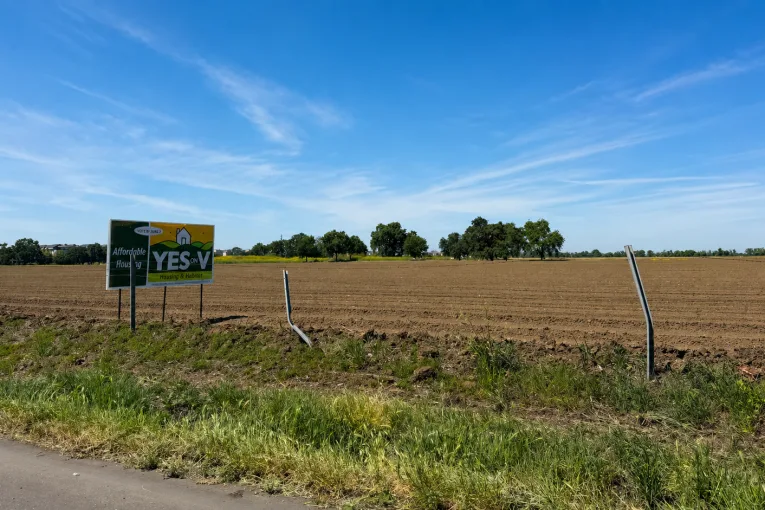
DAVIS, Calif. — For years, I have warned that the city’s persistent inability to approve enough housing could eventually invite intervention from the state. Now, those concerns are being echoed by one of the region’s most prominent newspaper voices.
In a sharply worded opinion column published by The Sacramento Bee, Pulitzer Prize-winning editorial writer Tom Philp argued that Davis’ long-standing pattern of rejecting peripheral housing projects has pushed the city to the brink of losing control over its own land-use decisions.
“The city of Davis, with its booming university and its refusal to build the necessary housing, is now the Sacramento region’s capital of not-in-my-backyard politics,” Philp wrote. “This has implications for all of us, and particularly for a city that deserves to lose control of its own urban planning.”
Philp’s column comes in the aftermath of the apparent defeat of Measure V, the June ballot measure that sought voter approval for the proposed Village Farms development on the city’s north side. The project would have allowed construction of approximately 1,800 housing units on roughly 400 acres near Covell Boulevard, including a substantial affordable housing component.
“Attorney General Rob Bonta, who is supposed to police cities that have inadequate housing plans, needs to start paying attention,” Philp wrote.
He added, “City voters are on the verge of rejecting yet another proposed expansion for family housing in the city.”
The apparent failure of Measure V represents the latest chapter in a decades-long struggle over growth in Davis. Since the adoption of Measure J in 2000, later renewed and modified by subsequent measures, voters have retained the power to approve or reject most proposals involving conversion of agricultural land for urban development.
Supporters of the voter-approval process have argued that it protects agricultural land, preserves community character and ensures residents maintain direct control over major growth decisions.
Opponents contend that it has effectively made it impossible for Davis to accommodate population growth associated with the expansion of UC Davis and the broader regional housing crisis.
Philp embraced the latter interpretation.
“Measure V’s rejection keeps intact a pattern by city voters to reject expansions for residents of all age types throughout the 21st century,” he wrote. “This is because ever since 2000, Davis has let city voters have the final say on urban expansion. And Davis voters have used this power with devastating effect to frustrate the city from building enough housing to keep up with the necessary growth of UC Davis as it serves its vital statewide mission.”
He pointed to what he described as an absence of successful family-oriented housing projects over the last quarter century.
“Since 2000, only one senior citizen housing project has been built in Davis,” Philp wrote. “The 150-unit Bretton Woods development was approved in 2018. For housing suitable for faculty, staff or adults who simply want to call Davis home, voters have an unblemished record of saying no.”
Village Farms supporters frequently framed the proposal as an attempt to address exactly those housing needs. The project included plans for a mix of housing types, including smaller homes, apartments and affordable units intended to serve working families, university employees and lower-income residents struggling to remain in Davis.
Opponents raised concerns about traffic, environmental impacts, flooding, toxic contamination and the loss of agricultural land surrounding the city.
Philp acknowledged those concerns, even as he concluded they had produced harmful consequences.
“There is no doubt that the Davis residents who have been resisting development have been doing so for what they believe are well-intentioned reasons,” he wrote. “Growth will bring more cars, and reduce open space.”
He continued: “And there is always concern that the city’s exhaustive planning process would fail to address community fears, such as flooding and toxic contamination that opponents of Village Farms raised, apparently to their great success.”
The column then turned toward California’s increasingly aggressive enforcement of state housing law.
“But cities are supposed to develop plans known as housing elements to demonstrate to the state how they intend to build the necessary housing of all types,” Philp wrote. “If the state finds a housing element to be inadequate, it can intervene so that builders can construct the necessary housing regardless of the local politics.”
Housing elements function as local governments’ blueprints for accommodating their assigned share of regional housing needs. While the state approved Davis’ most recent housing element update in 2024, that approval came after years of scrutiny and earlier findings that the city’s plans contained significant deficiencies.
Philp questioned whether the city’s certified housing element can remain credible if the projects necessary to fulfill it cannot obtain voter approval.
“Gov. Gavin Newsom issued such warnings to 15 cities throughout the state in March,” he wrote. “The city of Davis was not on that list.”
He also noted, “Equally silent about the Democratic stronghold of Davis is Bonta, who, with great fanfare, went after Elk Grove in 2023. The case was settled in 2024.”
The state has increasingly demonstrated a willingness to challenge local governments that fail to comply with housing mandates. Recent years have seen the use of builder’s remedy provisions, litigation and administrative pressure to compel cities to plan for and facilitate housing production.
Philp suggested Davis could become a candidate for similar scrutiny.
“The California Department of Housing and Community Development, after previously warning the city of glaring shortcomings, finally approved an updated housing element for Davis in 2024,” he wrote. “But the immovable obstacle of public votes on housing projects remained, prompting the City Council to ask voters to give up their control of any expansions for affordable housing.”
He added: “Fearing rejection by voters, the council has refused to place this measure on the last two ballots.”
The Davis City Council had previously discussed potential reforms to Measure J, including exemptions for affordable housing projects. However, concerns about voter opposition prevented such proposals from advancing to the ballot.
“And now these same voters have rejected Measure V,” Philp wrote. “The prospect of Davis voters giving up control over housing seems as unlikely as President Donald Trump carrying this liberal city in an election.”
Philp’s strongest criticism was directed not at any particular project, but at what he characterized as a structural breakdown in local governance.
“The record is pretty clear Davis now,” he wrote. “The city’s housing element isn’t worth the paper it is written on.”
He continued: “The City Council, which unanimously supported Village Farms, is not in control of its city. Urban planning in Davis is one of the most time-consuming and fruitless exercises on Planet Earth. And it’s economic suicide for builders to propose the housing that Davis truly needs.”
Village Farms supporters had emphasized that the proposal sought to balance housing production with preservation goals.
“The campaign for Measure V was all about championing a complex of smaller homes and apartments and preserving open space,” Philp wrote.
Yet he warned that repeated rejection of housing proposals may ultimately undermine the very local control Davis voters have long sought to protect.
“Something tells me that most residents in Davis have no idea how they have endangered local control of local land use decisions by saying no to necessary housing, again and again, for 26 years.”
Philp concluded with an unmistakable call for Sacramento to step in.
“For the sake of smart growth in the region, so that people can live closer to their jobs, Davis is ripe for state intervention,” he wrote. “The sooner, the better.”
Whether state officials ultimately agree remains uncertain. But the appearance of such an argument in the pages of The Sacramento Bee signals that concerns once voiced primarily by local housing advocates have entered California’s broader conversation about growth, housing accountability and the future of local control.
Follow the Vanguard on Social Media – X, Instagram and Facebook. Subscribe the Vanguard News letters. To make a tax-deductible donation, please visit davisvanguard.org/donate or give directly through ActBlue. Your support will ensure that the vital work of the Vanguard continues.

Meanwhile here in the immediate reality the biggest losers in the loss of Measure V are the people who would have someday occupied the Affordable housing rejected with the defeat. Everyone who voted no owns the loss of that housing, but, for those homeowners who already have housing, they won’t experience the hardship the loss of that housing means for people of lesser means.
Ron,
You mean the affordable housing that was never going to get built? The affordable housing “plan” was abysmal with a huge loophole of the word “may” to let the developer off the hook in 10+ years which was the last phase of the project. It was not a realistic plan.
This is precisely why the state is going to take a good look at Davis’ housing policies.
The state will do nothing.
No solid contract should ever have wiggle words like “may” and “could”.
Surprise, I agree with Keith O!
Its a pretty stupid position to be in: Either approve a poorly specced housing development, or lose the ability to object to poorly specced housing developments in the future.
That is the definition of “Lose-Lose”
We need to be focused on “How do we create GOOD housing outcomes”… its doable, it requires a small amount of political courage and work and “not letting the status quo bowl you over”… but communities have solved issues like this before, and its not toing to happen on its own.
I have been warning for some time that the state is not going to stand by and allow Davis to keep blocking projects.
“We need to be focused on “How do we create GOOD housing outcomes”… its doable, it requires a small amount of political courage and work and “not letting the status quo bowl you over”… but communities have solved issues like this before, and its not toing to happen on its own.”
Okay if your rationalizations make you feel better. Actually it would happen if people like yourself would get out of the way.
Ron G
You and others who assert that we should just accept what wealthy developers push on us are saying “Democracy just gets in the way. Only those with money who own land have the right to determine what our community looks like.” That’s just supporting a plutocracy that pushes the rest of us aside in determining what our future could look like.
Letting an individual who builds a single house to put up pretty much whatever they want is fine and consistent with maintaining private property rights. But building an 1800 unit neighborhood is creating a new adjacent small town that has enormous spill over effects on all of us. That’s why the entire community needs to have a say in what’s created. A single individual focuses on satisfying their singular motives and can’t possibly encapsulate and balance the community wide perspectives. The Village Farms team never truly opened up to community input and the City didn’t truly pressure them to do so. The failure is not on the community, of which the key opponents were very specific in what they requested, but on that the proponents and their enablers.
“Letting an individual who builds a single house to put up pretty much whatever they want is fine and consistent with maintaining private property rights.”
What??? Where does THAT happen?
Some YIMBY author’s opinion in the declining Sacramento YIMBY rag has no meaning whatsoever.
He has no idea what he’s even talking about.
The state cannot force cities to sprawl outward. And if they start doing so (which would require a change in the laws), it would show them to be something other than what they claim to be.
The YIMBY thing is supposed to be about infill in places where their sponsors want to cram in more employees and which aren’t expanding outward (e.g., Silicon Valley).
Of course, they’ve since embraced “California Forever”, so they’ve already exposed what they actually are.
But honestly, did anyone believe what they claimed to be in the first place?
Make no mistake – most of the mainstream rags have ALWAYS had a “YIMBY” point of view.
The state and more specifically the courts can invalidate the law
No, they can’t – for reasons already discussed many, many times on here.
Also, the state and court systems are not the same thing.
Frankly, I’m tired of hearing this b.s. about what “may” happen (even though the law doesn’t support that).
Either put up, or shut up. And if Measure J is as vulnerable as you claim to believe, it would be doomed regardless of individual outcomes.
In the meantime, I hope no one responds to attempts to blackmail voters using fear as a tactic.
Take it to court, rather than to blogs. Test it, and see what happens.
Of course they can
Of the two of us, I’m the one encouraging someone to try it. Go ahead – make sure that Bonta knows about it. Should I notify him, myself? Or would you like for me to wait until you write a thousand more articles about it, first?
If I could currently vote in Davis, I’d also vote against Willowgrove. Even with a thousand more articles to come.
Right on Mr. O, power to the People.
Don’t you mean power to the people with power? The power to say no depriving poorer people access to housing.
Ron, what part of Village Farms was for poor people? The smoke and mirrors Affordable apartments that wouldn’t come for upwards of 10 years, if and only if they get Federal and State funding? Or any of the ownership housing?
You have drunk the kool aid.
“You have drunk the kool aid.”
Congratulations, Matt. You won. Maybe now you can stop insulting people.
Please, cry me a river, during the campaign there were plenty of insults coming from the people who were for the Measure.
Don, what insult. Kool Aid was a staple of my youth.
The Kool-Aid was right there every day in my lunchbox with the PB&J sandwich and a few carrots
Okay in ten years and what do you get instead now? Sixteen acres of tomatoes and nothing for poor people. Congratulations. Rationalize what you have done all you want but remember you did nothing to help the less fortunate when you could have.
What would we have gotten for the poor now if it had passed … nothing. Just empty promises. There are over 450 shovel-ready Affordable Housing projects in California right now that are stalled because of the lack of Federal and State funding.
Village Farms would have had to go through all the steps necessary to even apply for Federsl and State funding, and then they would have just gotten into the 450+ project queue, behinds most of them.
“Sixteen acres of tomatoes and nothing for poor people.”
How many actual “poor people” would’ve been homed there?
More than there will be now.
Ron O
Your comments are ironic given that you are criticizing an outsider for telling Davis what to do. And I agree that both of you have no idea about what your talking about.
However, Philp has identified a potential risk for the City. The problem is that he doesn’t acknowledge well enough that we have the opportunity to address this in our General Plan Update. This situation just makes this need more visible to those who had been too sanguine about VF and WG solving our near term crisis.
BTW, I don’t remember Village Farms and Willowgrove being keystones in the latest Housing Element that runs through 2029 (especially since neither was/is likely to have significant housing built by 2029)? I thought the HE was met through infill.
Richard: It seems like I’m exactly the type of person that you’re trying to entice to move to Davis, given that you’re advocating for “outsiders” to move there.
As such, perhaps my perspective (and observations) are more applicable than yours regarding your own goal.
But you are correct, in that neither Village Farms or Willowgrove are included in the current housing element.
And due to Measure J, no “potential” housing proposal can be included in ANY housing element going forward, either. HCD made that appropriately clear.
Obviously, the city can’t include proposals that they have no control over, regarding approvals. HCD would immediately reject any such inclusions in housing elements.
Well, here’s one thing I’d agree with the author on:
“The record is pretty clear Davis now,” he wrote. “The city’s housing element isn’t worth the paper it is written on.”
Though obviously, that includes the housing elements for nearly EVERY CITY and COUNTY in the state – INCLUDING Sacramento itself. (Doctor, heal thyself – first.)
Assuming they even turned in a “successful” one in the first place (some still haven’t – and probably won’t do so before the current cycle ends, and the next one begins)!
So apparently, continued sprawl ain’t gettin the job done, either.
https://cities.fairhousingelements.org/
In a limited sense, Ron is correct, the housing element Davis got certified never had a chance of getting enough affordable housing. Of course, Ron’s solution is throw in the towel and that’s a nonstarter.
I don’t propose solutions regarding targets that are ill-advised, undesirable, and unachievable statewide. (Other than for cities across the state to continue what they’re doing – by submitting fake plans in response to a fake housing shortage.)
1.5 kids per couple statewide; 1.6 kids nationwide.
Let’s face it – I’m apparently the uncredited pied piper of the no-growth movement. And the young’uns agree with me via their actions.
I also posted a mainstream article the other day which “blames” the rise of smart phones for the declining birthrate. (And the graph they had was pretty convincing, regarding a connection.)
Enrollment is declining in places like Texas, as well. Should I post that article from The Chronicle again?
You could have stopped after the first four words
Ron O
So you’re proposing that we wait 30 years to address this issue through a currently declining birth rate and just ignoring the local housing affordability crisis we have now…. And never mind that the population trend could shift again in that period?
You’re conflating affordability with sprawl.
As for “shifting populations” – that’s a choice that’s made (e.g., pursuing residents who are moving out of the Bay Area, primarily due to high costs there).
Interestingly-enough, Mexico has an even lower birthrate than the U.S., these days. It’s happening everywhere.
School enrollments are dropping in Texas, as well.
The growth monkeys would be better off building fertility clinics, than housing.
David, if you were guessing, what proportion of all the housing elements in all the jurisdictions of the State do you believe “have a chance of getting enough affordable housing?
Also, what role do you think the high interest rates play in the reality that appropriately zoned parcels in housing elements throughout the State are not actually commencing construction?
My prediction is that Willowgrove passes and this whole issue goes away.
There is no guarantee that WG will pass and even if it does, Davis will still be well short of its affordable housing requirements.
So will almost 100% of the jurisdictions in the State.
I agree with you Jim.
No, that won’t get us far enough along to meet the next Housing Element requirements. And Village Farms will come back–the developers won’t leave $100M on the table.
Both Tom Philp’s Bee column and your summary miss a critical piece of context: the upcoming Willowgrove project expected to be before Davis voters this November. Never does he reference it in his OpEd. Measure V was not evaluated in a vacuum. Many Davis voters saw Village Farms and Willowgrove as competing peripheral growth proposals and were never likely to approve both. I’ve spoken with many residents who opposed Village Farms but are open to supporting Willowgrove because they view it as a better-designed project. Ignoring Willowgrove leads to the mistaken conclusion that Davis voters are simply rejecting all housing. The more likely reality is that voters are being selective about which projects they believe best fit the community. Once W passes this all goes away.
It doesn’t because Willowgrove alone won’t get Davis to 930
Yes on Willowgrove. It will be interesting to see if all the nimby’s who have used Willowgrove as a stalking horse against Village Farms now support Willow Grove. I hope so.
I live over here in Lake Alhambra, a stones throw those people from the Willowgrove site, and can tell you firsthand the several of my neighbors have confirmed they will be voting yes on W in November. I just wish they’d come up with a different name. We already have Willowbank in Davis.
“I just wish they’d come up with a different name.”
Seriously! Willowbank, Willow Glen, Willow Creek….
I expect it will pass. Problem is, it isn’t just the state watching. There are private groups ready to file lawsuits (Californians for Home Ownership, Ca YIMBY), and they have been watching Davis carefully. I expect they’re likely to cause issues sooner than the state. State action, if I understand correctly, would be likelier with the start of the next RHNA cycle, which is only a couple of years away.
Ron G
Again, you don’t understand the swing group of opponents to VF. We were asking for higher density in VF to create more market rate affordable housing. WG is almost 50% more dense, approaching what we expressed as an acceptable alternative for VF in the Environmentally Preferred Alternative #4. That makes it much more acceptable. (Many of us don’t like the placement of the “regional” park that will create more traffic, but we may have an opportunity to change that.) You keep trying to push everyone who disagrees with you into a single pigeon hole.
Well what did you get built? So far nothing.
Yeah, but it’s a good start and hopefully will keep the state off our backs. How many more Half Moon Bay battles are they looking to get into?
“Something tells me that most residents in Davis have no idea how they have endangered local control of local land use decisions by saying no to necessary housing, again and again, for 26 years.”
I agree. This very narrow vote is going to backfire very badly, IMO. Without development on that site, the city won’t reach the RHNA numbers.
The VF developers know what they need to do to get sufficient support to win in another election. The swing voters have been very specific in their requests. However, the passage of Willowgrove may drain away some some support if “yes” voters believe they’ve done enough. We also have the opportunity to change the rules of development with the General Plan Update. Just acquiescing to developers’ fantasies won’t solve this issue. There’s a reason why Measure J came about from dissatisfaction with what had happened the previous decade. VF was just a rehash of the 1990s.
And when do you expect the actual investors to return with another ballot proposal?
Eliminating the word “the” from your sentence, the answer to your question is “this November’s general election”. In addition investors in 13 different investor groups are moving forward with 1,635 housing units in project sizes from a high of 368 units down to a low of 12 units, all of which have their entitlements in place. And that doesn’t include the 700 units at Nishi or the 148 units at The Nest, which are pending entitlements.
Investors are not in short supply.
Sure Matt, but Richard was specifically predicting the VF developers are going to return to the ballot. On what basis he makes that claim I guess is the risk reward calculation. But I’m not so sure about that conclusion. The owners have lost twice at the ballot box. They spent millions of dollars and got nothing. The last time it took 20 years for them to return so I think its fair to ask Richard about his prediction. The clock is ticking. Housing delayed is housing denied.
“The failure is not on the community, of which the key opponents were very specific in what they requested, but on that the proponents and their enablers.”
Weird to blame your victory on the people who lost.
Not weird at all. Elections are sometimes won and (probably) even more often lost.
Take for example DiSC 2022. Dan Carson’s ill considered law suit naming David citizens as defendants caused the election to be lost. There was nothing in the actions of the No on DiSC side regarding that law suit that caused the election to be won.
In this election there were a lot of actions that caused Yes to lose votes. A lot.
I don’t think DiSC would have passed even without Dan’s intervention, however, it likely contributed to the magnitude of the loss. I would argue that in the scheme of things, Measure V was pretty clean.
That is a different point, focusing on the end result rather than the process. We will never know how many votes that Dan’s actions lost, but it was huge … and no action by the opponents’ campaign contributed in any way to the losing or gaining of those votes.
It’s not weird, the way I read it is he’s blaming the proponents for their own loss.
It’s surprising that the well-organized opponents of Measure V are declining to take responsibility for its defeat.
No. You won. By a tiny margin of just a couple of hundred votes, you blocked a housing project. Congratulations.
The Davis Planning Group, and Matt Williams, and all the others who called for more specificity and revising the General Plan and community visions and things like that?
Go for it.
Get those community forums going, the planning charettes. Work up a plan, find a landowner and a project developer. I know you wouldn’t trust the city council or staff to do those things, so we’ll all be interested to see what you come up with.
I agree that Willow Grove support will likely undercut any support for another housing development soon. That’s an unfortunate consequence of it having been put forward repeatedly as a preferred alternative by opponents of Village Farms. You will have to work to overcome that problem as you sell your project to the voters.
If your notion is that re-writing the General Plan with a bunch of detailed expectations will somehow encourage builders to come forward, I see no reason to believe that will occur. I expect that greater detail and more demands in the General Plan will likely result in fewer projects coming forward.
I will be very surprised if the Village Farms property owners return any time soon. I hope I’m wrong. But they waited twenty years from the last vote. Land developers invest and work on a very long planning horizon.
Don, it is not surprising at all. Compared to the opposition to DiSC, which was a tight knit collective, this opposition was much more ad hoc. Eileen Samitz completed the work of four individuals, and provided the glue that kept the ad hoc parts cohesive.
That cohesion centered around two key characteristics,
(1) that Davis needs to add housing for its modestly paid workforce that for the most part has modest financial resources … but not for the economically elite demographic that has a consistent average inventory of expensive homes in the resale market of 30-40 units.
and
(2) that the process used to consider this project was incredibly flawed at all levels. The expression “putting a thumb on the scale” is very apt.
Beyond those two commonalities there were many diverse reasons for people voting “No” and that diversity is the antithesis of your description “well-organized.” But to be fair, if you said “Eileen Samitz was well-organized” you would be spot on.
“Without development on that site, the city won’t reach the RHNA numbers.”
The city wouldn’t hit its RHNA numbers even with VF, because the Affordable units aren’t feasible.
Well they certainly aren’t feasible now.
Ron,
The affordable units never were feasible at Village Farms. it was all a fantasy with a huge loophole that would let the Village Farms developer off the hook in 10+ years during the last phase of the project.
Affordable units are never feasible that is why they require subsidization. But one thing is certain the proposed 16 acres of Affordable housing is not now going to get built.
Regardless of the sour grapes and threats, can we just take a moment to appreciate the apparent results of the vote?
“Corn and tomatoes and sunflowers – oh my!” (Sorry – I just watched a clip from the Wizard of Oz right before they met the lion.)
I appreciate every time I drive by it, and every time I look out at it from Nugget. And it appears that it will at least get a temporary reprieve.
Yes Ron, that open piece of farmland certainly adds to the ambiance of the town.
Davis ambiance for those commuting in from Woodland because there aren’t enough houses in Davis.
There’s plenty of houses for sale AT ALL TIMES in Davis (and any other city).
But most of those who chose Spring Lake, for example, weren’t “priced out” of Davis – they simply wanted more for their money. Especially for those who didn’t want to live in a run-down or overpriced shoebox (e.g., when starting a family).
In any case, the Village Farms site provides a lot more “ambiance” for those living near it in Davis (e.g., Wildhorse, The Cannery), and anyone else who uses the Costco Highway (and would prefer reaching that destination without getting stuck in gridlock).
How do you measure “plenty of houses?” The appropriate metric is house price which reflects the supply-demand equilibrium. When we look at the equilibrium price for Davis we see that its 50% higher than any of the surrounding communities. The other useful metric is the ratio of price to median household income, which has been rising and again Davis is higher than neighboring cities. (I think that Alex Archmore had a previous comment highlighting this aspect.) That reveals that the supply is inadequate since the demand is exogenously driven and cannot be affected by any local decisions other than degrading community attributes (not particularly desirable–ask Detroit.) We can only control the housing supply to bring prices more in line with the rest of the region. So there are not “plenty of houses” available based on these metrics. (The housing demand 30 years from now is not an appropriate metric.)
Ron O
Too bad you don’t pay the taxes to support what you appreciate about Davis. Your preferences are meaningless as a Woodland resident.
You don’t know if I pay taxes in Davis.
Do you pay DJUSD parcel taxes – or do you claim an exemption?
This Sac Bee article is ridiculous. Gloom and doom because Measure V is not turning out as they wanted. The reality is Davis has always fulfilled its fair share of growth historically, unlike may other cities. So, the Sac Bee needs to stop picking on Davis, and pick on some other city which has been delinquent on affordable housing over the years.
The SacBee author could have “picked on” Sacramento itself – since they’re also not “on track” in regard to RHNA targets. Just like the vast majority of cities and counties across the entire state.
https://cities.fairhousingelements.org/
These people might “help” more if they stopped typing and volunteered at Habitat for Humanity, instead.
(But since most of them have never seen one, they’ll probably need some training to understand that the blunt end of the hammer is the side that’s applied to the nails.)
Yeah, I know – the professionals primarily use nail guns nowadays, anyway.
Sacramento just approved a new 25,000 unit development in Natomas that will go a long ways towards their goal:
https://www.cbsnews.com/sacramento/news/sacramento-county-approves-controversial-upper-westside-project/
Sacramento County approved the plan over the objections of the city. Do you support this approach?
“You need to know the community opposed this project,” said Heather Fargo, president of the Environmental Council of Sacramento and former mayor.
The project will be a mix of homes and businesses, along with new neighborhood parks and schools.
Located west of Interstate 80 and four miles from downtown, the project will be on land that was supposed to be spared from urban development as part of a compromise between developers and environmental groups in effect for 30 years.
Many residents who live near the project are concerned over a big increase in traffic, especially along the Garden Highway, which is a narrow, two-lane levee road.
The land is just outside the Sacramento city limits and city leaders previously voted to oppose the project.
“We still don’t have answers to a lot of these questions surrounding schools, water supply, continuity in services,” Sacramento Vice Mayor Karina Talamantes said.
The city has refused to provide municipal water to the property, forcing the developers to seek other sources.”
Don: It’s disgusting (and it seems that Richard implicitly supports it).
It’s also an example of the reason that Measure J exists
Natomas is an embarrassment in regard to the region, a cost to taxpayers in regard to the taxpayer funded levees that enabled it to be developed (without any actual say in the matter), and a future taxpayer liability when it floods.
Latest election results: Stick a fork in it, it’s done.
https://ace.yolocounty.gov/207/Election-Returns
“Green acres is where I want to be . . . farm livin’ is the life for me”.
“Something tells me that most residents in Davis have no idea how they have endangered local control of local land use decisions by saying no to necessary housing, again and again, for 26 years.”
What did the guy do, read the Vanguard? With that ridiculous logic that you have to vote Yes in order to preserve your ability to vote No? That’s insane. And I’m saying that as someone who believes J/R/D should be terminated.