
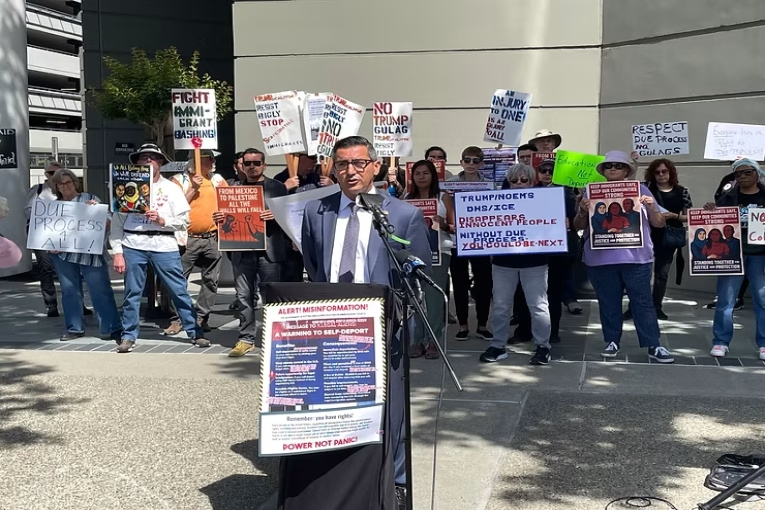
SAN FRANCISCO, CA – Immigration and Customs Enforcement (ICE) agents have been entering immigration court buildings in Northern California, triggering alarm among legal advocates and immigrant rights organizations who warn that the operations are spreading fear, undermining due process, and deterring immigrants from attending court hearings.
According to a joint press release from the California Collaborative for Immigrant Justice (CCIJ), the Contra Costa Immigrant Rights Alliance, and the California Immigration Project, ICE agents were recently seen at the San Francisco, Concord, and Sacramento immigration courts asking people for their names and identification. ICE attorneys inside courtrooms have reportedly coordinated with agents outside by requesting that immigration judges dismiss certain cases—potentially clearing the way for immediate arrests as individuals exit the building.
While no case dismissals have succeeded in Bay Area courts thus far, CCIJ confirmed that one person was arrested outside the Concord courthouse. Advocates say that the presence of ICE agents, especially those in plain clothes, has already disrupted legal proceedings and created a chilling effect that discourages immigrants from attending hearings.
In response, legal organizations and community groups have mobilized volunteers, legal observers, and rapid response teams to assist immigrants appearing in court. These volunteers have been helping individuals understand their rights, countering ICE motions, and monitoring agents’ conduct. Rights organizations have adopted a message of “power, not panic,” and are urging immigrants to contact their local Rapid Response Networks for support and legal assistance.
The impact of ICE’s presence was visible in courtroom attendance. Victoria Hartanto, an immigration attorney volunteering through the San Francisco Bar Association’s Attorney of the Day program, described an unusually empty courtroom during one recent hearing. “It’s usually a packed courtroom,” she told NBC News. “Today almost nobody showed up.” Hartanto said that on the docket she was monitoring, at least 10 out of 12 scheduled respondents failed to appear.
Cynthia Ashley, a volunteer with the Concord Court Accompaniment Program, witnessed a troubling incident on May 21. After reminding individuals of their right to remain silent, including one person who was later detained, Ashley was escorted out of the courthouse by security. “The incident shook me to the core,” she said. “The ICE agents’ display of force and power, and their disdain for the right this man had been given to plead his case, are beyond comprehension.”
Sergio Jaime Lopez, Community Defender Coordinator with the Contra Costa Immigrant Rights Alliance, said the emotional toll was profound. “At the end of the day, one person didn’t make it back home to his family—and I can’t stop thinking about the human side of that,” he said. “This country was built on the foundation of rights and due process. On days like this, it feels like those rights don’t exist for everyone.”
Angela Chan, Assistant Chief Attorney at the San Francisco Public Defender’s Office, called on elected officials to intervene. “We need our local and state elected officials to partner with us to defend our immigrant communities against this unprecedented attack on due process rights,” she said. “Ramp up funding for community defense, including rapid response networks, immigration legal services, public defender resources, and community-based organizing efforts.” She also urged leaders to reaffirm and strengthen California’s Sanctuary laws, which limit collaboration between local agencies and federal immigration enforcement.
Kamalpreet Chohan, Coordinator of the Sacramento Attorney of the Day Program at the California Immigration Project, said the ICE presence forces immigrants into “impossible choices.” “Attend their hearings and risk arrest, or stay home and face a deportation order,” she said. “No one should have to face such a decision. We will continue to speak out, organize, and share know-your-rights information.”
Sean McMahon, Senior Attorney with the California Collaborative for Immigrant Justice, reaffirmed the community’s commitment to resisting fear. “You are not alone. We are doing everything we can to be there at the court to support you,” he said. “Reach out to local immigration legal services and your fellow community members, prepare yourself, and exercise your rights.”
Thais Santos, Program Manager with the San Francisco Immigrant Legal and Education Network, offered a stark warning about the broader implications. “ICE’s shameful tactics endanger everyone in the United States by bringing us closer to a fascist police state,” she said. “If they can target our immigrant communities without due process, they can target any of us.”
As court proceedings continue in Northern California, immigrant rights groups are emphasizing that legal accompaniment, rapid response coordination, and widespread know-your-rights education remain critical tools for resisting what they describe as an erosion of civil liberties under the banner of immigration enforcement.
