
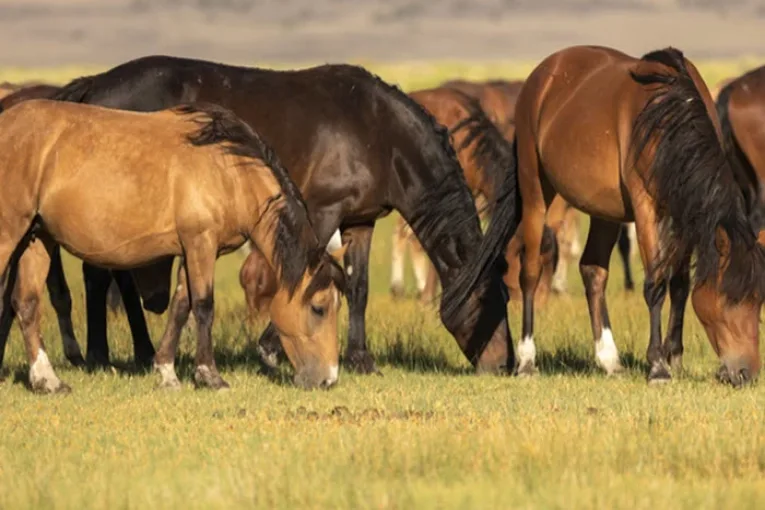
SACRAMENTO, Calif. — A federal lawsuit filed Aug. 11 seeks to block the Bureau of Land Management and U.S. Forest Service from carrying out a planned roundup that would permanently remove more than 600 wild horses from the Montgomery Pass Wild Horse Territory, the largest free-roaming herd in California, according to a press release by Heather Marlowe from Eastern Sierra Wild Horses.
Plaintiffs Cherie Tobin, a physician and wildlife photographer, Craig Downer, a wildlife ecologist, and filmmaker Carl Mrozek argue that the agencies’ proposed roundup would devastate the historic herd, which they describe as vital to the region’s ecological balance.
The trio assert that the agencies’ proposed action amounts to a “decimation of the historic herd, undermining their essential ecological role,” according to the release.
“If allowed to move forward, the roundup would inflict extreme suffering on the wild herd and erase their essential ecological role,” Downer stated in the release.
The lawsuit, filed in federal court, alleges violations of the Wild Free-Roaming Horses and Burros Act, the National Environmental Policy Act, and the Administrative Procedure Act. According to the plaintiffs, the federal agencies have failed to adopt the legally required Herd Management Area Plan (HMAP) for nearly four decades. Marlowe added that they also accuse BLM and USFS of mismanaging water, fencing, recreation and habitat in ways that force the horses out of their protected territory.
“The agencies have had decades to manage this herd responsibly and legally, yet they have failed to adopt even the most basic plan required by law,” said Randall Weiner, the lead attorney for the plaintiffs. “Now they aim to punish the horses for their own failures.”
The release highlights longstanding concerns about water access within the territory, noting that the herd has been pushed to dangerous highway crossings in search of off-territory water sources. Advocates argue that solutions such as solar well construction, improved on-territory water access or expansion of the territory should be pursued instead of removing the horses.
“These are the most colorful American wild horses I’ve filmed in over 20 years, and the High Sierra landscape is magnificent,” said Mrozek, who is producing a documentary on the herd. “I am outraged that most of these mustangs would disappear forever if this unjust roundup occurs.”
The plaintiffs emphasize that the herd demonstrates rare social ecological dynamics, shaped by natural selection and predation by mountain lions. Supporters are calling for the horses to be recognized as an “Official Study Herd,” noting their genetic diversity and unique adaptations.
Advocates argue that wild horses play a critical role in ecosystems. According to the release, the animals help reduce wildfire fuel, aerate soil, disperse seeds and create diverse habitats that benefit other species. The Montgomery Pass herd is also known for producing rare albino and light-colored horses, which draw photographers, researchers and eco-tourists to the region, adding cultural and economic value.
But advocates warn that federal roundups are often brutal. “Roundups stampede wild horses into traps, often causing broken necks, broken limbs, orphaned foals and deaths,” the release states. Once captured, horses are typically sent to holding facilities where they may remain for years in crowded conditions at taxpayer expense.
According to American Wild Horse Conservation, holding facilities where many captured horses end up have alarming mortality rates. At the BLM’s Fallon (Indian Lakes) short-term corral, the agency’s largest holding facility, 267 horses died in 2023, accounting for 11% of its population. Of those, 106 deaths were due to “Undiagnosed/Unknown” causes, while others resulted from routine procedures like gelding, raising concerns about humane care.
Roundups themselves have also proven lethal. In Nevada’s Pancake Complex, more than 2,000 horses were rounded up, and 31 died — a fatal toll that triggered part of the legal action that led to Judge Miranda Du’s mandate for an HMAP, according to AP News. Similarly, in one roundup operation in the Triple B Complex, 27 horse deaths were reported, attributed to bone fractures, poor condition, blindness and deformities.
“These wild horses have a place in the Circle of Life, which comprises all beings. I am dedicated to protecting them so they can stay on their land and remain in that Circle,” Tobin stated.
Supporters say the outcome of the lawsuit will determine not only the future of the Montgomery Pass herd, but also broader questions about how federal agencies manage America’s wild horses.
Follow the Vanguard on Social Media – X, Instagram and Facebook. To learn make a tax-deductible donation, please visit davisvanguard.org/donate or give directly through ActBlue. Your support will ensure that the vital work of the Vanguard continues.
