
By Vanguard Staff
SACRAMENTO — Orange County Business Council President and CEO Jeffrey Ball said California’s 2025 legislative session delivered meaningful progress on housing but warned that mounting regulatory and cost barriers continue to undermine the state’s competitiveness.
In an op-ed published in Capitol Weekly on October 24, Ball wrote that the session “reflected both the complexity and potential of doing business in California.” He said the year was “not all doom and gloom,” but added that “Sacramento has much more work ahead to ensure our state remains a place where businesses, families and communities can thrive.”
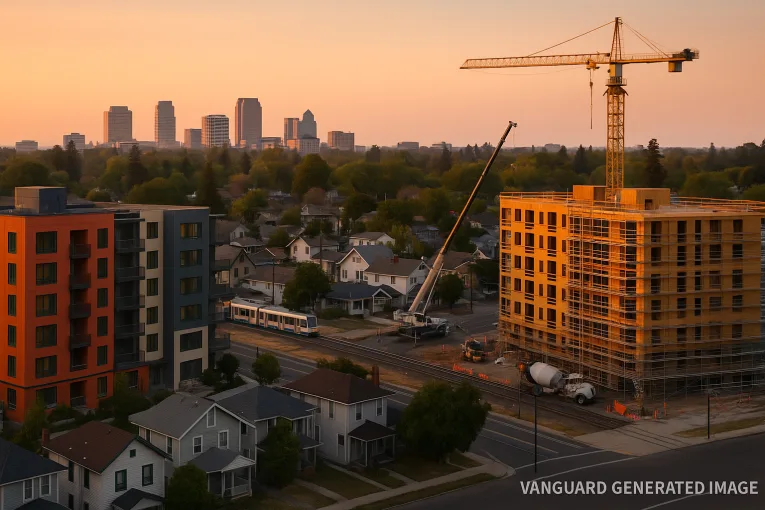
Ball praised Senate Bill 79, which Governor Gavin Newsom signed into law on October 10, as “a win for employers and the people they support.” The bill creates a “by right” approval process for housing near transit stations. “Streamlining approvals for high-density homes along major transportation corridors is a smart step that will help communities meet housing demand, reduce traffic, and give workers more options to live closer to where they work,” Ball said.
He also commended SB 131, a housing trailer bill backed by OCBC and passed earlier this summer, which he said “includes reforms to streamline approvals near transit hubs.” Together, the two bills “represent a win for common-sense housing policy,” according to Ball.
However, he criticized Assembly Bill 130, describing it as a “Vehicle Miles Traveled housing tax.” Ball said the measure will “counteract the solid reforms passed by the legislature” by raising development costs. “Instead of pairing reforms with new fees, California should encourage housing production rather than make it more expensive for developers and residents,” he wrote. “The VMT tax is shortsighted and will counteract the solid reforms passed by the legislature, ultimately making those efforts moot.”
Ball said the Legislature’s decision to move AB 52 — a proposal to expand the California Environmental Quality Act — to a two-year bill signaled that lawmakers “may finally be listening to concerns about the urgent need to streamline housing development.” Still, he wrote, “CEQA remains a major roadblock, with lawsuits delaying critical housing and job-creating projects. Until meaningful reform is achieved, housing affordability will remain out of reach for many Californians.”
He also highlighted the state’s uneven progress on infrastructure, saying the move toward a Western States Energy Grid was “a win for energy reliability,” but criticized lawmakers for again delaying “action on the Delta Conveyance Project, a critical initiative for water reliability and regional infrastructure hardening.”
Ball pointed to Orange County agencies like Irvine Ranch, Moulton Niguel and Santa Margarita as leaders in “recycling, conservation and storage,” and urged that “it is time for the rest of the state to follow their lead.”
The OCBC president expressed concern over what he described as new regulatory burdens enacted this session. He said the organization opposed AB 288, which “expands the jurisdiction of the Public Employment Relations Board into matters already covered by federal law under the National Labor Relations Act.” Ball warned that “by adding another layer of oversight, businesses could face conflicting rules and longer disputes, making it harder and more expensive to resolve workplace issues.
“These added costs and delays make it more difficult for employers to hire, grow and invest in our communities, slowing job creation and making California a less attractive place for businesses and workers alike,” Ball said.
He also criticized SB 82, which “restricts how businesses can structure dispute resolution in consumer contracts.” Ball said that “by limiting the ability of companies to enforce agreed-upon terms, the bill increases legal uncertainty and the potential for costly litigation.”
He warned that the two measures “create new hurdles for businesses, reduce private investment, slow economic growth, and limit job creation in California.”
Ball concluded that, despite some bright spots, “employers continue to face some of the highest costs in the nation.” He called for all future legislation to be evaluated by “a simple test: does it make it easier or harder to grow jobs and opportunity here?”
“OCBC and the broader business community will continue to partner with policymakers to build a more affordable and competitive state,” Ball wrote. He said that work includes “advancing housing production, addressing CEQA abuse, prioritizing investments in water and energy infrastructure, revising overly complex employment laws, and advocating for policies that support job growth and help keep companies and good-paying jobs in California — rather than encouraging them to leave.”
“It is time for California’s leaders to act,” he concluded. “Reform must become the standard, not the exception, if we are to keep our state affordable, competitive, and a place where both businesses and families can thrive.”
Follow the Vanguard on Social Media – X, Instagram and Facebook. Subscribe the Vanguard News letters. To make a tax-deductible donation, please visit davisvanguard.org/donate or give directly through ActBlue. Your support will ensure that the vital work of the Vanguard continues.

The VMT issue is the modern version of the buggy whip. With e-bikes more and more locals are giving up cars. One neighbor told me that they use e bikes so much that they had to recharge their e car because it was running down because of lack of use. The e bike is revolutionizing local transportation but groups like the self appointed Davis Planning Group are far behind the curve on visualizing what an e bike future will look like.
Ron G
NO, Davis Citizens Planning Group is all in on e-bikes. (Have you seen Tim Keller riding his electric uniboard?) I personally see cargo e-bikes as a potentially huge market. That’s why we insist that the new developments have bike lanes that can accommodate all of that increased use. Likely they can share use with transit buses given that the traffic volume is lower. However, e-bikes in standard streets and roads mixed with autos are death traps. The state needs to step forward and establish universal regulations to keep e-bike use safe. It’s the Wild West out there right now. (My wife is a biking program coordinator for a regional transportation demand management agency and we’ve had many discussions around this.)
That said, e-bikes in Davis won’t solve our traffic problem if we continue to build oversized houses for commuters who will still drive to Sacramento or Vacaville. E-bikes ONLY work here if we build for the “missing middle” market that serves those who currently commute INTO Davis. They’re the ones who will switch over and quit driving. Be mindful of the target market.
From article: “He called for all future legislation to be evaluated by “a simple test: does it make it easier or harder to grow jobs and opportunity here?”
And if that’s the primary/only criteria, it’s an example of why “business council CEOs” shouldn’t be running the state (more than they already do). What they advocate for is an environmental disaster, as well as the underlying cause of the so-called “housing crisis” itself.
This type of mentality is literally destroying the habitability of the earth for humans and other life. Unfortunately, what they teach in schools is that this mentality can continue, as long as we’re driving electric cars, taking one minute showers, etc. (In other words, they’re searching for ways to continue this destructive path by delaying/shifting its impact.)
Ron O
It is so ironic to read your concerns about the environment (which I agree with) while you try to drive new development to other communities that are less considerate of environmental impacts than Davis. This is so illustrative of the wealthy progressive’s conundrum of wanting to achieve a lofty goal while trying to keep everyone away from their treasures.