
By Vanguard Staff
DAVIS, Calif. — The Village Farms Davis project team will host a community open house on Wednesday, Oct. 15, from 4 to 6 p.m. at Tandem Properties, 3500 Anderson Road, to highlight local partnerships supporting sustainable development and community resilience.
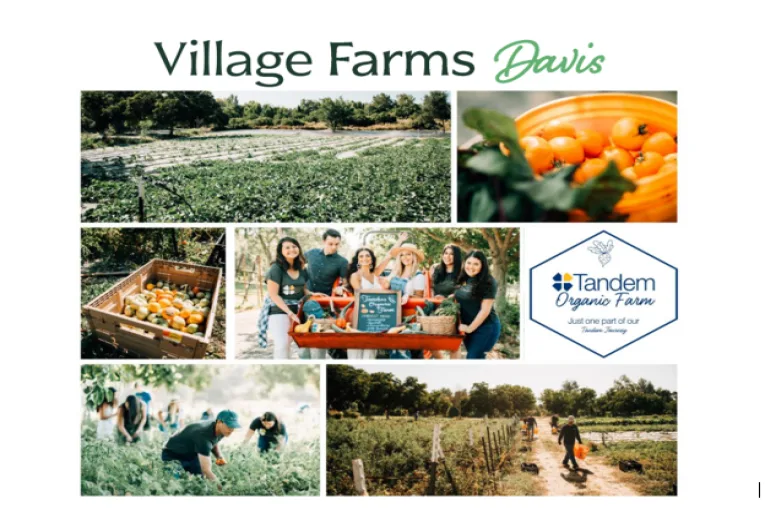
The event will showcase collaboration between Village Farms Davis, Tandem Organic Farms, and the Yolo Food Bank. According to organizers, Tandem’s Organic Farm — which has donated nearly half a million pounds of produce to Yolo Food Bank — is serving as the inspiration for the future Educational Farm at Village Farms Davis, planned in partnership with the Davis Joint Unified School District.
Guests will be able to meet project representatives, view exhibit boards, and learn how sustainability, education, and innovation are being incorporated into the project’s design. Light refreshments will be provided.
Village Farms Davis is a mixed-use community proposed across from North Davis’s Nugget Market on a prominent infill site. The project will include 1,800 new homes, including affordable and down-payment-assistance options, organized into walkable neighborhoods connected by parks, trails, and open space.
The development is designed to expand housing opportunities while preserving agricultural heritage and promoting long-term sustainability. Exhibit boards at the event will feature project plans that include 47 acres of preserved habitat and natural open space, a 107-acre agricultural area linking urban living with local food production, and sustainability measures aligned with the City of Davis Climate Action and Adaptation Plan.
Organizers describe the project as a forward-thinking approach to community building and a commitment to ensuring that housing, nature, and agriculture grow together to strengthen Davis for generations to come.
The event is free and open to the public.

So let me get this straight. A developer wishing to pave over ag land is holding an event to ‘praise’ local agriculture.
Shall we play a game of who can make up the most parallel ironic “that’s like . . . ” metaphors without evoking Hitler?
I agree with Alan. Wow, Village Farms being “environmentally sustainable”? “Housing, nature, and agriculture grow together”? Seriously? Nothing could be further from the truth.
1) The 1,800 housing unit Village Farms project as well as its predecessor Covell Village planned to pave over the vernal pools. That proposal is still officially on the table as “The Proposed Project”. In fact, the vernal pools have been occasionally disced over the years. Two years ago, just California Native Plant Society in 2023 which featured these vernal pools and the very rare native plants like Astragalus tener var. tener and Extriplex joaquiniana. Two weeks later the vernal pools were disced. This was just before the Village Farms Draft EIR environmental studies began. Two weeks later the vernal pools were disced! The subsequent environmental studies revealed that the endangered Vernal Pool Tadpole shrimp were located in the vernal pools which are federally protected, which forced the Village Farms developer to propose an alternative which did not include the vernal pools. So, proposing a 47-acre habitat was not voluntary by any means. The developer only proposed it when it was required of him. The entire discing of these rare vernal pools on the Village Farms just before the Draft EIR studies began, was reminiscent of the predecessor Covell Village project but the same developer where by a Burrowing Owl colony was disced just before those Draft EIR studies began.
2) The “107-acre agricultural area” will actually be a 10-foot-deep dig pit, to move 1 MILLION cubic yards (100,000 X 10-cubic yard truckloads of soil to try to raise the level of the enormous 100-acre flood plain). The other issue is that the fantasy that Village Farms is trying to promote is that this 10’ deep dig-pit is entirely within the massive FEMA Hazard Zone A (the worst zone) of the 100-year flood plain can be farmed! So, this 107-acre 10-foot dig pit will chronically be full of water, yet the Village Farms developer is trying to claim that this muddy mosquito producing dig pit, which will also act as a detention basin in rainy season, will be farmed? Another fantasy. Plus, the Village Farm project avoids having to provide the required agricultural mitigation that the UATA site requires, when it is re-designated “agriculture”.
3) What about the unaffordable cost of Village Farms market rate housing comprising the majority of the 1,800-unit project? The market rate housing costs will be a minimum of $750,000 going up to $1 million. That is a monthly payment of $6,500- $7.500+ including taxes and other fees. Yet, they claim the project will bring 700 school age kids which is absurd since the vast majority of young families cannot above $6,500 – $7,500 for a monthly house payment, So, contrary to the School District’s claims, Village Farms will not help bring many hundreds of school-age kids.
4) What about the 18.6 acre of land that the Village Farms developer has refused to dedicated for affordable housing? Yet, he has known this amount of land is required since the inception of planning Village Farms. Well, the developer has decided he does not want to dedicate the required 18.6 acres required by Davis’ Affordable Housing Ordinance of his roughly 500-acre project proposal, So he has said that he will only provide 9-9.5 acres of land for affordable housing. So far, it appears that the City will let him get away with that as well as avoiding the require agricultural land mitigation for the project.
5) Then, there is the plethora of serious problems that Village Farms project land site has starting with, the massive more 200-acres flooding risks. At least half of the Village Farms project is in the FEMA Hazard Zone A massive flood plain. California State has passed legislation years ago making clear that cities foolish enough to build in large flood plains will NO LONGER be bailed out physically, nor financially by the State. Village Farms building on this massive floodplain involving more than half the project is an irrational proposal. And the City will be liable to the damages from potential flooding, but Davis residents will wind up paying the costs for it financially.
6) Then, there is more liability to the City from the toxics including carcinogenic PFAS “forever chemicals” leaking from the adjacent unlined Old City Landfill and Sewage Treatment Plant. These PFAS chemicals are carcinogenic and are leaking into the ground water in high levels, as are another of high-level chemical contaminants including manganese, arsenic, selenium, aluminum, and nitrates. These contaminants can mix with the Channel A water since the ground water levels have been rising and the channel rerouting will be as deep as 10 feet deep on average. This contaminated water would travel to the east via Channel A and to the wetlands including the Vic Fazio Wildlife Area in the Yolo Basin and to other connecting waterways. Also, there are serious soil toxics like the 1,200,000 ng/kg of toxaphene (a carcinogen and neurotoxin) and high lead concentration of the soil in the Village Farms park for kids and families.
7) There are significant unsafe access issues because Covell Blvd. and Pole Line Road are fast moving roads for bicyclists and pedestrians to cross. The Village Farms DEIR was not certain if a Pole Line Road grade-separated crossing was “feasible”, plus the developer was making clear that he was not interested in covering all the construction costs (even though it was needed for his project). Well, we still have not heard anything definitive about the status of this situation, but even if it were feasible, and if he agreed to pay for the Pole Line grade-separated crossing, why is the developer not paying to build an F St. grade-separated crossing that his project is also causing the need for? How is it different than the Pole Line Road grade-separated crossing? Let’s remember that the same developer (John Whitcombe) claimed he would get the grade-separated crossing built at the Nishi project, which was approved by a Measure J/R/D vote. But no progress has been made in 7 years. Why would we give more entitlements for his Village Farms project with more false claims?
8) Massive infrastructure costs, including the unneeded additional fire station, because 90% of the fire department calls are medical, not fire related. The obvious solution is to instead have an emergency medical service (EMS) which would cost a fraction of the cost and its small footprint could go anywhere in East Davis. The renovation of the downtown fire station was roughly $34,000. Imagine the cost of a new fire station and the massive costs in the multi-millions into the future for the additional firefighter salaries, equipment and operational costs? Davis resident taxes will skyrocket. Further, the developer is only being responsible for a “fair share” of only some of the road and traffic control ”improvements” that Village Farms will cause the need for all along Covell to the east and all the way west to Sycamore and Hwy 113. Davis residents will pay the rest.
9) Then there are the massive traffic impacts that Village Farms will create from the 1,800 housing units at Pole Line and Covell Blvd. where there are currently huge traffic impacts particularly from Spring Lake. The Draft EIR is claiming only 15,000 more car trips a day, however that is a gross underestimation by the Draft EIR which is falsely assuming that many residents will be using public transit. Yet, Davis public transit will not even circulate through the roughly 400-acre project. Further, Davis public transit is inadequate, inconvenient and planned primarily around UCD’s student needs, not community needs. And there is no funding or plans for massive expansions of our public transit. So, these Draft EIR car trip impacts significantly underestimated and we all know the traffic would be gridlock.
10) What about the air quality issues from the massive traffic back-up that would be at Covell Blvd. and Pole Line Roads and beyond? Also, from aerosolizing 1 MILLION cubic yards of soil to try to raise the 200-acre flood plain level. The Draft EIR says it would take at least 15 years to build out Village Farms, which includes the construction traffic and impacts. There is nothing environmentally sustainable about that, or Village Farms.