
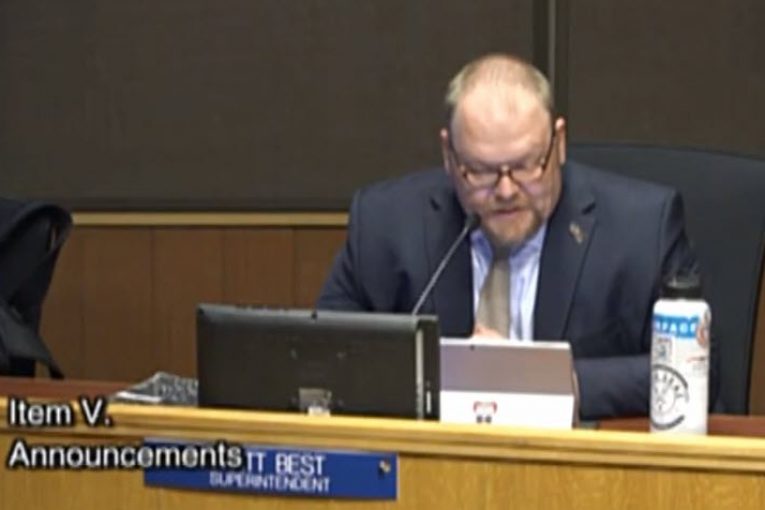
The emotional scene at Thursday’s Davis school board meeting — parents in purple shirts fighting to keep Patwin Elementary open — was about more than one school. It was about a community reckoning with two decades of slow growth, policy paralysis, and the creeping realization that Davis’ housing choices have caught up to its schools.
As teacher Stephanie Tealdi told trustees, the uncertainty of closure has shaken her faith in the district she’s served for nearly twenty years. She said she’s stayed not because she loves DJUSD as an institution, but because she loves Patwin — the community, the students, the sense of belonging. Her words capture what’s at stake: not just enrollment numbers on a chart, but the human texture of a neighborhood, the shared identity that schools create.
Superintendent Matt Best acknowledged as much. He thanked families and staff who have engaged in the district’s boundary and facilities workshops, noting that “without new housing to attract young families, we’re heading into a prolonged decline.” He warned that if birth rates continue to fall and the city fails to build, the district will face shrinking enrollment well into the next decade.
For many, that realization has been a long time coming.
Over the last twenty years, Davis has prided itself on controlled growth, environmental stewardship, and a quality-of-life model that sought to preserve the city’s small-town charm.
But that same philosophy — often codified through voter-approval requirements and a culture of “smart growth” that too often meant no growth — has also throttled housing production. And now, the consequences are visible in classrooms, payrolls, and community cohesion.
According to the Economic & Planning Systems (EPS) peer review of the Village Farms proposal, Davis’ housing stagnation is directly tied to its declining school enrollment.
“A combination of declining birth rates and housing unaffordability has placed serious strain on DJUSD enrollment,” the analysis notes. “Not enough housing has been built in Davis, and prices are too high for families to locate in the city.”
That’s the hard truth: Davis is aging faster than it’s renewing. Nearly half of the city’s housing stock consists of single-family detached homes, while only about 15 percent is medium-density housing like duplexes or townhomes. Those missing middle options — the kinds of homes young families, teachers, and nurses could realistically afford — have been largely absent from the city’s planning vision for decades.
And without them, the city’s demographics have tilted toward the upper end of the income spectrum. The EPS report shows that Davis’ average household income now sits at roughly $128,000, but the median home price remains close to $900,000. The math simply doesn’t work for most working families. For all the pride Davis takes in its progressive values, its housing market tells a different story — one of exclusion by inertia.
That exclusion has consequences. Schools lose students. Teachers lose colleagues. Neighborhoods lose vitality. Civic life becomes a little more brittle.
In the same EPS study, Superintendent Best and Chief Strategy Officer Maria Clayton are quoted as saying, “We’re not here to advocate for a particular project or type of housing, but we are here to make the consequences of inaction clear. The connection between housing and schools isn’t just abstract — it’s immediate, it’s financial, and it’s human.”
Village Farms, the proposed 1,800-unit development on the city’s north side, may not be the silver bullet that some hope for. But it represents the most significant opportunity in a generation to rebalance the city’s housing mix and stop the slow bleed of young families from Davis. The project’s economic and demographic projections tell a story that deserves close attention.
EPS estimates that Village Farms would add about 700 new students to the Davis Joint Unified School District — an increase of more than eight percent, enough to stabilize enrollment levels that have been declining for years. That’s not just a number; it’s the difference between keeping schools like Patwin open and watching them close their doors.
The project would also expand the city’s property tax base by about $1.24 billion, add roughly $74 million in annual retail spending power, and inject life into existing neighborhood shopping centers. And crucially, nearly two-thirds of the proposed homes would be medium-density — the very segment that’s been missing from the city’s housing landscape.
These are not luxury mansions; they are the kinds of homes that allow two-earner households — educators, researchers, small business owners — to stay in the city where they work. The report notes that for a dual-income family earning about $168,000, a $740,000 medium-density unit would be attainable. That’s still expensive by most measures, but it’s a step toward a more functional, inclusive market.
EPS frames this in clear economic terms: by broadening housing options, Village Farms “can help address Davis’ economic development needs for the long term,” allowing local employers to attract and retain the workforce that sustains the city’s economy. The study even links housing diversity to labor market resilience — the ability of the city to weather downturns by maintaining a balanced mix of residents and jobs.
In other words, housing isn’t just about where people sleep. It’s about whether a community continues to regenerate itself.
But if the past two decades have shown anything, it’s that Davis does not change easily. Every proposal for new housing beyond city limits becomes a proxy battle for the city’s identity. Each project is scrutinized not only for its design or density but for its symbolism — will it make Davis “less Davis”?
That question, more than zoning maps or traffic counts, has guided the city’s politics for years. And it’s why, even as nearby communities like Woodland and Dixon have added homes and families, Davis’ population has barely budged.
Meanwhile, the human costs mount quietly. Teachers wonder whether they’ll have jobs in five years. Parents fear that their neighborhood schools will be shuttered. Small businesses see fewer families walking through their doors. And city leaders wrestle with budgets stretched thinner by demographic decline.
If there’s a silver lining, it’s that these converging pressures — the enrollment crisis, the housing imbalance, and the fiscal strain — have finally made it impossible to ignore the connection between housing policy and community sustainability. The Patwin controversy, painful as it is, may be the jolt the city needs to confront what has long been evident.
The challenge now is whether Davis can move beyond a politics of preservation toward a politics of renewal.
Projects like Village Farms can help, but they are only one part of a broader solution. What Davis really needs is a sustained commitment to producing housing at all income levels — not just because the state requires it, but because the city’s social and economic future depends on it. The schools, the workforce, the local economy — they all hinge on whether Davis remains a place where families can afford to live and grow.
That will require difficult conversations and a willingness to rethink long-held assumptions. It will require revisiting the city’s growth boundaries, re-evaluating Measure J/R/D’s constraints, and reconciling environmental values with human needs. And it will require courage from leaders who understand that doing nothing is not the neutral choice it once appeared to be.
Because doing nothing is, in fact, a decision — one that carries its own costs.
Those costs are now playing out in real time: in shrinking classrooms, in worried teachers, in parents pleading for their school’s survival. The faces in that boardroom last week were not opponents of growth; they were the consequences of stagnation.
Davis built its reputation on thoughtful planning, environmental consciousness, and a sense of community. Those are values worth preserving. But preservation, taken to an extreme, can become its own form of decline. The challenge is not to abandon what makes Davis special — it’s to ensure that those values still have a future to inhabit.
At some point, the city must decide whether its progressive identity is compatible with a pattern of exclusion and demographic contraction. If it continues to prize control over renewal, it risks becoming the very opposite of what it imagines itself to be: a community frozen in time, governed by fear of change, watching its schools close and its families drift away.
As Superintendent Best put it, “Without forward-thinking housing policy, we will continue to see the peaks and valleys of school enrollment.”
Those peaks and valleys mirror the larger story of Davis itself — a city whose fortunes rise and fall with its willingness to plan for tomorrow. The question now is whether Davis will finally take the long view, or whether it will stand still once again, waiting for the next school to close before realizing what’s been lost.
Follow the Vanguard on Social Media – X, Instagram and Facebook. Subscribe the Vanguard News letters. To make a tax-deductible donation, please visit davisvanguard.org/donate or give directly through ActBlue. Your support will ensure that the vital work of the Vanguard continues.

How is it that the local public school system can engage in self-interested political campaigns, without someone getting thrown into prison?
Seems like the law needs to change.
And actually, I’d ask that of a non-profit blog engaged in political campaigns, as well. Why should they be exempt from tax, when every other business which engages in this gets taxed? If anything, “actual” news sources are more objective and provide more of a public service than this blog. (Why aren’t they also exempt from tax?)
The City where I grew up was still growing massively when they started closing schools. All four public schools I went to were closed, and two of those the land was sold for housing. Still they aren’t opening new schools. Why? Because it was the baby boom that caused all those schools to be needed. That city still grew for years until all the lots were filled. A few housing projects in Davis aren’t gonna do it, nor is a report by a “tell us what you want us to say and we’ll use the word ‘could'” consultant. The school board should (could!) stay out of politics and deal with the realities on the ground. That would be the best #ahem!# course of action.
Declining enrollment is a problem for school districts the way they are currently financed. Davis has artificially constrained its housing through its land use and therefore resetting things by building up to the state mandate seems a reasonable way forward. Lost in all of this is that all this does is build to the state RHNA numbers. And people are whining about it. Amazing.
“And people are whining about it. Amazing.”
So who’s doing most of the whining? The anti-housing people or the pro-housing sprawl advocates?
You tell me
Well for starters the anti-housing people aren’t writing almost daily articles about it.
The anti housing people post the most comments
“Davis has artificially constrained its housing through its land use”
Or the school district could just deal with what there is, and set one campus aside in case there is growth. I don’t agree with RO about a lot on housing, but the YIMBY/Vanguard/Progressive build-baby-build has soured me to being the moderate I have been the last 20 years. I agree with RO that too many are going to get p’d off at the current environment and are going to come up with a state amendment that will probably win, because owners tend to vote in greater numbers than renters.
” . . . and therefore resetting things by building up to the state mandate seems a reasonable way forward.”
It *could* work #snicker-snicker#.
Even more bizarre to me is the school district is out of desperation looking to the ‘forever growth’ model to fund itself, which is essentially the corporate model of capitalism that incentivizes market growth via manipulated population growth. But y’all progressives regarding such capitalism are whining about it, but not the school acting the same way. Amazing.
It doesn’t matter Alan, they aren’t asking for anything that the state isn’t already asking for.
And when the homeowners discover that their high housing values rely heavily on the quality of the school district, they’ll finally realize that they were being selfish. Or they probably won’t realize they shot themselves in their collective feet and just bitch and moan some more about how Davis is falling apart. Or they’ll get to blame their parents for being so stupid and short sighted.
What factor is effecting home prices more? Quality of school or constrained supply. I don’t know…but you raised the point about schools and the housing market so I….had to ask……
As to Davis falling apart….that’s less a result of new home construction absolutely the result of a failed economic plan…which should include growth.
“The City where I grew up…”
Where did you grow up?
Ross Road, Ortega, Wilbur, Cubberley.
Ashes to Ashes. Dust to Dust. Schools to Houses in the case of the first two.
And we still had plenty of empty lots and even a few orchards still around when the first school closed.
Maybe they should close Foothill Park and make it into “affordable housing”. It’s all in the city limits, and lefties don’t care about the environment as top priority, not if ‘affordable’ housing can be built :-|
Cubberley High School is no longer an operating high school. The school, which was located in Palo Alto, California, closed in 1979 due to declining enrollment. The site is now used as the Cubberley Community Center.
Why a park? How about an unused road? We reduced 5th Street from four lanes to two. Take the south side of fifth by PG&E and build Affordable housing.
Interestingly-enough, I don’t believe that the city I grew up in (San Francisco) has closed any of the schools I attended (and I attended 3 different elementary schools over a period of time). Despite the fact that San Francisco is much more expensive than Davis, and young parents have been fleeing that city for decades.
A high school that a couple of my much-older siblings attended closed some 45-50 years ago, however. And was turned into housing shortly thereafter – apparently due to the “housing crisis” that existed at that time (or so I’m told).
This was in the days prior to Proposition 13, derogatory terms such as NIMBY, etc. Way before housing prices skyrocketed due to civic pursuit of select businesses.
San Francisco has closed a number of schools. But school closures ultimately are a temporary bandaid if enrollment continues to decline. Everyone acts like closing a school or three will solve the problem, it won’t.
As a side note, I seem to recall that one elementary school (very close to one of the schools I attended) closed when I was still in elementary school (probably around 55 years ago). I believe that the building is still there, but I don’t know if it reopened as a school. (I could find out.) It’s in the Twin Peaks area – and every school in that area was probably as good as the ones in Davis.
San Francisco’s population was also remarkably stable for a long period of time when I was young. It still hasn’t increased much since then.
Closing schools absolutely “does” work, and there’s always a residual need for them due to turnover of existing housing stock. But the need is (generally) permanently reduced compared to the time when developments were new. That’s always the way it works, and it’s even occurring in Woodland (in older sections of town).
Don’t be afraid of change.
“Don’t be afraid of change”
You are
I don’t think so. The primary “change” is reflected in 1.6 kids per woman nationwide. (The nationwide part is what makes this truly noteworthy, since that has absolutely nothing to do with Davis or California housing prices.)
Honestly, I’m more hopeful about the future than I used to be (due to the generations which succeeded the boomers regarding birth rates in particular).
Tomorrow’s article will show why this view is wrong.
Wait a minute – you’re going to write a housing article tomorrow?
I was counting on hell not freezing over, which seems even less likely due to climate change. (Then again, it is protected from the climate, since it is underground – as long as it’s somewhere above the earth’s mantle.) See? I did learn something in school (actually no – pretty sure I found that out regarding the earth’s mantle elsewhere).
Just for that I’ll write five
“Just for that I’ll write five”
You act like that’s going to shock someone…
Tough crowd
Five per day?
I suspect that one of the differences between you and me is that I also want to protect YOUR home town – despite only being there maybe a couple of times during my lifetime. Nice area, for sure.
I’ve been through this before – witnessed areas destroyed by development. (And honestly, protection of the environment “belongs” to boomers – I’m at the tail end of that.)
The young’uns only focus on climate change, without seeing the bigger picture. (Though I do appreciate their birth rate.)
DG quote RO, “Don’t be afraid of change”; DG say “You are”
DG apparently missing the obvious irony that RO was putting forth due to the laughably always used tactic of accusing opponents to any project as having “fear of change”. As I’ve pointed out numerous times, we don’t fear change, we dread change that makes things suck more.
The national birth rate has only a remote relationship to demand for housing in Davis which is an economic job center. People move to where the most valuable jobs are. That’s why housing prices are so high in the Bay Area. Plus the U.S. has had significant immigration from other nations, with California gaining a disproportionate number. We won’t see the effect of declining birth rates, if they continue, for a few decades. We have to provide affordable housing to people between now and then.
Ron O
“I also want to protect YOUR home town.”
You don’t seem to get it–we don’t want you to “protect” us because you have no competence in doing so. Your refusal to acknowledge the facts that counter your fantasy narrative about “saving” Davis. You have no stake in the outcome here, so please go away.
Please just stick to “protecting” your home town of Woodland. We don’t need you here to muck things up.
RMcC say, “Davis which is an economic job center. People move to where the most valuable jobs are.”
??? I’m confused. I thought the issue with Davis was we don’t have good jobs and we’re a bedroom community for old people and commuters.
RMcC say, “We won’t see the effect of declining birth rates, if they continue, for a few decades. We have to provide affordable housing to people between now and then.”
Since it’s “affordable”, the demand will be endless. But my point was that the schools need to deal with what they are dealt, not get involved in politics, and that back in the day they closed schools with declining enrollment. No one liked it then, either, but the school board didn’t try to increase the supply of students, it dealt with the local demographics (not national demographics).
“Don’t be afraid of change”
Are you referring to the people who are fearing the change of having to close a few schools due to necessity?
Richard is correct extrapolating national birthrates to local housing demand is fool hardy.
RO say, “derogatory terms such as NIMBY, etc. ”
NIMBY was a term, it just meant ‘not in my backyard’. It wasn’t just automatically derogatory back in the day, because most people understood and even empathized with having a horror built next to you, and City Councils often took that into account. Now it’s like: ‘you own land, you must be an oppressor, now that you’re made it you are evil, we must make you suffer evil NIMBY!’
Unfortunately, what started out as a movement to protect what we have has turned into a method of enforcing segregation against those we consider “others.” NIMBYs now try to clothe their motives as being altruistic but they’ve been revealed as essentially selfish instead.
RMcC say, “Unfortunately, what started out as a movement to protect what we have has turned into a method of enforcing segregation against those we consider “others.” ”
I haven’t seen any such change. The change has been in the aggressiveness and political saturation of the YIMBY/Vanguard/Ultra-Left-Progressive types and away from the latter giving a flying S about good old-fashioned environmentalism, which, unlike it’s modern deformed cousin, “Climate Change”, actually made a difference locally instead of globally. People haven’t gone from caring about the neighborhood to being bigots, they just care about the neighborhood, as always.
When I was young I lived through the densification of my neighborhood in Los Angeles. As a young person it was alienating which is why I have always maintained a beware of what you ask for attitude towards densification.
“At some point, the city must decide whether its progressive identity is compatible with a pattern of exclusion and demographic contraction.”
Davis has this weird understanding of what progressive means. I remember 20 years ago asking my neighbor what are progressives for since they seemed to be against everything? His response “High home values.” So they got exactly what they wanted.
My other more historic understanding of Progressives are people who think they know how other people should live. Look at the nonsense about the community wanting to re-design Village Farms with a perfect is the enemy of the good mindset and you see Davis remains a progressive community.
As for you David I find it infuriating that you write this stuff while still supporting the policies that led us here. As the bill comes due I’m still waiting for your mea culpa.
Oh, no, he supporters Measure J/R/D with ‘changes’. And as he himself pointed out earlier, what does one do with changes? Fear them!
Yeah changes but when David got none he supported Measure D anyway. So he has a multi decade history of supporting the chokehold on development that has brought Davis to its current housing predicament.
“Davis has this weird understanding of what progressive means.”
I personally have no idea what it means, at this point (not just in Davis). All I know is that the opposite of progressive is regressive.
Though truth be told, political labels have less-and-less meaning to me these days.
When I was younger (and stupider), those labels helped me to determine who was the good guy (or gal), and who was the bad guy (or gal). And I was just stupid enough to believe it, sort of.
Can we get a link to the EPS study? It’s very difficult to assess the underlying assumptions without being able to see the actual report.
We *could* :-)
Richard says: “We don’t need you here to muck things up.”
I’m actually trying to protect the town (and mostly – surrounding farmland) from people like YOU. (And for some unknown reason, from your former colleague on the natural resources commission.)
LOL