
To the members of the;
- Davis City Council
- Davis Planning Commission
- Davis Social Services Commission
David Thompson, Davis Citizen and Affordable Housing, Advocate, Co-Founder National Cooperative Bank and Inducted into the US Cooperative Hall of Fame
No to this flimsy, sketchy, ill-prepared and financially dangerous to co-op members Limited Equity Housing Cooperative (LEHC) proposed by Village Farms
My first major point is that the path of an LEHC(laid out below) takes many steps and requires much over $2 million dollars of an entity’s money prior to even starting construction, The path to a LEHC if travelled, will take about five years from inception to occupancy. The member’s own investment of $50,000 each ($3.5 million overall) is likely at risk during the latter two years of construction. Dos Pinos took close to 3 years of active one on one marketing to get to 85% occupancy. At Dos Pinos, no one lives on top of anyone else. At 15 townhome units per acre it is an attractive community. Each owner member has a separate front door on the ground floor with a front and back patio. A four-floor apartment building with no patios at 30 units per acre is not an attractive home ownership model.
Much as I love LEHCs, the Village Farms LEHC proposal is impossible to develop under present circumstances. To be fair to the City and to the citizens this proposal should be removed immediately or else it will be a huge waste of the City’s time and the citizen’s resources or it will be a major housing proposal seen as an ill-prepared developer’s red herring that should have been eliminated. Village Farms does a disservice to the City by presenting a thin dream without details to back up the Co-op.
The City should immediately reject the Village Farm LEHC as being infeasible.
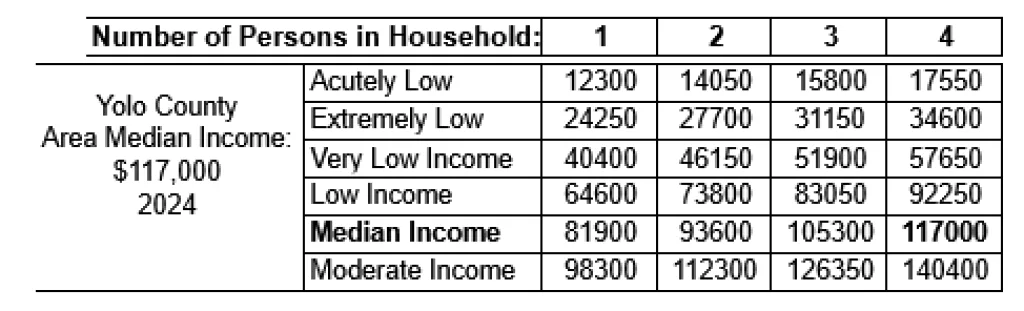
My point of view is that the proposed LEHC as submitted is not feasible to meet a family at 100% -120% of Yolo County median income. Please remember that the city requirements are that the average of all of the units is that they are affordable to a household of four (in a three bedroom unit) earning at or below $117,000 per year i.e. $9,750 per month and $3,412 max for housing costs at 35% (2024 State Stats). The weighted average for an equivalent three bedroom market rate rental unit in Davis (2024 UCD Housing Study) is $3,273.
I am a Co-Founder of the National Cooperative Bank (1978) and then the original Director of the Western Region (14 states) of the NCB, I was inducted into the Cooperative Hall of Fame (2010) and am the author or co-author of 6 books and over 400 articles about co-operatives. From the National Association of Housing Cooperatives I have received the President’s Award, the Jerry Voorhis Award (thee highest honor of NAHC) and Author of the Year (twice). I Co-wrote the California law (1978) that established the first LEHCs in the USA. TO me this LEHC doesn’t work.
Under the existing conditions presented by Village Farms, the thinly thought through 82 unit LEHC proposal would be almost impossible to develop. It would also expose 82 Davis families to the potential of extensive unrecoverable financial losses of $4.1 million dollars.
If the Co-op can overcome the following list of extensively high economic barriers then it might be possible? However, I cannot see this be anything but a cooperative that will become a horrendous local failure with millions of local member‘s capital at risk. The details I show are close to the normal mortgage bank or National Cooperative Bank (NCB) requirements.
With the LEHC quite likely not feasible and no single family affordable homes in the PIP, there are no affordable ownership units in the PIP.
The general steps on the pathway to an LEHC,
- The planning phase (architecture, civil engineering, property taxes, legal, etc.) would generally require an expenditure of at least $700,000 to be paid up front. Who will pay that $700,000, Village Farms or the City of Davis?
- The parcel set aside for the LEHC will need to be shovel ready (ground cleared, streets built, amenities plugged to the site (electric, gas, telephone, water) etc. Could be up to $400,000, who will pay? Village Farms should.
- Marketing to arrive at 82 signed memberships will require staff, legal work and advertising of about $50,000 per year for three years = $150,000. Who will pay that, Village Farms or City of Davis?
- At $500,00 per unit the construction costs will be $41 million
- At risk equity invested in the co-op will require 20% so $8,2 million
- At 10% equity max by state law, each share will average $50,000casg investment per average member = $4.1 million at risk
- Where does the other 10% of equity ($4.1) come from, Village Farms or City of Davis?
- There are no federal or state subsidies for LEHC co-ops today as there were in the 1980’s.
- Banks use comparable values to weigh credit risk. However, in this case there is no similar 82 unit new built unsubsidized LEHC co-op in California to measure against. Only one similar LEHC (Dos Pinos, Davis 60 units) but that was 40 years ago. The developer carried all the costs until turning Dos Pinos over to its’s members with carrying costs that met the city’s standards.
- There are no comps since the mid 1980’s, 40 years ago.
- Only two unsubsidized newly built LEHC’s have been built in California since LEHC law passed in 1980. Both in the 80’s.
- As soon as the property is assigned and owned by the co-op it will be assessed property taxes and other city and county fees. Initial property taxes/fees will be about $70,000 to be paid per year for five years until occupied = $350,000. Who will pay this, Village Farms or City of Davis?
- The ongoing property taxes and fees will be 1.5% of between $40 to $50 million dollars.
- Once occupancy permit received on finished project, the property taxes will be about $480,000 per year. LEHC’s as a nonprofit co-op is not tax-exempt as if it were a nonprofit tax exempt entity. I have urged the director of CCDC to pursue a lower tax for LEHCs but she refused.
- Banks that lend to new build housing cooperatives are almost impossible to find in California. NCB requires 50% of the $50,000 shares be sold to 41 members before a construction loan can begin.
The $2,050,000 in member assets must be turned over to NCB. All these member shares are now at risk.
- NCB requires that 85% of full shares be sold and handed over before the permanent loan can be accessed and borrowed. Now 70 units at $50,000 each sold and turned over to the NCB = $3.5 million, All these member shares are now at risk.
- At a required density of 30 units per acre this will mean a four-story apartment building. (see attached 32 per acre density Celeste in Davis)
- From a marketing point of view, I cannot see 82 households putting up $50,000 at risk to buy an apartment in a four-floor building at 30 units per acre when they can rent at about the same price.
As Regional Director of the NCB I Funded/Developed 10 LEHCs amounting to 1,500 units 1981-85.
No new build multi-family LEHC of the VF size has been funded since 102 unit (Redwood Shores) done by me in 1983 (forty years ago).
With the LEHC not feasible and no single-family affordable homes in the PIP, there are no affordable ownership units in the PIP.
In my opinion this PIP does not pass the test.
Follow the Vanguard on Social Media – X, Instagram and Facebook. Subscribe the Vanguard News letters. To make a tax-deductible donation, please visit davisvanguard.org/donate or give directly through ActBlue. Your support will ensure that the vital work of the Vanguard continues.

I don’t understand some of this, though it seems to be directed at those who will understand it.
In any case, does this mean that the “affordable” housing at Village Farms is not going to include ANY single family housing? Or is there a different program regarding that?
The author is correct that ownership of anything other than a single-family house (or at worst – a duplex) is not appealing to most buyers. Not in this geographic area, at least.
Buy yourself a pre-existing single family house (and if needed – rent out a room to a student for awhile). And stay away from the nonsense that no one wants or even understands.
Better yet, get yourself some money before trying to buy a house – anywhere. Apparently, that’s what most people do.
Ron O
Are you a well known real estate expert that we’ve never heard of? You really know nothing about the housing market. You have never presented any evidence to support your assertions, despite the many counter examples in our very own county such as West Sac’s Bridge District. Have you been in the Central area of Davis? It’s dominated by duplexes that have housed families for decades.
I too don’t understand the jargon, but it sure sounds da*ning.
Dear Ron O.
You ask, ”
In any case, does this mean that the “affordable” housing at Village Farms is not going to include ANY single family housing? Or is there a different program regarding that?”
You are correct. There will be no single family homes in the “affordable” proposal. And there is no other program.
How can there be when the required 18 acres for “affordable housing” has been cut in half and down to 9 acres at 30 units to the acre density.
This PIP Project Individualized Program proposed by Village Farms is an ever changing shell game with flimsy information. It is factually deficient and with city staff raising so many questions it should be turned down by the City.
That’s just crazy, regarding a “for sale” Affordable housing program that doesn’t include single family housing. In my opinion, that’s the ONLY type of “for sale” housing that might justify an affordable program.
Especially since a lot of the arguments being put forth claim that more families need to be housed in Davis. (Families do not want to live in the other type of multi-floor, apartment-style described in your article.) That type of housing might appeal to families in truly-expensive areas, like San Francisco. But not in this area, where they can purchase a brand-new “actual” house in some place like Spring Lake.
David – I see a few misstatements and wrong assumptions in your argument.
1) If prospective members deposit $50,000 each with the NCB and, for whatever reason, the project is not completed, those members get their deposit money back. IT IS NOT LOST as you wrongfully claim.
2) You claim no one will purchase the units if in a 4 story building because they can rent for the same price. Firstly, there is no current plan to put the co-op housing in a 4-story multi-unit building as you claim. The exact location and size will be determiined in consultation with the developer and the City and the Social Services Commission. But even if the coop units are in a 4-story condo building, lots of people would still want to purchase their homes (even if the monthly cost is the same) because it builds generational wealth if property prices appreciate. In fact, lots of condos are being bought and sold every year in the Sacramento region.
3) Perhaps your world view is colored by the fact that you are retired and have long-lived in a large single family home in Davis. Perhaps you do not appreciate the strong and fervent desire of many, many working class folks to be able to buy their own home in Davis – one way or another – for their kids to attend Davis schools.
4) I suggest you wait until you see the details before you broadside the entire proposal based on things you just assume. A lot of middle class folks I have otherwise talked with who have long been denied the opportunity to purchase a home in Davis are quite excited by the prospect of both the number of smaller homes being proposed (including many with a 15% down payment assistance offered by the developer) and the potential opportunity to buy into a coop model housing development.
Alan Pryor
I just can’t figure out why AP is such of staunch defender of this one particular project after years of fighting projects. It’s like sitting down to watch a western and John Wayne is riding a camel. Something just isn’t right.
And here’s a hurl that only would hold a dagger to those in the housing activism business: “you are retired and have long-lived in a large single family home in Davis” oooooh, burn?
Dear Alan,
I have now read your comments three times to make sure I understand.
Clearly, like many people, you do not understand how a limited Equity Housing Cooperative (LEHC) works.
As in previous campaigns, you make charges that are not relevant to the issue.
You use Co-op and condo as though they are synonymous. They are not. They are completely opposite forms of ownership.
In a LEHC co-op, under state law, members cannot have any of the benefit of the market rate gain.
Upon dissolution of a co-op all the market value has to be donated to a 501c3 non profit.
All LEHC cooperatives in California by law are very different than condos.
In a condo you own the entire unit carry your own mortgage, and can sell it at market value to anyone you choose and can rent it out if you wish.
In an LEHC co-op you own one share in the entire co-op building, you must leave the membership and turn your unit back to the co-op and cannot sell your co-op unit to anyone else. The vacated unit is transferred by the co-op to the member next in line for that size unit. The co-op unit is not sold and there is no market gain for the departing member.
If you read the PIP you will see that the acreage for the affordable units has been cut in half from 19 acres to nine acres and the developer has said that the density of that 9 acres will be at 30 units per acre.
Alan, my information is not an assumption as you claim. It is from my professional role in the field of cooperative housing.
Furthermore, your last paragraph has no application to the co-op. However, it does mislead and confuse people which might be the intent of your post.
Alan you also wrote,
“The exact location and size will be determined in consultation with the developer and the City and the Social Services Commission””
Completely false. The co-op by the PIP will be in the 9 acres wherever Village Farms wants to put it.