
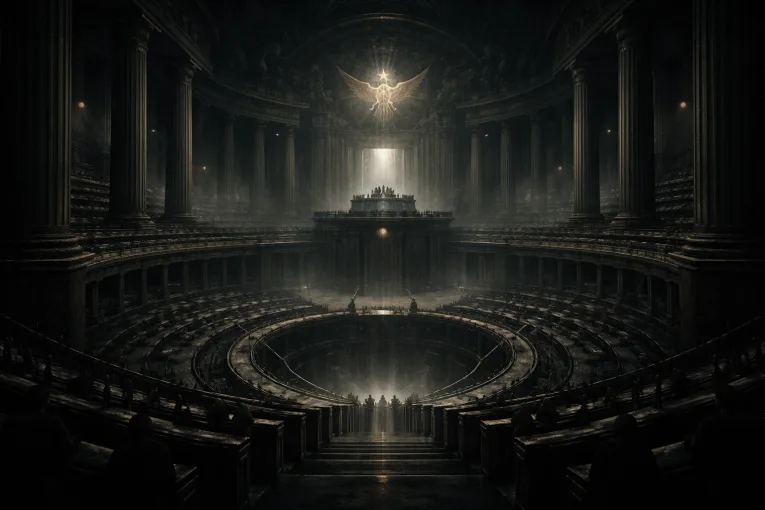
If democracy means rule by the people, then the United States has never actually attempted it.
We talk about American democracy the way people talk about a childhood home. With nostalgia, selective memory, and a refusal to inspect the foundation. The phrase gets repeated so often that it stops meaning anything at all. Oldest democracy. Beacon of democracy. Defender of democracy. But repetition is not evidence, and patriotism is not proof.
If democracy means rule by the people, then the United States has never actually attempted it.
That statement sounds inflammatory only because we have been trained to treat the word democracy as sacred rather than descriptive. Once you look at the structure honestly, the mythology falls apart quickly.
The country was not founded as a democracy. This is not a hot take or a modern reinterpretation. The founders said it plainly, in writing, over and over. They feared democracy. They feared the public. They feared that ordinary people, given too much power, would threaten property, hierarchy, and stability. So they designed a system to prevent that.
The Constitution is not a democratic document. It is a containment system.
The Senate was never meant to reflect the people. It was meant to represent elite interests and state power, insulated from public pressure. The President was not elected by voters but filtered through the Electoral College to ensure the wrong kind of person could not be chosen by popular will. Judges were placed beyond accountability entirely. Voting itself was restricted to a narrow slice of the population, not as an oversight, but as a feature.
This was not democracy interrupted. It was democracy declined.
Over time, the franchise expanded. Slaves were freed. Women gained the vote. Property requirements were removed. These are real and meaningful changes, hard-fought and costly. But expanding who can vote is not the same as transferring power. Participation grew while control remained centralized. The ritual changed. The outcome did not.
Voting in the United States has never been designed to grant governing authority. It grants permission. You may choose from approved options, funded by concentrated wealth, constrained by party machinery, and limited by laws written by those already in power. Once your vote is cast, your influence largely ends.
If voting were a genuine expression of democratic control, popular policies would not consistently die in committee. Universal healthcare, higher minimum wages, campaign finance reform, and term limits all enjoy broad public support across party lines. They fail anyway. Not occasionally. Systematically.
That pattern is not a coincidence. It is the point.
Political scientists have shown repeatedly that policy outcomes track closely with the preferences of the wealthy and barely at all with the preferences of the general public. When the desires of ordinary people conflict with elite interests, ordinary people lose. Every time. A system that behaves this consistently is not broken. It is performing exactly as engineered.
We are told that voter suppression, gerrymandering, and campaign finance abuse are distortions of democracy. They are not distortions. They are updates. Whenever participation threatens outcomes, new barriers appear. Whenever legitimacy wanes, symbolism increases. More flags. More speeches. More talk about freedom.
Representation without accountability is not democracy. Elected officials are not obligated to act in accordance with the will of their constituents. There is no binding mechanism forcing them to do so. There is no rapid recall. No enforceable mandate. No material consequence for betrayal beyond the hope of a future election in which money, messaging, and media will once again dominate.
This is why so much emphasis is placed on decorum, norms, and respect for institutions. These are not democratic values. They are stabilizing values. They preserve continuity, not consent.
Democracy in America functions as a brand. It is invoked to justify authority rather than distribute it. We celebrate the appearance of participation while avoiding its consequences. We are encouraged to argue about parties, personalities, and culture wars while the structural arrangement remains untouched.
The result is a population that senses something is wrong but cannot name it without being accused of cynicism or extremism. People disengage not because they are apathetic, but because they are perceptive. They recognize that the system listens selectively, responds performatively, and corrects itself only when forced.
So no, American democracy is not under threat.
American democracy is a promise that was never made.
What exists is an oligarchic republic stabilized by elections, managed dissent, and a shared myth powerful enough to keep people arguing inside its boundaries. Calling this democracy does not make it one. It simply lowers the standard of what democracy is allowed to mean.
The real question is not how to save American democracy.
It is whether we are willing to attempt it for the first time.
Follow the Vanguard on Social Media – X, Instagram and Facebook. Subscribe the Vanguard News letters. To make a tax-deductible donation, please visit davisvanguard.org/donate or give directly through ActBlue. Your support will ensure that the vital work of the Vanguard continues.